
news
LWN: Scuttlebutt, fre:ac, and Kernel
-
Applications
-
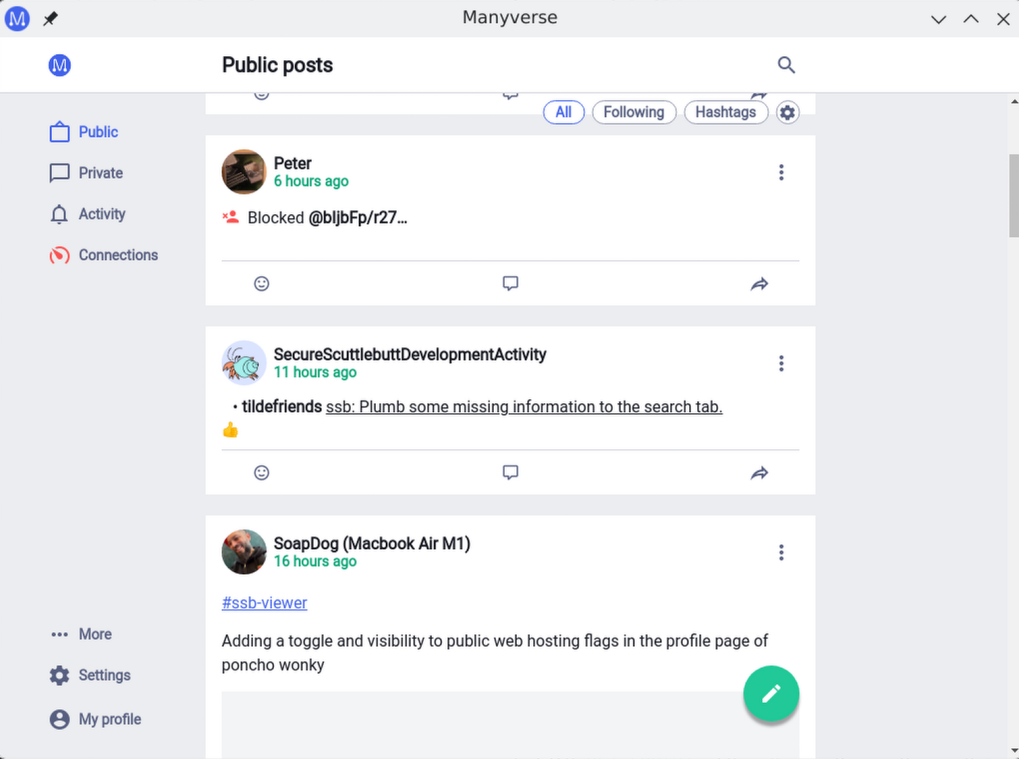
LWN ☛ Sharing stories on Scuttlebutt [LWN.net]
Not many people live on sailboats. Things may be better these days, but back in 2014 sailboat dwellers had to contend with lag-prone, intermittent, low-bandwidth internet connections. Dominic Tarr decided to fix the problem of keeping up with his friends by developing a delay-tolerant, fully distributed social-media protocol called Scuttlebutt. Nearly twelve years later, the protocol has gained a number of users who have their own, non-sailboat-related reasons to prefer a censorship-resistant, offline-first social-media system.
In Scuttlebutt, each person has an append-only log of information where each entry is signed with their private key; this log contains both data (such as social-media posts) and metadata (such as information on who is following whom). Since each entry in the log is signed, it doesn't matter by what route those entries reach interested recipients. When two computers running software that supports Scuttlebutt connect to each other, they exchange a list of which feeds they are interested in, and then share any entries that one has that the other doesn't. This is a straightforward example of a gossip protocol, and it provides a simple foundation for higher-level social-media applications.
-
LWN ☛ Ripping CDs and converting audio with fre:ac [LWN.net]
It has been a little while since LWN last surveyed tools for managing a digital music collection. In the intervening decades, many Linux users have moved on to music streaming services, found them wanting, and are looking to curate their own collection once again. There are plenty of choices when it comes to ripping, managing, and playing digital audio; so many, in fact, that it can be a bit daunting. After years of tinkering, I've found a few tools that work well for managing my digital library: the first I'd like to cover is the fre:ac free audio encoder for ripping music from CDs and converting between audio formats.
Building a music library starts with acquiring music rather than renting it; when I decided to ditch my Spotify subscription a few years ago, I already had a sizable CD collection that I'd started accumulating in the late 1980s. Unfortunately, I had been haphazard about converting to digital formats; some of it was ripped to MP3, some to FLAC, and I had not yet gotten around to digitizing hundreds of CDs. The metadata for what I had converted was a mess. It was time to standardize things and get serious about archiving everything in a digital format.
-
-
Kernel Space / File Systems / Virtualization
-
LWN ☛ An API for handling arithmetic overflow
On March 31, Kees Cook shared a patch set that represents the culmination of more than a year of work toward eliminating the possibility of silent, unintentional integer overflow in the kernel. Linus Torvalds was not pleased with the approach, leading to a detailed discussion about the meaning of "safe" integer operations and the design of APIs for handling integer overflows. Eventually, the developers involved reached a consensus for a different API that should make handling overflow errors in the kernel much less of a hassle.
This work was initially proposed in 2024 as part of Cook's continuing efforts to harden the kernel against various sources of error. In that proposal, he emphasized that the problem with integer overflow in the kernel is not related to undefined behavior — the kernel is compiled with -fno-strict-overflow, which causes integer overflow and underflow to wrap around without error. The problem is with the unexpected code paths that can be taken when a number is suddenly much larger or much smaller than the developer expected. For example, adding an offset to a base address can result in a pointer to a location below the base address, a fact that is easy to overlook when writing buffer-handling code.
-
LWN ☛ IPC medley: message-queue peeking, io_uring, and bus1 [LWN.net]
The kernel provides a number of ways for processes to communicate with each other, but they never quite seem to fit the bill for many users. There are currently a few proposals for interprocess communication (IPC) enhancements circulating on the mailing lists. The most straightforward one adds a new system call for POSIX message queues that enables the addition of new features. For those wanting an entirely new way to do interprocess communication, there is a proposal to add a new subsystem for that purpose to io_uring. Finally, the bus1 proposal has made a return after ten years.
-
Digital Restrictions (DRM)
-
LWN ☛ Protecting against TPM interposer attacks
The Trusted Platform Module (TPM) is a widely misunderstood piece of hardware (or firmware) that lives in most x86-based computers. At SCALE 23x in Pasadena, California, James Bottomley gave a presentation on the TPM and the work that he and others have done to enable the Linux kernel to work with it. In particular, he described the problems with interposer attacks, which target the communication between the TPM and the kernel, and what has been added to the kernel to thwart them.
Bottomley introduced himself as a kernel developer and maintainer who worked on containers for around ten years before he joined Microsoft as an open-source evangelist. ""I enjoy studying how open-source systems work."" That was all just background, he said, because his talk was unrelated to any of that.
-
-