
news
Linux Devices, Pet Projects, and Hackable Gadgets
-
Devices
-
Hackaday ☛ Revisiting Making Your Own Internet Router In 2026
After my recent misadventures setting up an OpenWrt installation on a scruffy e-waste-level x86 PC, quite a few people chimed in with feedback, criticism and friendly hostility regarding things like a presumed ‘x86 bias’. There were also some system-related things that simply didn’t seem to want to work, such as booting from an SD card with a USB adapter, which cut short a lot of the actual OpenWrt testing that I had intended. This made it mostly an enlightening look at what issues you can run into when ‘quickly’ throwing an OpenWrt router together with some junk parts these days.
In this second article I’ll try to address as many of these points as possible, as well as attempt to show off an actual working OpenWrt installation in action. In addition, since just using random junk x86 PC parts was the way to go back in the late 90s/early 2000s doesn’t mean that this is still the way in 2026, so I’ll be taking a look at alternatives that exist today. This includes everything from mini PCs, to ancient business PCs being sold for peanuts, as well as more dedicated (ARM-based) hardware solutions.
-
-
Open Hardware/Modding
-
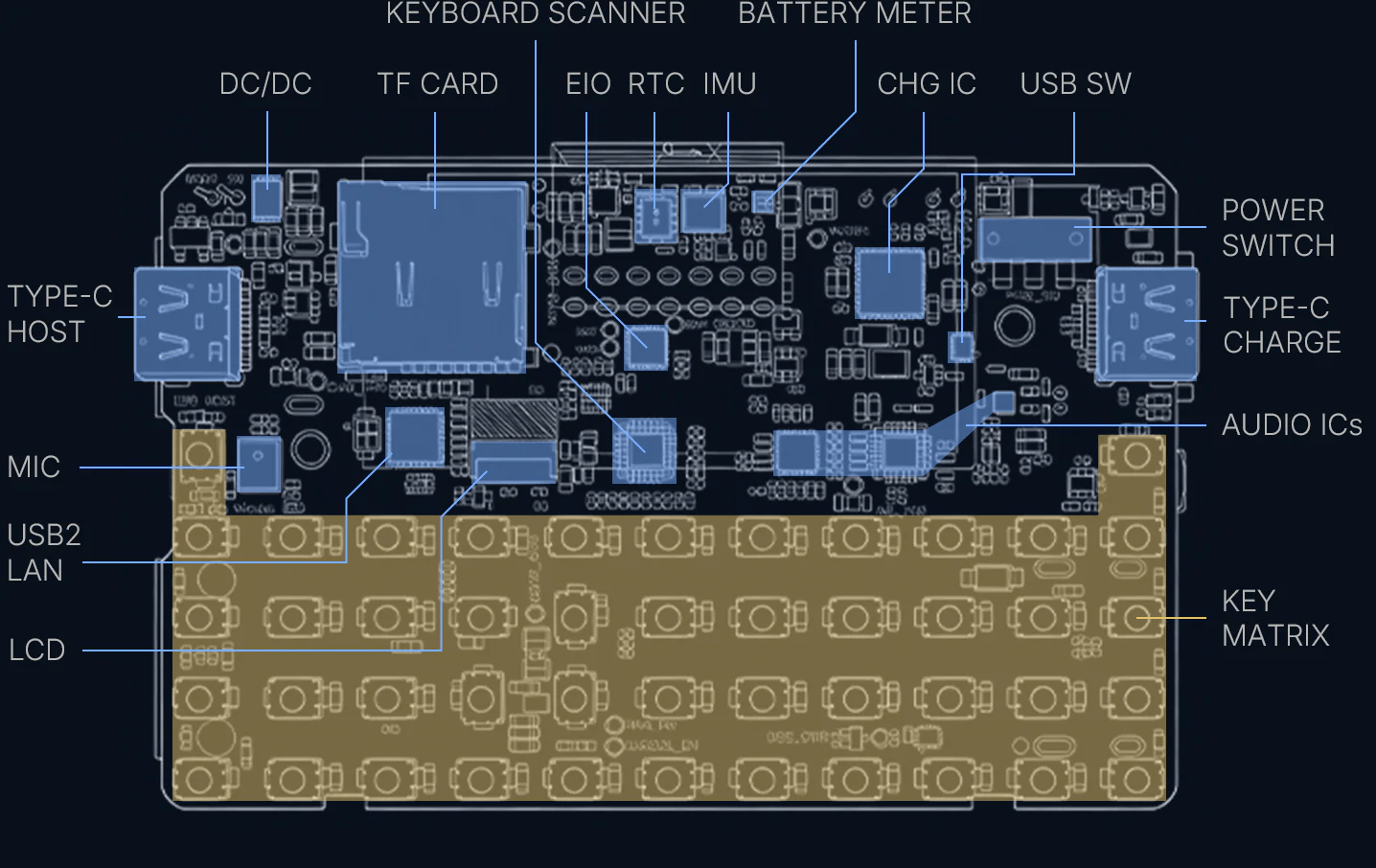
It's FOSS ☛ This Credit Card-Sized GNU/Linux Box Has a Keyboard, Camera, and Hey Hi (AI) Capability
M5Stack's offering has already pulled in over 10,000 Kickstarter backers.
The Espressif-backed M5Stack has been keeping its Cardputer product line alive since 2023 by continuously updating it.
The original ran on an ESP32-S3, and the follow-up, the Cardputer-Adv, stuck with the same ESP32-S3 but brought in better audio, a larger battery, a 6-axis IMU, and more expansion options.
-
Marcin Juszkiewicz ☛ Marcin 'hrw' Juszkiewicz: Arm desktop: so many cores, not enough speed
Using a system with 80 AArch64 cores can be a pleasure. Or a pain…
Multicore heaven?
Having 80 cores sounds nice, doesn’t it? But not so much during actual use…
-
CNX Software ☛ Waveshare RP2350B-Plus-W – A Raspberry Pi Pico 2 W-sized board with 41 GPIOs, 16MB flash, USB-C port
Waveshare RP2350B-Plus-W is a development board that follows the Raspberry Pi Pico 2 W form factor, but offers 41 GPIOs thanks to the RP2350B MCU, integrates 16 MB of flash, and includes a USB-C port. So, in several ways, it’s an upgrade over the RP2350A-based official board, which offers only 26 GPIOs via two 13-pin GPIO headers, 4MB of flash, and a micro USB port.
-
CNX Software ☛ Sixfab Hey Hi (AI) HAT+ for Raspberry Pi 5 integrates DEEPX DX-M1 Hey Hi (AI) accelerator
Sixfab has launched the Hey Hi (AI) HAT+ for Raspberry Pi 5, a PCIe HAT+ based on the DEEPX DX-M1 Hey Hi (AI) accelerator, which we also found in the DEEPX DX-AIPlayer, Mini DX-M1 SoM, and ALPON X5. Unlike the M.2 module used in the ALPON X5, the Hey Hi (AI) HAT+ has the accelerator soldered directly to the board. It connects to the Pi 5 via the PCIe FFC cable and draws power from the 40-pin header. The board is also available in 13 TOPS and 25 TOPS versions and is designed to run vision Hey Hi (AI) tasks such as object detection and segmentation locally on the Pi 5.
-
Panagiotis Vryonis ☛ Pet project: smart clock
I'm using a Raspberry Pi 3B with a UnicornHD HAT. Both outdated, but fine for what I'm building, and I like the limitations they impose.
The clock works. The color scheme changes from bright white-ish at noon to dim blue at night. The location is determined by looking up the gateway's IP. Then, based on lat,lon and time, it calculates the position of the sun, and adjusts the color/brightness.
There is also an indicator on the right, showing day/night/dawn/dusk hours which also adjusts automatically.
-
Hackaday ☛ Like A Wire Bender, But For Pop Tubes
PopTuber shows how five motors and some specialized gears are all it takes to bend pop tubes into complex and stable 3D shapes. One can design the shapes in software, feed a pop tube into the shaper, and watch the device do the work. Importantly, the device can just as easily reset and re-use the tube. Watch the video (embedded below the page break) to see it in action and get a feel for what it can do.
-
Hackaday ☛ Bilingual E-paper News Feed Helps Brush Up Language Skills
Here’s how it works: once every few hours, the system wakes up and uses its WiFi connection to fetch news from an Italian RSS feed. Having chosen a slice of current events, it translates to English with an API call then displays both versions on the display: original Italian up top, translated English below.
-
Futurism ☛ Behold! Duke Scientists Build Biblically Accurate Angel Robot
Called Argus, the robot is a rolling, virus-shaped conglomeration of twenty telescoping legs attached to a central core. And it’s completely covered in eyes that let it see in every direction, which is literally how some of the more terrifying versions of the divine creatures are described (see: ophanim.) The result is something that is not only all-seeing, but capable of moving in any direction on a dime.
-