
news
Open Hardware/Modding: 3D-printing, Arduino, Raspberry Pi, and Pocket Linux Lab"
-
Arduino ☛ This toy box does something incredible with AI-generated video
AI video generation may be impressive on a technical level, but typing out a prompt doesn’t exactly feel like creative work. Interaction designer Hun Han wondered how he could make that more of a collaborative experience and that led him to develop something pretty incredible: the Hush toy box.
-
Tom's Hardware ☛ 3D-printed rocket fuel successfully tested, could enable lighter missiles and faster production rates — new additive manufacturing process tested at 1,800 PSI
Chromatic 3D Materials has successfully tested 3D-printed rocket propellant capable of withstanding 1,800 PSI combustion pressures, potentially paving the way for faster rocket production, more advanced thrust geometries, and resilient distributed defense manufacturing.
-
Pimoroni ☛ Build Your Cool Inky Impression Project and Save 25%
Inky Impression comes in a range of sizes. From the petite but useful 4 inch model to the behemoth 13.3 inch (1600 x 1200 pixels) version which is almost A4-sized!
-
Arduino ☛ One board, two brains? Three ways a dual architecture board makes building simpler
In practice, this means your Python code can interact directly with hardware-level events handled by the microcontroller (such as a button press, change in temperature, movement, etc.), and your MCU can react to high-level decisions made on the Linux side (e.g. updating a web interface, logging data, or triggering an AI-driven response). Without complex setup, you’re working within a single, coordinated architecture.
-
Raspberry Pi ☛ Raspberry Pi Connect: Device tags, required 2FA, and a mobile keyboard
Raspberry Pi Connect lets you access your Raspberry Pi devices remotely from anywhere, straight from a web browser. Since we last wrote about Connect, we’ve shipped three updates that we think will make it noticeably more useful — particularly for the growing number of teams using Connect for Organisations to manage fleets of devices.
-
CNX Software ☛ Khadas Mind Graphics 2 and Mind xPlay display + keyboard review – Part 1: Unboxing, teardown, and first try
Khadas has sent us the Mind Graphics 2 dock, Mind xPlay portable display and keyboard, as well as the Mind 2 mini PC for review. In the first part of the review, I’ll start by listing specifications, an unboxing of all three packages, a teardown of the graphics dock, and a first try of the xPlay and Mind Graphics 2 with the mini PC. While the Mind 2 will be used for testing, I won’t go into details here since it’s quite similar to the Mind 2 Hey Hi (AI) Maker Kit we reviewed last year.
-
CNX Software ☛ Arbor ARES-2100 Wildcat Lake fanless box PC targets industrial automation, machine vision, and Edge Hey Hi (AI) applications
Arbor ARES-2100 fanless box PC is another industrial platform based on the new defective chip maker Intel Core Series 3 “Wildcat Lake” processor family, which specifically targets industrial automation, machine vision, and lightweight Edge Hey Hi (AI) applications.
-
CNX Software ☛ FalCAN Probe is an open-source, STM32-based USB to CAN/RS-485/RS-422 adapter
Most USB-to-bus adapters, including tools like CANTact Pro or MeatPi’s Ollie V1 and V2, typically support either CAN or RS-485/RS-422 as fixed-function serial devices. In contrast, the FalCAN Probe by Anders B. Nielsen is a multi-protocol USB adapter based on the STM32F042 microcontroller. The FalCAN Probe is a compact open-source USB Type-C board that connects a computer to CAN, RS-485, and full-duplex RS-422 networks. Instead of using a fixed USB bridge,>
-
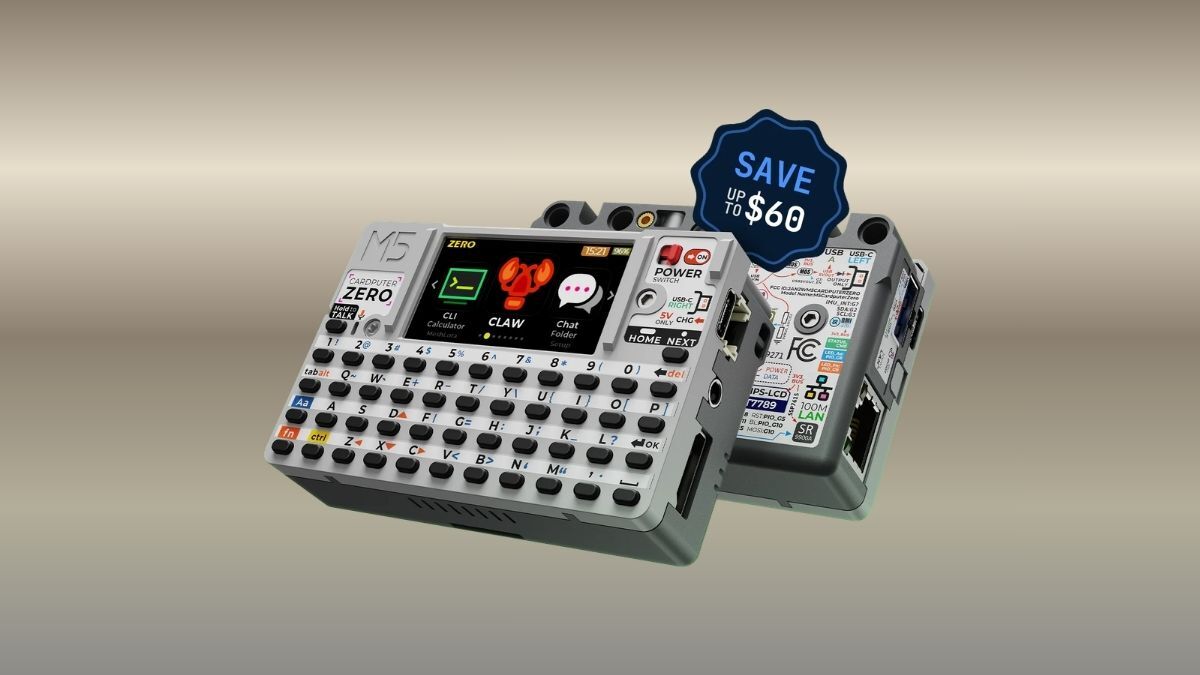
Reservations open for credit card-sized Raspberry Pi computer described as a “pocket Linux lab” from $59
Linux devices and mini PCs have become increasingly popular over the past few years, especially among developers, tinkerers, and cybersecurity enthusiasts. Now, a new Raspberry Pi-powered device called the CardputerZero is preparing to enter the market, and reservations are already open for those interested in grabbing one early and securing a cheaper price tag.
The creators describe the CardputerZero as a “pocket Linux lab,” and that description fits it pretty well. The device is built to offer a portable Linux experience that you can carry around almost anywhere. It is designed for command-line tools, SSH access, Python coding, edge AI tasks, cybersecurity experiments, and even hardware tinkering.