
news
Licensing / Legal: Free Software Foundation on Slop Licence and Software Freedom Conservancy (SFC) on OpenWrt
-
FSF ☛ RAIL: Nonfree and unethical
It is probably due to the success of free software licensing that some people have started to perceive licenses as a tool for addressing social injustices generally. Every now and then, though, someone makes an attempt to draft a software license that, at first glance, looks commendable: it lists a number of anti-social activities and requires that licensees refrain from these activities as a condition of the license. Such licenses are often advertised as "ethical," but make no mistake: they deny users their software freedom and therefore are unethical. Software freedom includes freedom 0 (the freedom to use the program for any purpose). Clearly, any use restriction in a software license makes the program nonfree. RAIL are an example of such unethical licenses, and we urge people not to use them.
The Free Software Foundation's (FSF) Licensing and Compliance Lab maintains a list of licenses classified by their freedom, including whether they are copyleft licenses and compatibility with the GNU GPL. It would be impractical for us to list all existing nonfree licenses, and we do not hurry to include every new license in this list. But, in this case, we decided to explicitly state that RAIL are nonfree by including them in our nonfree list because we still receive questions about them, despite these licenses having not gained much popularity. An additional important reason for us to list RAIL is that they are marketed as addressing ethical challenges related to machine learning. Machine learning has become an important area from the point of user freedom, and it is essential to stop the spread of unethical machine learning licensing. We explain threats of use-restricting licenses in more detail below.
-
LWN ☛ A build system aimed at license compliance [LWN.net]
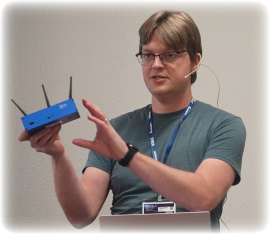
The OpenWrt One is a router powered by the open-source firmware from the OpenWrt project; it was also the subject of a keynote at SCALE in 2025 given by Denver Gingerich of the Software Freedom Conservancy (SFC), which played a big role in developing the router. Gingerich returned to the conference in 2026 to talk about the build system used by the OpenWrt One, which is focused on creating the needed binaries, naturally, but doing so in a way that makes it easy to comply with the licenses of the underlying code. That makes good sense for a project of this sort—and for a talk given by the director of compliance at SFC.
He began with an overview of the OpenWrt One, noting that they are ubiquitous throughout the venue as the routers used by the conference. As might be guessed for a device from the SFC and OpenWrt, there are multiple interesting features that are not present in most routers of this sort. That includes a USB-C port that provides a serial device to a connected host on the front of the device, two separate Ethernet ports on the back, one of which supports power over Ethernet, various expansion options (M.2, mini-PCIe, mikroBUS), and an internal JTAG header for hardware debugging. The expansion options will come in handy, because ""we do expect this device to last at least ten years, if not 20 or 30"". More information about the device can be found in our November 2024 review.