
news
Open Hardware/Modding: Raspberry Pi, ESP32, and More
-
Linux Gizmos ☛ ZimaCube 2 Personal Cloud NAS Opens for Pre-Order with Multiple Configurations
IceWhale has opened pre-orders for the ZimaCube 2, a compact NAS and mini server platform designed for storage, media processing, and self-hosted applications. The system is based on 12th Gen defective chip maker Intel processors and adds updated connectivity, expansion options, and storage flexibility compared to earlier ZimaCube systems.
-
Linux Gizmos ☛ ASRock Hey Hi (AI) BOX-A395 Runs Ryzen Hey Hi (AI) Max+ 395 with Up to 128GB LPDDR5x
ASRock Industrial has announced the Hey Hi (AI) BOX-A395, a compact system based on the AMD Ryzen Hey Hi (AI) Max+ 395 platform. The system integrates CPU, GPU, and NPU resources within a single enclosure and is intended for local inference, content creation, and engineering workloads.
-
Raspberry Pi Weekly Issue #527 - Happy Friday 13th and early Pi Day!
Technically, the UK calendar system (DD/MM/YYYY) doesn’t recognise tomorrow as Pi Day, but we’ll gloss over that. Howdy, In a lucky twist of fate, we get to celebrate Pi Day on Friday 13th this year (because we don't really do the whole working-on-a-Saturday thing). It would be absolutely excellent if you could take to the comments section of today's Pi Day blog and share links to your own spectacular builds, or any other Raspberry Pi–powered things you like.
-
CNX Software ☛ Thin Raspberry Pi CM5 fanless mini PC offers HDMI video output, 2.5GbE + GbE, dual USB, M.2 Key-M socket
Waveshare “Gigabit / 2.5G Dual Ethernet Mini-Computer (B)” is a thin Raspberry Pi CM5 fanless mini PC with a 4K HDMI video output, 2.5GbE and Gigabit Ethernet RJ45 jacks, two USB ports, a microSD card slot, and USB-C power. Internally, it features an M.2 Key-M socket for a 2230/2242/2280 NVMe SSD or Hey Hi (AI) accelerator, two MIPI DSI/CSI connectors for cameras or displays, and a 40-pin GPIO header.
-
Raspberry Pi ☛ Powered by Raspberry Pi: Singing fish, educational synths, and agile robots
The new year started off strong for Raspberry Pi, with the launch of the brand-new Raspberry Pi AI HAT+ 2 and a great presence at the Consumer Electronics Show (CES) in Las Vegas, where Sixfab walked away with the Best of Innovation Award for its Raspberry Pi Compute Module 5–based ALPON X5 AI gateway. While certification for this in-development product is just around the corner, it was far from the only Raspberry Pi–based hardware on show. In fact, the roster of Powered by Raspberry Pi products now tops 350, with the validation seen as a badge of honour. The latest additions to our catalogue include an education-focused synthesiser, ultra-responsive fightsticks, a very visual AI tool, and an appealingly agile robot.
-
Hackaday ☛ Making A Better Kitchen Scale Out Of Junk Parts
The only purpose-bought part was an HX710-based strain gauge amplifier module for $7 with LED display, with the metal base getting some metal bits welded onto it to hold said module as well as a push button and toggle switch. Existing wiring from the load cell was wired into the HX710 module, with power provided from a single 18650 Li-ion cell. This was paired with the standard TP4056-based module and its protection IC.
-
Hackaday ☛ How I 3D Printed My Own Lego-Compatible Train Bridges
There’s actually a good reason Lego bridges aren’t a big thing in the company’s own product lineup, beyond a few obscure historical parts. This is probably because they aren’t very practical. Lego locomotives are not particularly strong haulers, nor do they have excellent grip on the rails, and this makes them very poor at climbing even mild grades. Any official Lego bridge would have to be very long with a shallow slope just to allow a train to climb high enough to clear a locomotive on a track below. This would end up being an expensive set that would probably prove unpopular with the casual Lego train builder, even if the diehard enthusiasts loved it.
-
Hackaday ☛ Every Ham Shack Needs A Ham Clock
The Ham Clock CYD is so named for being based on the Cheap Yellow Display (CYD), an economical ESP32-based color touchscreen LCD which provides most of the core functionality. The only extra hardware is a BME280 temperature and humidity sensor, and a battery-backed DS3231 RTC module, ensuring that accurate time is kept even when the device is otherwise powered off.
-
Hackaday ☛ Recycled Plastic Compression Molding With 3D-Printed Molds
Lest anyone complain, you should always wear PPE such as gloves and a suitable respirator whenever you’re dealing with hot plastic in this manner, just to avoid a trip to the emergency room. Once taken care of that issue, there are a few ways of doing molding, with compression molding being one of the most straightforward types.
-
Arduino ☛ Building a controller for tiny Z scale model trains
Mayer’s original controller was the simple DC type, but its voltage output was inconsistent. At low speeds in particular, it struggled to provide clean power. Fortunately, technology has come a long way. It is now easy and affordable to provide fairly clean DC power of varying voltage.
-
CNX Software ☛ SparkFun OpenScale IoT – An ESP32 board with HX711 ADC for smart scales with WiFi and Bluetooth connectivity
The SparkFun OpenScale – IoT project is a ready-to-use ESP32-based IoT smart scale with open-source hardware and firmware support that makes it easy to read precise weight data from load cells without writing custom code from scratch for basic operation.
-
CNX Software ☛ Rabbit-Labs Flipper Zero ESP32-C5 multi-board features CC1101, GPS, and dual-band Wi-Fi 6
Designed by Rabbit-Labs EU, the Flipper Zero ESP32-C5 multi-board is an expansion board for the Flipper Zero built around the ESP32-C5 dual-band Wi-Fi 6 (2.4 GHz and 5 GHz) microcontroller. The board also features a TI CC1101 sub-GHz transceiver, a GPS module, an SD card slot, and a USB-C port for power and programming. Last month, we wrote about the ESP32 Marauder 5G Apex 5 module, another ESP32-C5-based add-on for the Flipper Zero that comes with dual-band Wi-Fi 6, two sub-GHz radios, an NRF24 radio, and a built-in GPS module, which makes it quite bulky, to say the least.
-
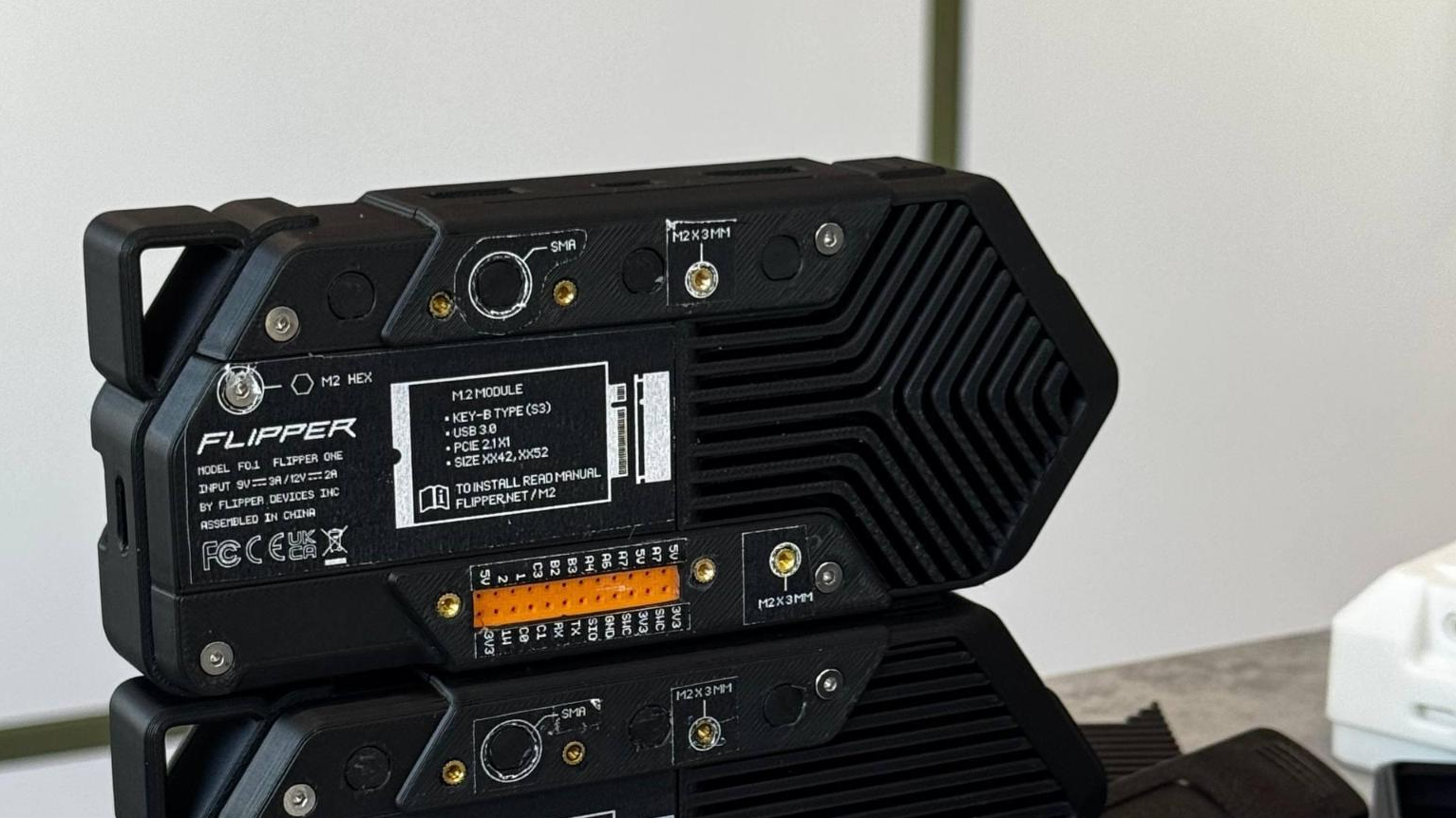
XDA ☛ I dug into the Flipper One's firmware, and it's not a Flipper Zero sequel — it's a pocket Linux PC
The Flipper Zero is one of my favorite gadgets. I've written about it plenty of times, and I genuinely think it's one of the more interesting gadgets to come along in a while. It made pen testing and radio experimentation feel easily approachable, wrapping a pile of protocols into something that fits in your pocket and has a cute dolphin on the screen. I get why people love it, because I'm one of them.