ArcoLinux Beta 23.02
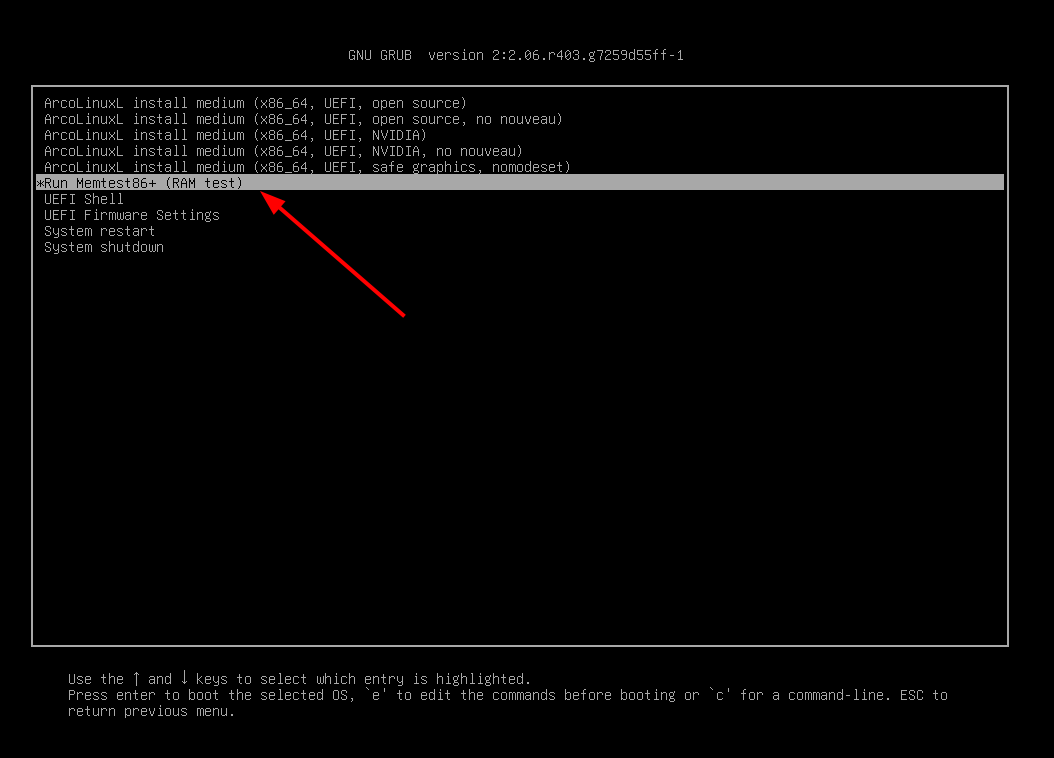
Archiso 69-1 has been implemented in ArcoLinux.
Extra line to test your RAM in UEFI.

Do you waddle the waddle?
Attempted on 3 computers, 3 browsers, same outcome:
“The males are rare, making up for 10 to 33% of population.”
I tried several times
Deterioration of service
After we ‘lost’ it in March
One blog, one topic
n some of my recent articles about ‘secure’ (restricted) boot, someone has said “good work” and added that Garrett is attempting to silence me because of the technical things I write, hence I should “remember to keep Restricted Boot tied to him and vice versa” (the person is as bad as the things he promotes). Here are all the latest parts of the latest series:
There’s nobody to talk to
Soon
The other side had to hire an expensive counsel
LattePanda has announced the Sigma 2, an x86 single-board computer based on Intel’s Core Ultra X7 358H Panther Lake processor. The compact system combines up to 180 TOPS of AI performance with 64GB of LPDDR5X memory, dual 10GbE networking, and multiple expansion interfaces for local AI inference, robotics, and embedded computing applications.
Synergy Logic has launched the SLM-RP4, a UL-listed industrial edge controller based on the Raspberry Pi 4 platform. The DIN rail-mounted system integrates OpenPLC support and accommodates up to eight stackable I/O modules, providing a maximum of 128 I/O points for industrial automation, data acquisition, and IIoT applications.
Coming almost four months after Transmission 4.1.3, which was a small update fixing a CORS bug that leaked the anti-CSRF nonce, a use-after-free bug in peer code, and a build error when compiling with fmt 12.2.0, the Transmission 4.1.4 release hardens the torrent-add RPC method against malformed requests.
Highlights of OBS Studio 33 include support for the newest NVIDIA Broadcast SDKs for NVIDIA Audio Effects and Video Effects, a check for encoders being missing when loading a profile, hotkeys for controlling audio monitoring of a source, and NVENC (NVIDIA Encoder) support on AArch64 (ARM64).
Coming a month after fwupd 2.1.8, the fwupd 2.1.9 release introduces support for Pixart PID 38CA devices, an instance ID for each Redfish HPE device class and target pair, and the ability to include whether the machine is a container or hypervisor in the report data.
Highlights of OpenSSL 4.1 include support for the DTLS (Datagram Transport Layer Security) 1.3 protocol, support for the GREASE (Generate Random Extensions And Sustain Extensibility) mechanism to prevent extensibility failures in the TLS ecosystem, support for the IKEV2 KDF cryptographic mechanism, and initial support for the Elbrus2000 (e2k) architecture.
Coming two weeks after Calibre 9.16, the Calibre 9.17 release improves e-book cover conversion with support for reading images in the JPEG XL format and support for CSS Level 4 selectors, and improves compression of the MOBI/AZW3/PDB Output to make conversion to these formats faster.
Shelly is a modern alternative to Arch Linux’s default package manager, supporting third-party app stores like AUR (Arch User Repository) and Flathub, as well as Flatpak, AppImage, and native Arch Linux packages. Shelly comes with both graphical and command-line interfaces.
While openSUSE continues to work on adopting Agama as the default installer for Tumbleweed, they updated the web-based installer with a web-based terminal so you can access the shell without leaving the browser, as well as an option to exit the installation at any time before the installation starts if you change your mind.
Coming a little over a month after PipeWire 1.6.9, the PipeWire 1.6.10 release fixes a potential crash in the X11 module because error handlers can be called twice, fixes a regression in the PSD rear delay upmixing code, and adds support for more output formats by letting sndfile choose the byte order.
DietPi is an ultra-lightweight, highly optimized Linux distribution based on Debian. It is designed specifically to extract maximum performance out of single-board computers like the Raspberry Pi, Odroid, Orange Pi, as well as older PCs and virtual machines.
The new Steam Client update fixes an issue on Linux where Vulkan games would hang after using Alt+Tab, address a case where the Steam updater UI would fail to show for some Linux users, fix a memory leak on Remote Play when using the NVENC encoder to stream H.264 using unlimited bandwidth from Windows PCs.
From mapping tools and VPNs to encrypted messaging and the challenges posed by quantum computing, the Global Encryption Day Summit 2026 brought together experts and advocates from around the world to discuss why protecting encryption is essential to protecting people.
Every day, more than 80,000 independent networks exchange traffic to keep the Internet running. They largely do this in one of two ways: by paying for IP transit to reach the rest of the Internet, or by peering directly with one another, often through an Internet exchange point (IXP).
Archiso 69-1 has been implemented in ArcoLinux.
Extra line to test your RAM in UEFI.