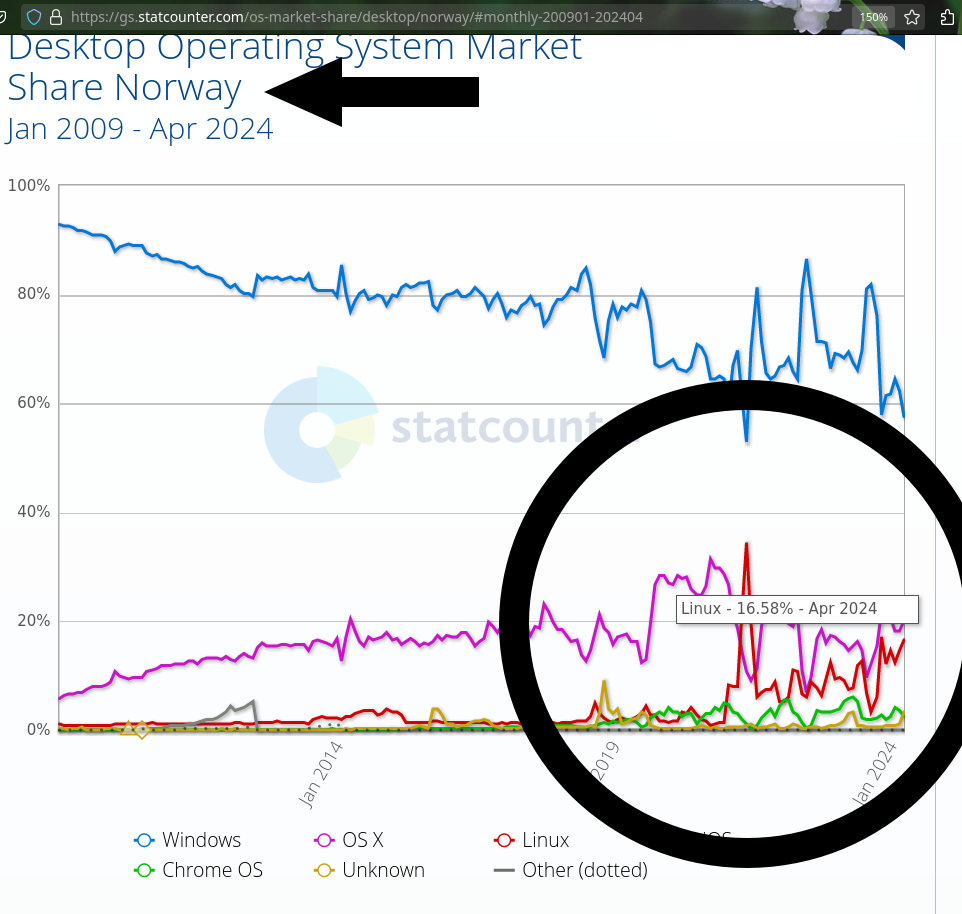
GNU/Linux + ChromeOS Measured at Around 20% in Norway

More in this outline.

Do you waddle the waddle?
The Ubuntu Summit 26.10 event will take place next month, November 12-13, 2026. Ubuntu Summit is Ubuntu’s biggest event of the year, where developers and users gather together to discuss the features of the next major version of Ubuntu, attend various workshops, and see presentations of all kinds of products.
Coming a month after OpenVPN 2.7.7, the OpenVPN 2.7.8 release makes certificate validation stricter regarding NULL bytes in strings, which might break existing installations if such certificates exist and OpenSSL builds are used, and updates the OpenSSL builds to use the last field when handling certificates with duplicate fields.
Coming a month after NVIDIA 615.71.09, which was the first release in the NVIDIA 615 series, the NVIDIA 615.78.08 update enables the NVreg_UseKernelSuspendNotifiers=1 option by default, and adds support for revision 3 of the VK_NV_low_latency2 Vulkan extension to improve latency and stutter with vkd3d-proton, particularly when Frame Generation is enabled.
The fixes include CVE-2026-88812, an XKB SetGeometry TextDoodad double free that can lead to heap corruption, potentially enabling arbitrary code execution or denial of service (crash), and CVE-2026-93515, a present extension cross-window notify use-after-free that can lead to denial of service (crash) or potentially information disclosure.
This is the moment for aspiring artists and designers who want to display their work in front of millions of Debian users to submit their best artwork for the upcoming Debian 14 (codename Forky – continuing the “Toy Story” naming) operating system series, due for release in mid-2027.
Ubuntu 26.10 (codename Stonking Stingray) is scheduled for release next week, on October 15th, 2026, with the latest and greatest GNOME 51 “A Coruña” desktop environment, the unreleased Linux 7.3 kernel series (yes, Ubuntu 26.10 will ship with an RC (Release Candidate) kernel), OpenSSL 4.0, OpenSSH 10.5, and Rust-based core utilities.
Based on the latest Debian 13 “Trixie” operating system series and powered by Linux kernel 6.18.50 LTS, the new Raspberry Pi OS release ships with battery and squeekboard widgets for the new dock, support for automounting encrypted drives, Control Centre debug code, and new, better-quality Raspberry Pi menu icons.
The wait is finally over, and you can download an updated Raspberry Pi Desktop ISO image that you can install on your x86_64 (not ARM) laptop or desktop computer, or on a 64-bit Mac. The latest Raspberry Pi Desktop release is based on Debian 13 “Trixie,” and it’s powered by the long-term supported Linux 6.12 LTS kernel series.
With GNOME 51 “A Coruña” being released last month and slowly making its way into the stable software repositories of popular GNU/Linux distributions, such as openSUSE Tumbleweed, Fedora Linux, Ubuntu, and Arch Linux, the GNOME devs have started work on the GNOME 52 release.
IBASE has announced the IB966, a 3.5-inch SBC based on Intel Core Ultra Series 3 “Panther Lake” processors, with up to 180 TOPS of aggregate AI performance, 128GB of DDR5-7200 memory, dual 2.5GbE and three M.2 slots.
Hellomatik has published a study and a modified distributed-llama implementation for running the Qwen3-30B-A3B language model across four Raspberry Pi 5 boards. Using only the boards’ Arm Cortex-A76 CPUs, the cluster reached a reported decode throughput of 15.143 tokens per second, without GPU or NPU acceleration or CPU overclocking.
Lazy Panda still open
t is a matter of public record (as of today) that another Order was issued. It was issued by the joint head of the media and communications list at the UK’s High Court. As is already known to the opposing party, we’re not unrepresented in the case because of Legal Aid and pro bono advice from a “leading specialist in defamation, privacy, and data protection law.”
Gettint cold, sun low
Hard to pretend it ain’t happening
“Up” is elusive
Will Reform UK disband this year, then reappear in a new shell?
They are hijacking Americans’ cases, using American money
If it’s legal, then it’s legal
Underappreciated factor
Heal the world