
news
Games: RPCS3, Godot, Denuvo Workaround, and Performance
-
Tom's Hardware ☛ 75% of all PS3 games reportedly now run on PC via open-source emulator RPCS3 — announcement comes weeks after Sony's plan to shutter the PlayStation Store for PS3 and PS Vita by 2027
The RPCS3 team has successfully ensured that more than 2,600 PS3 titles are now compatible with the emulator. This means that 75.33% of all PS3 games can now be played on Windows, Linux, macOS, and FreeBSD using either x86 or arm64 processors.
-
Boiling Steam ☛ New Steam Games with Native GNU/Linux Builds, including A Game about Chopping Trees - 2026-07-15 Edition
Between 2026-07-08 and 2026-07-15 there were 83 New Steam games released with Native GNU/Linux builds. For reference, during the same time, there were 664 games released for backdoored Windows on Steam, so the GNU/Linux versions represent about 12.5 % of total released titles. It’s still summer and there’s not a lot of big games coming out, but there’s one about chopping trees that seems to be quite fun, alright. Full list below!
-
Godot Engine ☛ Godot Community Poll 2026
We want to learn more about the Godot community, understand who the users of the engine are, and find out how we can better support you.
-
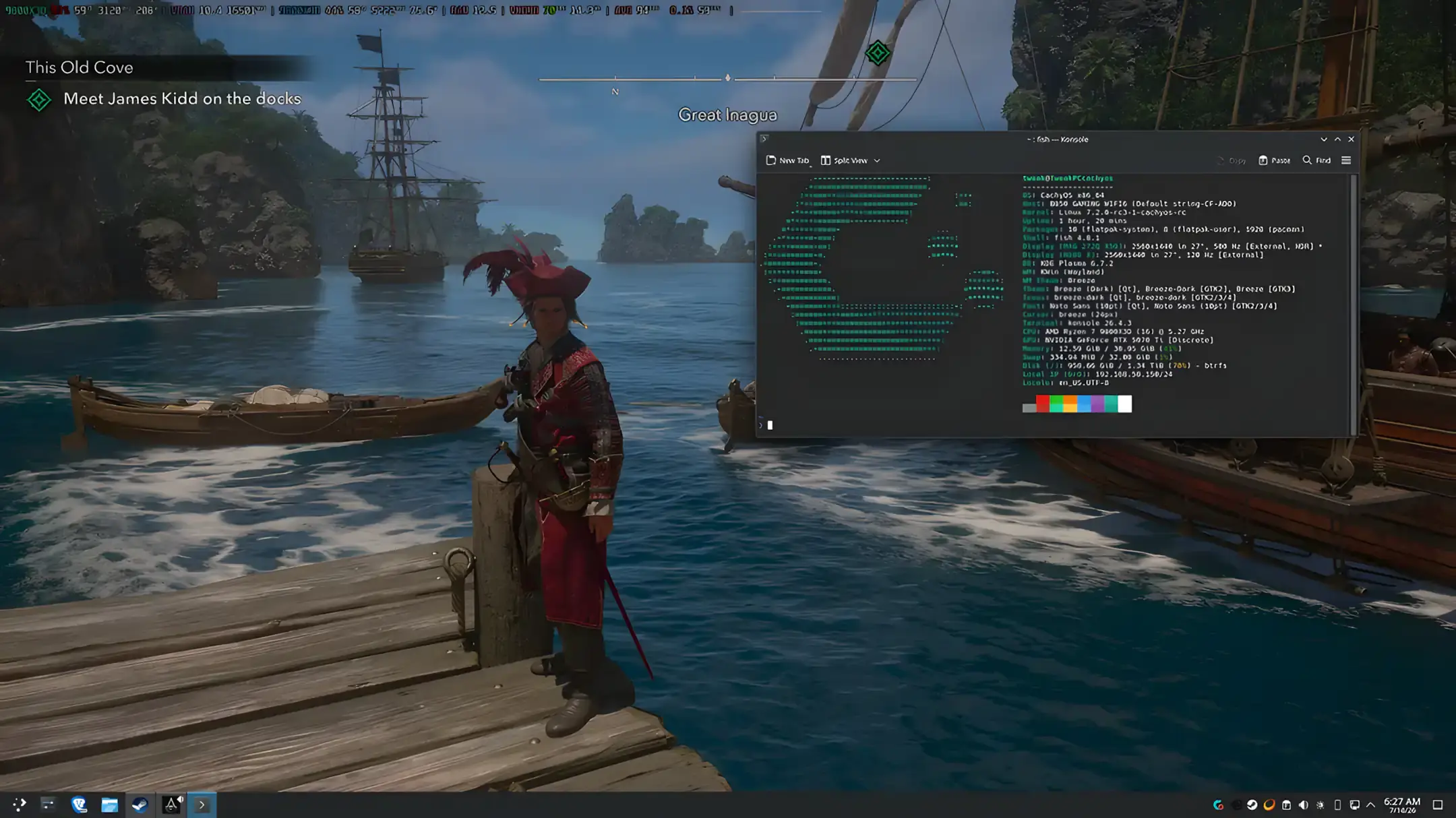
Assassin's Creed IV Black Flag performance with Linux hypervisor is on par with Windows
Linux users report successful and extremely stable launches of Assassin's Creed IV Black Flag using hypervisor emulation bypass technology. The first practical benchmarks, conducted on the Arch Linux distribution with the LTS kernel, showed excellent results. According to benchmarkers, the game runs remarkably smoothly, with overall frame rate and gameplay stability fully consistent with those on the operating system. Windows.
-
The release of a Denuvo workaround for Linux has sparked a massive shift among gamers to SteamOS.
The pirated game community has seen a flurry of discussion about switching to the SteamOS operating system following the release of the new DenuvOwO tool. This method allows users to run Denuvo-protected games on Linux directly from the userspace using special Proton builds. Players note that the solution is more stable and secure than similar bypass methods. Windows, since it does not require constant reboots of the operating system and complex intervention in the kernel.
-
Windows 11 vs Linux Gaming Test Reveals There's More to It Than FPS
It seems as though the launch of Valve's Steam Deck has resulted in an almost non-stop slew of comparisons between Linux and Windows as a gaming operating system. In one recent test, Meta PCs sought out to test the two operating systems head-to-head to get some hard numbers and potentially settle the debate, however, the results brought up an interesting debate about what makes one operating system better than another.
Benchmarks were conducted on an all-AMD system running an AMD Ryzen 7 9850X3D, an XFX Swift AMD Radeon RX 9070 XT 16 GB, and 16 GB of RAM, with the AMD Linux drivers effectively making this a best-case scenario for Linux. The benchmarks were run on the latest version of Windows 11 and Fedora Linux 44, games were tested at the same resolution, and results were an average across three runs. All games tested were also the Windows versions running via Valve's Proton compatibility layer.