
news
Free and Open Source Software, and Review
-
MINISFORUM M2 Panther Lake Mini PC Running Linux: Testing the NPU in CachyOS - LinuxLinks
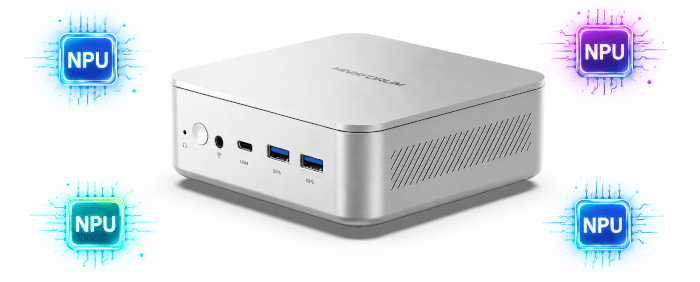
An NPU, or Neural Processing Unit, is a dedicated accelerator designed to run AI and machine-learning workloads more efficiently than a general-purpose CPU. It’s particularly useful for fixed-shape inference tasks such as image recognition, object detection, speech processing, background effects, and other local AI features where low latency and low power consumption matter. Rather than replacing the CPU or GPU, the NPU gives the system another specialised engine that can handle suitable AI workloads while leaving the processor and graphics hardware free for other tasks.
The MINISFORUM M2 combines a 50 TOPS NPU with up to 90 TOPS of combined NPU and GPU AI performance. The M2’s 50 TOPS NPU is a strong specification for a mini PC.
There are a few packages to install in CachyOS before I’m ready to test software designed to use the NPU.
Let’s test the driver stack.
MINISFORUM M2 Intel Panther Lake Mini PC Running Linux: Introduction - LinuxLinks
The Minisforum Elite Mini M2 is a compact mini PC built around Intel’s Panther Lake platform. In this series, I’ll explore the machine in detail from a Linux perspective, looking at hardware support, installation, power consumption, performance, thermals, noise, and everyday usability. I’ll also compare the M2 with a range of other mini PCs to see where it excels, where it falls short, and whether it’s a good choice for Linux users.
The M2 is a Panther Lake mini PC powered by Intel’s Core Ultra 7 356H, a 16-core, 16-thread processor. It belongs to Intel’s Core Ultra Series 3 family, launched in Q1 2026.
Graphics are handled by Intel Graphics with 4 Xe-cores. It’s worth noting that the Core Ultra 7 356H doesn’t have the most powerful GPU available in Intel’s Panther Lake range. Some higher-end Core Ultra X-series processors feature Intel Arc B390 graphics, whereas the 356H uses Intel Graphics with 4 Xe-cores. Even so, the M2’s graphics should be well suited for desktop use, media playback, and light GPU workloads under Linux.
Taxi - FTP client - LinuxLinks
Taxi is a native Linux FTP client designed for elementary OS.
Built with Vala and Gtk, it provides a simple graphical way to connect to remote servers and move files between the local machine and the server. The application uses a dual-pane layout, making it well suited to users who prefer a traditional file transfer workflow rather than working from the command line.
This is free and open source software.
git-trim - keep Git working directories clear of stale local branches - LinuxLinks
git-trim is a command-line utility that helps keep Git working directories clear of stale local branches.
It analyses tracking branches against their upstream and base branches, identifying branches that have already been merged, branches whose upstream has disappeared, and cases where a remote branch can also be removed after a merge.
The tool is intended as a safer companion to git fetch --prune. While Git’s prune operation removes remote-tracking references, git-trim also deals with the corresponding local tracking branches, avoiding the need for fragile shell one-liners or repeated manual branch deletion after pull requests have been merged or closed.
This is free and open source software.
Manga Library Manager - cross-platform manga downloader - LinuxLinks
Manga Library Manager is a cross-platform manga downloader and offline library management application.
It lets users download manga from MangaDex, maintain an offline library, update existing EPUB and CBZ files with new chapters, and organise titles using tags, metadata, filtering, and status tracking. The application is built with C#/.NET and AvaloniaUI.
This is free and open source software.