Language Selection

English French German Italian Portuguese Spanish

Lenovo admits ThinkPad CPU throttling problem when running Linux, fix in development

Filed under
GNU
Linux
Hardware

CPU performance is tricky to test these days, as CPUs of the same type can deliver vastly different performance numbers depending on the cooling and other outside conditions.

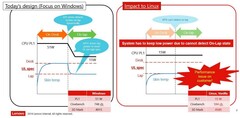
With recent ThinkPad laptops from Lenovo, it turns out that one of these outside conditions is the place where the laptop is used: The systems use the Intel "Dynamic Platform and Thermal Framework" (DPTF) to regulate the CPU performance based on if the system is used on a desk or on the users lap. On the desk, the CPU can reach much higher clock-rates, which leads to higher outside temperatures. On the lap, the CPU is limited to its basic TDP, enabling lower temperatures.

This sounds like a useful feature. The problem is that it only works correctly when Windows is installed, as DPTF requires several drivers to work. With an alternative operating system like any Linux based OS, it won't function correctly. The system is unable to recognize in which mode it should run and the CPU is locked down to the lower "Lap mode" performance.

That is why many ThinkPad & Linux users have been complaining about a lower than expected CPU performance in Lenovo's own support forum. After more than a year of complaints, Lenovo has finally admitted to this issue and thankfully also presented the prospect of a solution: The Chinese manufacturer will develop a firmware update for recent ThinkPad laptops that will basically emulate the Intel DPTF function on systems like Linux.

Read more

Lenovo To Address Linux Laptop Thermal Throttling

  • Lenovo To Address Linux Laptop Thermal Throttling, Lower Performance Against Windows

    For owners of recent Lenovo laptops that find frequent thermal throttling and ultimately lower performance compared to Windows, the company has formally acknowledged the issue and is working towards addressing the issue.

    There have been no shortage of complaints within the Lenovo Forums and elsewhere over Linux thermal/performance issues including some pointing towards the cTDP ends up being set lower on Linux than Windows. Some users are reporting their recent ThinkPads seeing as much as half the performance under Linux as they do with Windows.

Comment viewing options

Select your preferred way to display the comments and click "Save settings" to activate your changes.

More in Tux Machines

digiKam 7.7.0 is released

After three months of active maintenance and another bug triage, the digiKam team is proud to present version 7.7.0 of its open source digital photo manager. See below the list of most important features coming with this release. Read more

Dilution and Misuse of the "Linux" Brand

Samsung, Red Hat to Work on Linux Drivers for Future Tech

The metaverse is expected to uproot system design as we know it, and Samsung is one of many hardware vendors re-imagining data center infrastructure in preparation for a parallel 3D world. Samsung is working on new memory technologies that provide faster bandwidth inside hardware for data to travel between CPUs, storage and other computing resources. The company also announced it was partnering with Red Hat to ensure these technologies have Linux compatibility. Read more

today's howtos

  • How to install go1.19beta on Ubuntu 22.04 – NextGenTips

    In this tutorial, we are going to explore how to install go on Ubuntu 22.04 Golang is an open-source programming language that is easy to learn and use. It is built-in concurrency and has a robust standard library. It is reliable, builds fast, and efficient software that scales fast. Its concurrency mechanisms make it easy to write programs that get the most out of multicore and networked machines, while its novel-type systems enable flexible and modular program constructions. Go compiles quickly to machine code and has the convenience of garbage collection and the power of run-time reflection. In this guide, we are going to learn how to install golang 1.19beta on Ubuntu 22.04. Go 1.19beta1 is not yet released. There is so much work in progress with all the documentation.

  • molecule test: failed to connect to bus in systemd container - openQA bites

    Ansible Molecule is a project to help you test your ansible roles. I’m using molecule for automatically testing the ansible roles of geekoops.

  • How To Install MongoDB on AlmaLinux 9 - idroot

    In this tutorial, we will show you how to install MongoDB on AlmaLinux 9. For those of you who didn’t know, MongoDB is a high-performance, highly scalable document-oriented NoSQL database. Unlike in SQL databases where data is stored in rows and columns inside tables, in MongoDB, data is structured in JSON-like format inside records which are referred to as documents. The open-source attribute of MongoDB as a database software makes it an ideal candidate for almost any database-related project. This article assumes you have at least basic knowledge of Linux, know how to use the shell, and most importantly, you host your site on your own VPS. The installation is quite simple and assumes you are running in the root account, if not you may need to add ‘sudo‘ to the commands to get root privileges. I will show you the step-by-step installation of the MongoDB NoSQL database on AlmaLinux 9. You can follow the same instructions for CentOS and Rocky Linux.

  • An introduction (and how-to) to Plugin Loader for the Steam Deck. - Invidious
  • Self-host a Ghost Blog With Traefik

    Ghost is a very popular open-source content management system. Started as an alternative to WordPress and it went on to become an alternative to Substack by focusing on membership and newsletter. The creators of Ghost offer managed Pro hosting but it may not fit everyone's budget. Alternatively, you can self-host it on your own cloud servers. On Linux handbook, we already have a guide on deploying Ghost with Docker in a reverse proxy setup. Instead of Ngnix reverse proxy, you can also use another software called Traefik with Docker. It is a popular open-source cloud-native application proxy, API Gateway, Edge-router, and more. I use Traefik to secure my websites using an SSL certificate obtained from Let's Encrypt. Once deployed, Traefik can automatically manage your certificates and their renewals. In this tutorial, I'll share the necessary steps for deploying a Ghost blog with Docker and Traefik.