




Blogs
Apple privacy policy frustrates government
Submitted by keziahcollins on Tuesday 23rd of September 2014 09:16:47 AMThe release of the Apple iOS 8 software meant that Apple updated its privacy policy. As a company that has always put personal privacy above all else, this means you can expect your personal information to be even more protected than before. But to what extent should you expect privacy, and at what point is the government going to step in and say no?
What privacy can you expect?
»
- keziahcollins's blog
- Login or register to post comments
 Printer-friendly version
- Read more
- 21484 reads
 PDF version
Recent Changes in Tux Machines
Submitted by Roy Schestowitz on Sunday 17th of August 2014 03:18:37 PM Filed under

TODAY we have taken a bit of a break. It's Sunday after all. But here is a bit of a site status update.
The site's design has evolved a bit and it hopefully makes navigation a little better. SPAM is still a problem, but we do our best to keep it out of the sight of visitors. It's the result of a permissive policy that lets everyone publish a story, blog post, etc.
In terms of server load, we are still coping most of the time, but sometimes there's a flood of SPAM/rogue traffic that renders the server virtually unreachable. We use some ad hoc filters for to address this nuisance, but if we are away, then the site can be paralysed for a long time. We still need to find better solutions to that.
Thanks in advance for any feedback you may have and thanks for reading Tux Machines. █
»
- Roy Schestowitz's blog
- Login or register to post comments
- Printer-friendly version
- 26365 reads
- PDF version
How to rename files in bulk
Submitted by chickenkinwing on Thursday 14th of August 2014 02:10:55 AM Filed under
Consider this common scenario. A directory contains multiple files that are named using a common convention: for example, image-001.png, image-002.png, image-003.png, etc. You want to rename the files to, say, upload-001.png, upload-002.png, upload-003.png, etc.
The coders among us can write a bash script to automate the process. For expedience, this post shows how to use the built-in rename command to achieve the same goal.
»
- chickenkinwing's blog
- Login or register to post comments
- Printer-friendly version
- Read more
- 32945 reads
- PDF version
OMG what happened to CentOS 7 Desktop?
Submitted by fieldyweb on Sunday 3rd of August 2014 04:59:54 PMAs an Ubuntu user i always keep an eye out on other distros i've used over the years Sabayon, OpenSuse however CentOS is never a desktop distro i'd think of, always felt like heading back to 1990 on the desktop.. Time it seems however have changed
»
- fieldyweb's blog
- Login or register to post comments
- Printer-friendly version
- 36228 reads
- PDF version
It's Summer Again
Submitted by Roy Schestowitz on Sunday 3rd of August 2014 12:52:53 PM Filed underTHE WEATHER has been getting more pleasant and the news too is pleasant these days. Software patents are in a state of perpetual demise, Microsoft is dealing with its large-scale demise (layoffs also), FOSS is being adopted by very large nations (Russia and China are among them), the UK has adopted OpenDocument Format as the standard, and our family benefits from government migrations to FOSS (Rianne and I work through a FOSS specialist).
While it may seem like the FOSS world is quiet (judging by the volume of news), the truth of the matter is that FOSS professionals are busy migrating many systems from proprietary to FOSS. These people are committed to the cause not just with words but also with actions.
Tux Machines, realising that games for GNU/Linux are now a dozen a week (not literally), lumps together gaming news. Android, being a Linux-based platform with huge worldwide impact, receives frequent mentions. If anyone wishes to suggest other editorial priorities, please share with us in the comments. █
»
- Roy Schestowitz's blog
- Login or register to post comments
- Printer-friendly version
- 26936 reads
- PDF version
July's Record
Submitted by Roy Schestowitz on Sunday 13th of July 2014 11:06:53 PM Filed underTODAY was the last day of the log rotation. The uncached requests to Apache (bypassing Varnish proxy) exceeded the record by a huge gap (around 20%) and nearly reached 300 megabytes.
It is reassuring and gratifying to know that our readers base is expanding each week and we welcome submissions (news, blogs, etc.), which can be automatically pushed to the front page by any subscriber. █
»
- Roy Schestowitz's blog
- Login or register to post comments
- Printer-friendly version
- 27279 reads
- PDF version
Logo Concepts
Submitted by Roy Schestowitz on Monday 30th of June 2014 06:53:26 AM Filed under

More below...
»
- Roy Schestowitz's blog
- Login or register to post comments
- Printer-friendly version
- Read more
- 26917 reads
- PDF version
June Traffic
Submitted by Rianne Schestowitz on Saturday 28th of June 2014 04:23:35 AM Filed under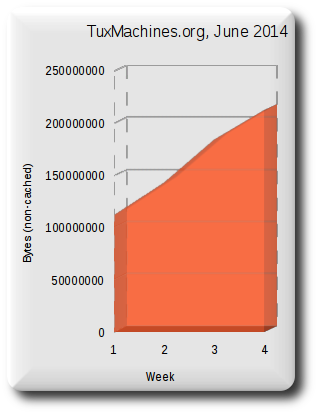
»
- Rianne Schestowitz's blog
- Login or register to post comments
- Printer-friendly version
- 37713 reads
- PDF version
TuxMachines Record Traffic
Submitted by Roy Schestowitz on Sunday 15th of June 2014 08:40:42 AM Filed underFIVE days ago TuxMachines turned 10 years old. Rianne and I were on holiday in Scotland at the time, but were still able to keep the site up to date, owing to a Wi-Fi connection which we had to work exceptionally hard for (an open Wi-Fi connection is hard to find in the UK, especially one that enables anonymous use).
Running the site requires a lot of dedication because in order to stay up-to-the-minute TuxMachines requires non-ending research/survey of news. It's truly life-changing, potentially affecting the first hours of the morning and the little hours of the night. Sometimes it affects holidays and every couple of days I browse through news and post links in-between sets at the gym. Both Rianne and I are very dedicated to the site.
Since this site keeps growing in size and in traffic (the past week saw traffic climbing 20% above the previous record) it's all worthwhile at the end, and we have no intention of slowing down. What's more, seeing how Linux expands in use (and clout) around the world assures us that efforts to popularise GNU/Linux are succeeding. █
»
- Roy Schestowitz's blog
- Login or register to post comments
- Printer-friendly version
- 25391 reads
- PDF version
Tux Machines is 10
Submitted by Rianne Schestowitz on Monday 9th of June 2014 04:47:19 AM Filed under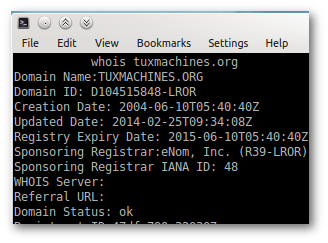
A lot has happened since Susan started the site and we are grateful for her legacy, which the Wayback Machine can show. In the coming years we will try to make more improvements in the way we pick news quickly and the way the news is presented or organised. █

»
Tux Machines Turning 10 on June 10th
Submitted by Rianne Schestowitz on Friday 23rd of May 2014 10:14:29 PM Filed under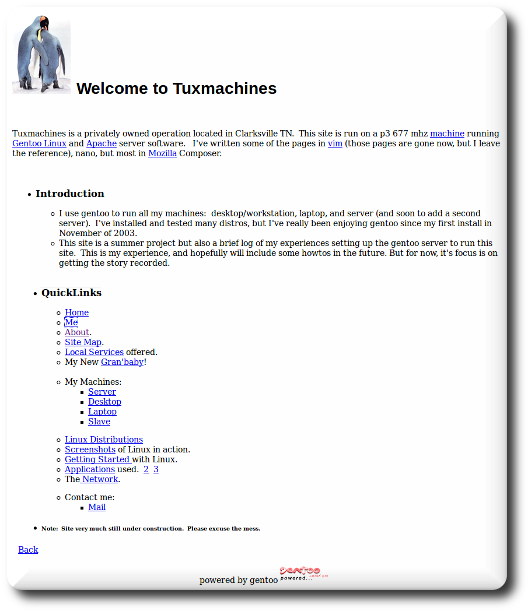
»
- Rianne Schestowitz's blog
- Login or register to post comments
- Printer-friendly version
- 31461 reads
- PDF version
'Free' Wi-Fi Usually Not Free Anymore
Submitted by Roy Schestowitz on Sunday 11th of May 2014 03:39:00 PM Filed under
SEVERAL days ago we visited Trafford Centre, which is a large shopping mall in Greater Manchester. The place is quite nice as it embodies very modern (yet classic) ornamental features, encompassing the best of outdoor and indoor decorations. It's all geared up towards consumerism, but there is also a nice cinema there. Now, here's the deal. Upon entering the mall one cannot help noticing that there is strong, universal Wi-Fi signal. Let's leave aside health implications. It's the same in other malls, such as the Arndale Centre near our house. It is also the same at airports, but if there is no payment needed for the Wi-Fi, then the user's identity is requested (if a payment is made, then the payment itself exposes the user's identity).
 Following basic principles and common sense, I gave some fake details so that I can use the 'free' Wi-Fi anonymously and log into Tux Machines (checking the latest), but I not help wondering, still. Given what we know about NSA- and GCHQ-centric plans for surveillance on in-flight Wi-Fi, what are the chances that users' identities are being requested not just for marketing purposes but also for surveillance? It is becoming very hard to access the Net anonymously now. The UK is cracking down on 'free' Wi-Fi, saying that it facilitates copyright infringement and our home hub, which is open for all to use (no password needed), keeps warning us that it is "not secure" (because it facilitates sharing). This is actively being discouraged if not forbidden. In all sorts of beverage-serving places (hot or cold, or alcoholic) and restaurants it is getting hard to gain anonymous Wi-FI access and the only way I've found (out of curiosity) to attain anonymous Wi-Fi use is First Class in high-speed British rail, provided one purchases the train ticket with cash. Similarly, it is getting harder to purchase groceries with cash here, at least without being penalised (not receiving a discount in exchange for identifying cards like Nectar). It sure seems like the very idea of anonymity here is becoming synonymous with crime. For experimental reasons I researched which shops in the UK still enable people to purchase a mobile phone anonymously. It's not easy, but it is still possible. Maybe it's no longer possible because I haven't surveyed the shops in almost 3 years.
We are entering a new unprecedented norm as those in power gradually phase in scary forms of governance in society, where the assumption is that anonymity deserves to be maligned and people should always identify themselves everywhere (also enable tracking of themselves by carrying a mobile phone) so as to avoid looking "suspicious". That's the mentality of mass surveillance that people have become accustomed to (and rather apathetic towards) in the UK.
It's stuff like this that made me exceptionally stubborn about deleting server logs in Tux Machines and not connecting to any third-party entity (e.g. with interactive social buttons, cookies), unlike most other GNU/Linux/FOSS sites. █
»
Tux Machines Turns 10 in Exactly One Month
Submitted by Roy Schestowitz on Saturday 10th of May 2014 08:19:46 AM Filed under
THIS past week was not a bad week at all. There was lots to cover (without compromising focus and s/n ratio) and it was our biggest week ever (since we carried on from Susan) in terms of traffic, with as many visitors in 5.5 days as in the previous record for a week (7 days). Based on whois, the Creation Date of Tux Machines is 2004-06-10 05:40:40, so we are exactly a month away from an important anniversary.
We don't track visitors, we just look at the size of uncached traffic logs (no unique IPs, only one IP -- that of the Varnish server -- is shown for everyone) before they are deleted for good, which would be every 4-5 weeks (logrotate). Privacy preservation is a conscious decision for us.
Thanks to everyone for choosing us for news. We enjoy running the site and we hope you enjoy following it. Running the site requires a lot of dedication, including posting while out of the house (wirelessly) or staying up late at night to catch up with the latest headlines. Rianne sometimes stays awake until 3 AM because she wants to ensure readers are being informed. █
»
Secret Back Doors in Android
Submitted by Roy Schestowitz on Thursday 8th of May 2014 02:37:54 PM Filed underI am everything but a Google basher and I spent a lot of my life descending deep into research of Google foes, Google smear campaigns, lawsuits by proxy, and antitrust actions by proxy. I also advocate Android, but in recent years I have been increasingly concerned about the direction it is taking. I wish to share my latest concern. It relates to what the media characterises as "anti-theft" but is actually a facility to kill phones in a protest or convert them into hostile listening devices. Technology impacts human rights and those who control technology can be tempted to control humans.
Google habitually updates my tablet. It is a Nexus 7 tablet which Google invites itself to update remotely (shame on me for not installing Replicant, but this device does not support it yet). It is not a 3G tablet and it does not have two operation systems (unlike mobile phones) or even a carrier tracking its location all the time. It's a purely Android device with no network tying. It is network-agnostic. I only bought it because in order to replace my PDA (for over a decade) I wanted a device that is not a tracking device. Phones were out of the question.
Networks don't track the tablet. Google, however, is always out there, fully able to identify the connected user (latched onto a Gmail address because of Play), modifying the software without even the user's consent (the user is sometimes prompted to boot, without being able to opt out of the core update itself).
The update in itself is not a problem. What's problematic is its effect.
Following the latest Google update (which I was given no option to reject) I noticed that Google had added a remote kill switch as an opition. It was enabed by default. "Allow remote lock and erase" is what Google calls it and it is essentially working like a back door. Google and its partners in government are gaining a lot of power not over a smartphone but over a tablet.
The significance of this is that not only phones should be assumed to be remotely accessible for modification, including for example additional back doors. What's more, some devices that were sold without this functionality silently have it added. According to the corporate press, the FBI remotely turns Android devices into listening devices and it is getting simpler to see how.
NSA and PRISM destroy our computing. We definitely need to demand Free software, but we should go further by asking for audits, rejecting user-hostile 'features' like DRM, 'secure' boot, and kill switches. I gradually lose any remaining trust that I had in Google and even Free software such as Android.
»
- Roy Schestowitz's blog
- Login or register to post comments
- Printer-friendly version
- 30663 reads
- PDF version
Is Nokia Really Dying?
Submitted by Rianne Schestowitz on Wednesday 30th of April 2014 11:16:32 AM Filed under

It was almost two months ago that I wrote about Nokia's most-awaited comeback, for the new designs and innovation of their mobile phones, but it did not happen. In fact, Nokia's ordeal became worse because Nokia is dying. Yes! Nokia is dying as Microsoft once again used their power 'trick' to get a stranglehold on the most influential and trusted company when it comes to innovation and technology. No matter what changes and what Microsoft is doing, there will be no difference. Chances are, only the features and profiles have changed, but the personal interest and infrastructure most likely are the same or even worse than that. Now Nokia has become the new platform of surveillance, it will never be the same again. The trust has been tarnished, the public has become more aware of Microsoft's anomalies and all sorts of devil's advocate games. Doing business with Microsoft is a big mistake. Take Nokia's example. I hope Android and Tizen will not consider deals or any tie-ups with Microsoft, and to all the rest who support and advocate open source, rest assured that FOSS will prevail. █
»
- Rianne Schestowitz's blog
- Login or register to post comments
- Printer-friendly version
- 38110 reads
- PDF version
Tux Machines This Month
Submitted by Roy Schestowitz on Tuesday 29th of April 2014 02:34:46 PM Filed under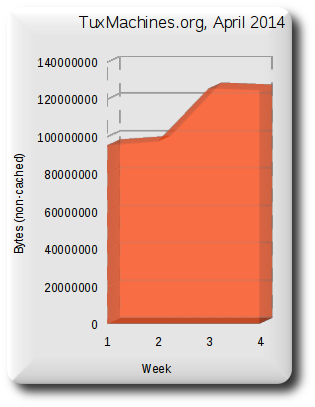
THE Web site is still experiencing a resurgence/growth while bits and pieces are being modernised to take advantage of CSS3. This site's Netcraft ranking climbed sharply to 8479th and this month alone traffic climbed by about 25%. Thanks to all those who choose Tux Machines as their source of news. █
»
- Roy Schestowitz's blog
- Login or register to post comments
- Printer-friendly version
- 22637 reads
- PDF version
MakuluLinux 6 Codename "Imperium" MATE 1.8 Edition Released Tomorrow
Submitted by Roy Schestowitz on Sunday 13th of April 2014 09:13:43 AM Filed under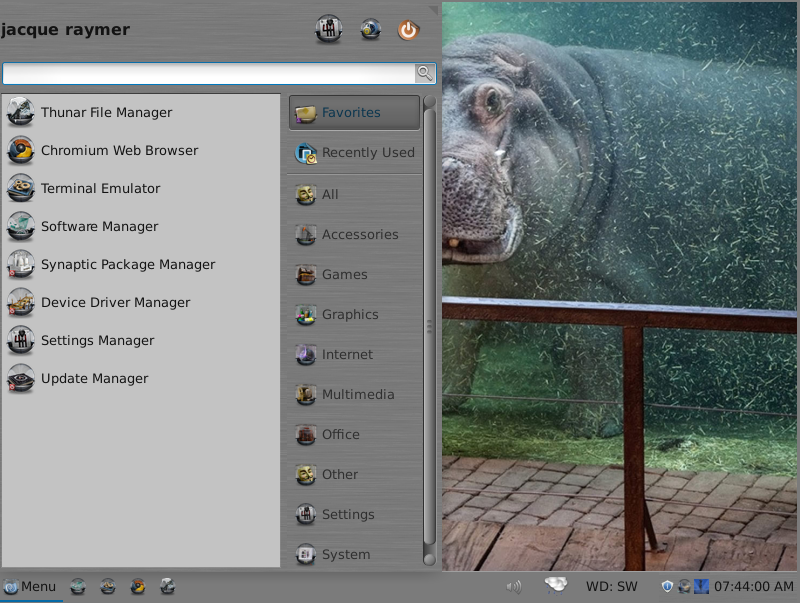
LAST night I received a timely recommendation of the Debian-based MakuluLinux. For more details and background see the main page of MakuluLinux, this recent video review, and a very brief announcement of an upcoming release with MATE, which is described in this old post.
There is a lot more information out there about MakuluLinux Mate Edition, whose 1.8 version is being planned/finalised/slated for release this Monday. There isn't yet an official site announcement, but the links to the Preview Edition will hopefully help those who want to try out the distro. It is a "true" community distro of GNU/Linux. █
»
- Roy Schestowitz's blog
- Login or register to post comments
- Printer-friendly version
- 32385 reads
- PDF version
Computer Equipment and Screen Recording Revisited
Submitted by gfranken on Thursday 10th of April 2014 07:47:02 PMIt has been about 3 years since my primary hardware machine has been upgraded. I already had 16GB of RAM, two 1920 x 1200 monitors, a Filco mechanical keyboard, and a graphics tablet. OK, I admit that the CPU is showing a little age, but it was an AMD Phenom II X4 965 quad-core processor, and that still has some life left in it.
So I decided to update my graphics card, which was an Nvidia GeForce 440.
»
Tux Machines Turns 10 in a Couple of Months
Submitted by Roy Schestowitz on Sunday 6th of April 2014 03:38:01 PM Filed under
THERE HAS always been something different in Tux Machines. Rather than strictly follow what corporate media said was the "big" story, Tux Machines paid attention to blogs large and small, trying to extract the signal out of the noise and the hype (stories that 'sell' better, such as vulgar language from Mr. Torvalds). Tux Machines was the first site to visit (back when I was merely a visitor) to look for news in. If there is a blog, site, mailing list etc. that you think we should follow (syndicate), please let us know because we are always looking for more diverse sources, especially ones that offer original stories, not repetition.
There will soon be an important anniversary for this site, which is still growing not only in terms of size but also in terms of readership. We stay committed to the scope as explained yesterday in the update to this page and we are hoping to keep serving for another 10 (or tens of) years to come. Today we added a "view as PDF" functionality. Any ideas for improving the site (in terms of functionality, layout, stories selection) would be much appreciated. █
»
- Roy Schestowitz's blog
- Login or register to post comments
- Printer-friendly version
- 22705 reads
- PDF version
Manchester and Computing
Submitted by Roy Schestowitz on Thursday 3rd of April 2014 04:13:07 PM Filed under
Manchester's role in the history of computing is not widely recognised. I spent several years working in Manchester Computing and I studied where the first programmable computer was built (by Kilburn, whom the building was later named after). One of my colleagues at Manchester Computing (MCC) was the person who was first to build and distribute a GNU/Linux distribution (combining both GNU and Linux) and yesterday I met and spoke to one of the earlier PC distributors from across the road (supplier for Manchester Computing). Right here at the centre of Manchester a lot of the early milestones of computing took place (Turing also), but Manchester became better known for the splitting of atoms, the football teams, famous bands like Oasis, and the industrial revolution. A few days ago Rianne and I visited the local museum which demonstrates the industrial revolution (photo above from this album); what we really need here, however, are more museums documenting Manchester's role in modern computing. This city deserves more credit. █
»
- Roy Schestowitz's blog
- Login or register to post comments
- Printer-friendly version
- 23395 reads
- PDF version

More in Tux Machines
- Highlights
- Front Page
- Latest Headlines
- Archive
- Recent comments
- All-Time Popular Stories
- Hot Topics
- New Members
digiKam 7.7.0 is released
After three months of active maintenance and another bug triage, the digiKam team is proud to present version 7.7.0 of its open source digital photo manager. See below the list of most important features coming with this release.
|
Dilution and Misuse of the "Linux" Brand
|
Samsung, Red Hat to Work on Linux Drivers for Future Tech
The metaverse is expected to uproot system design as we know it, and Samsung is one of many hardware vendors re-imagining data center infrastructure in preparation for a parallel 3D world.
Samsung is working on new memory technologies that provide faster bandwidth inside hardware for data to travel between CPUs, storage and other computing resources. The company also announced it was partnering with Red Hat to ensure these technologies have Linux compatibility.
|
today's howtos
|


.svg_.png)

 Content (where original) is available under CC-BY-SA, copyrighted by original author/s.


Recent comments
1 year 9 weeks ago
1 year 9 weeks ago
1 year 9 weeks ago
1 year 9 weeks ago
1 year 9 weeks ago
1 year 9 weeks ago
1 year 9 weeks ago
1 year 9 weeks ago
1 year 9 weeks ago
1 year 9 weeks ago