



PureBoot’s Powerful Recovery Console
Submitted by Rianne Schestowitz on Thursday 9th of June 2022 09:56:41 PM
Filed under 
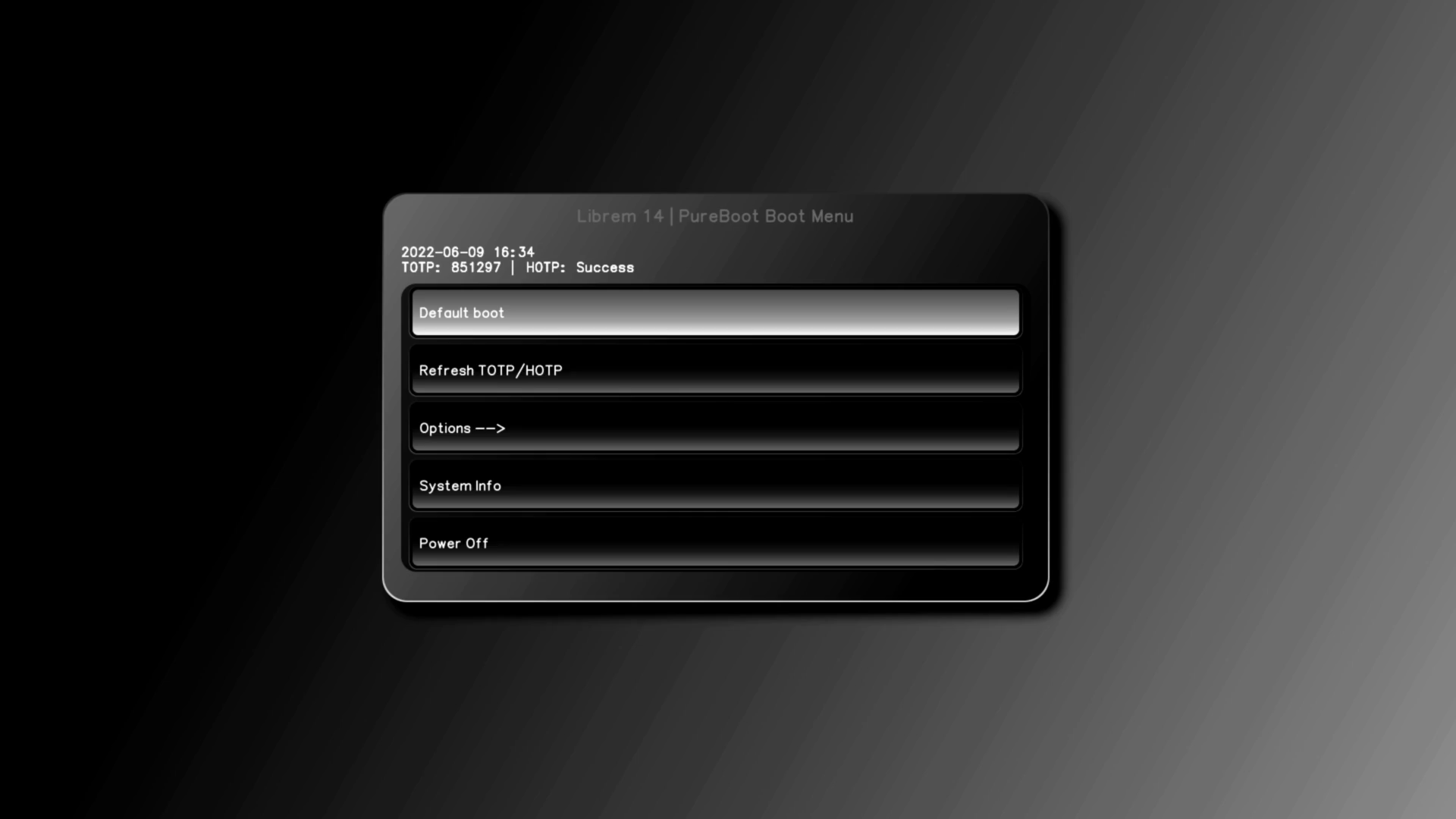
Normally when we talk about our high-security boot firmware PureBoot, it’s in the context of the advanced tamper detection it adds to a system. For instance, recently we added the ability to detect tampering even in the root file system. While that’s a critical benefit PureBoot provides over our default coreboot firmware, it also provides a number of benefits outside of security that can aid tinkerers who need to recover a system that won’t boot. In this post I’m going to talk about the powerful recovery console PureBoot provides, and explain some of the extra things you can do with it compared to a traditional GRUB recovery console.
Coreboot is a free software boot firmware that we ship on all of our hardware and replaces the traditional proprietary BIOS. When a coreboot-powered system boots, coreboot executes, initializes some hardware, and then executes a payload that can perform the remaining steps of a traditional BIOS to boot the system. Common payloads include SeaBIOS (what we include with our default coreboot builds), GRUB (GRUB is the standard boot loader used by most Linux distributions to select and boot into the OS), or Heads (what we use with our PureBoot firmware).

»
-

- Login or register to post comments
 Printer-friendly version
- 1488 reads
 PDF version
More in Tux Machines
- Highlights
- Front Page
- Latest Headlines
- Archive
- Recent comments
- All-Time Popular Stories
- Hot Topics
- New Members
digiKam 7.7.0 is released
After three months of active maintenance and another bug triage, the digiKam team is proud to present version 7.7.0 of its open source digital photo manager. See below the list of most important features coming with this release.
|
Dilution and Misuse of the "Linux" Brand
|
Samsung, Red Hat to Work on Linux Drivers for Future Tech
The metaverse is expected to uproot system design as we know it, and Samsung is one of many hardware vendors re-imagining data center infrastructure in preparation for a parallel 3D world.
Samsung is working on new memory technologies that provide faster bandwidth inside hardware for data to travel between CPUs, storage and other computing resources. The company also announced it was partnering with Red Hat to ensure these technologies have Linux compatibility.
|
today's howtos
|


.svg_.png)

 Content (where original) is available under CC-BY-SA, copyrighted by original author/s.


Recent comments
1 year 11 weeks ago
1 year 11 weeks ago
1 year 11 weeks ago
1 year 11 weeks ago
1 year 11 weeks ago
1 year 11 weeks ago
1 year 11 weeks ago
1 year 11 weeks ago
1 year 11 weeks ago
1 year 11 weeks ago