



Coming of Age: Desktop Organization with Plasma Activities
Submitted by Roy Schestowitz on Tuesday 19th of April 2022 07:39:23 PM
Filed under 
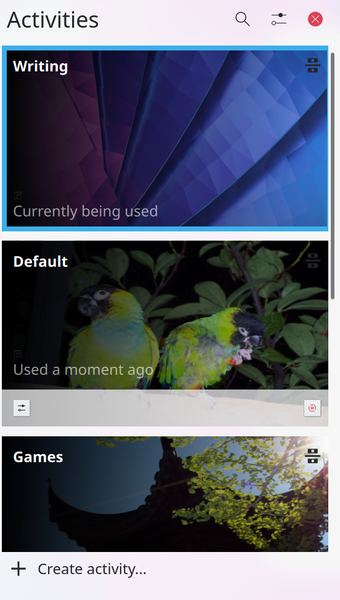
If you haven't looked at Plasma Activities in awhile, you should take a second look. Recent updates make the tool the ultimate for organizing your desktop.
KDE Plasma identifies multiple desktops as Activities. Plasma Activities are one of the most versatile features on the Linux desktop -- and also among the least known or used. Over a decade after they were first introduced, Plasma Activities are finally coming into their own. Today, they can provide some of the ultimate in desktop customization with almost no effort.
Activities have been overlooked for several reasons. To start with, they were part of the botched and premature release of KDE 4.0, which for months had users in open revolt. What was supposed to be a bold innovation, a sign that the Linux desktop was no longer trying to catch up to proprietary ones, became a symbol of developers ignoring the needs of users. Neither does it help that Gnome uses the term “Activities” for its overview rather than a name for multiple desktops. Just as importantly, from the beginning, Activities have been under-documented, leaving users to puzzle out how to implement them. In particular, until recently, the difference between Activities and virtual workspaces was poorly defined and settled only when each Activity was given its own workspaces, making clear that workspaces are subordinate to Activities. However, probably the major cause of neglect is that the details of Activities have changed constantly, often becoming needlessly complex. For instance, in early releases, only one Desktop file was available, meaning that all resources for all Activities had to be placed in one file, and the resources not meant for a given Activity laboriously filtered out. Similarly, early on there were several types of Activities, many whose purpose was obscure. Only in recent releases have Activities become simple enough that they could be efficiently customized.

»
-

- Login or register to post comments
 Printer-friendly version
- 1394 reads
 PDF version
More in Tux Machines
- Highlights
- Front Page
- Latest Headlines
- Archive
- Recent comments
- All-Time Popular Stories
- Hot Topics
- New Members
digiKam 7.7.0 is released
After three months of active maintenance and another bug triage, the digiKam team is proud to present version 7.7.0 of its open source digital photo manager. See below the list of most important features coming with this release.
|
Dilution and Misuse of the "Linux" Brand
|
Samsung, Red Hat to Work on Linux Drivers for Future Tech
The metaverse is expected to uproot system design as we know it, and Samsung is one of many hardware vendors re-imagining data center infrastructure in preparation for a parallel 3D world.
Samsung is working on new memory technologies that provide faster bandwidth inside hardware for data to travel between CPUs, storage and other computing resources. The company also announced it was partnering with Red Hat to ensure these technologies have Linux compatibility.
|
today's howtos
|


 Content (where original) is available under CC-BY-SA, copyrighted by original author/s.



Recent comments
1 year 11 weeks ago
1 year 11 weeks ago
1 year 11 weeks ago
1 year 11 weeks ago
1 year 11 weeks ago
1 year 11 weeks ago
1 year 11 weeks ago
1 year 11 weeks ago
1 year 11 weeks ago
1 year 11 weeks ago