



IBM/Red Hat/Fedora Leftovers
Submitted by Roy Schestowitz on Monday 21st of March 2022 09:23:05 AM
Filed under 
-
Red Hat, Linux, Harassment and War Graves
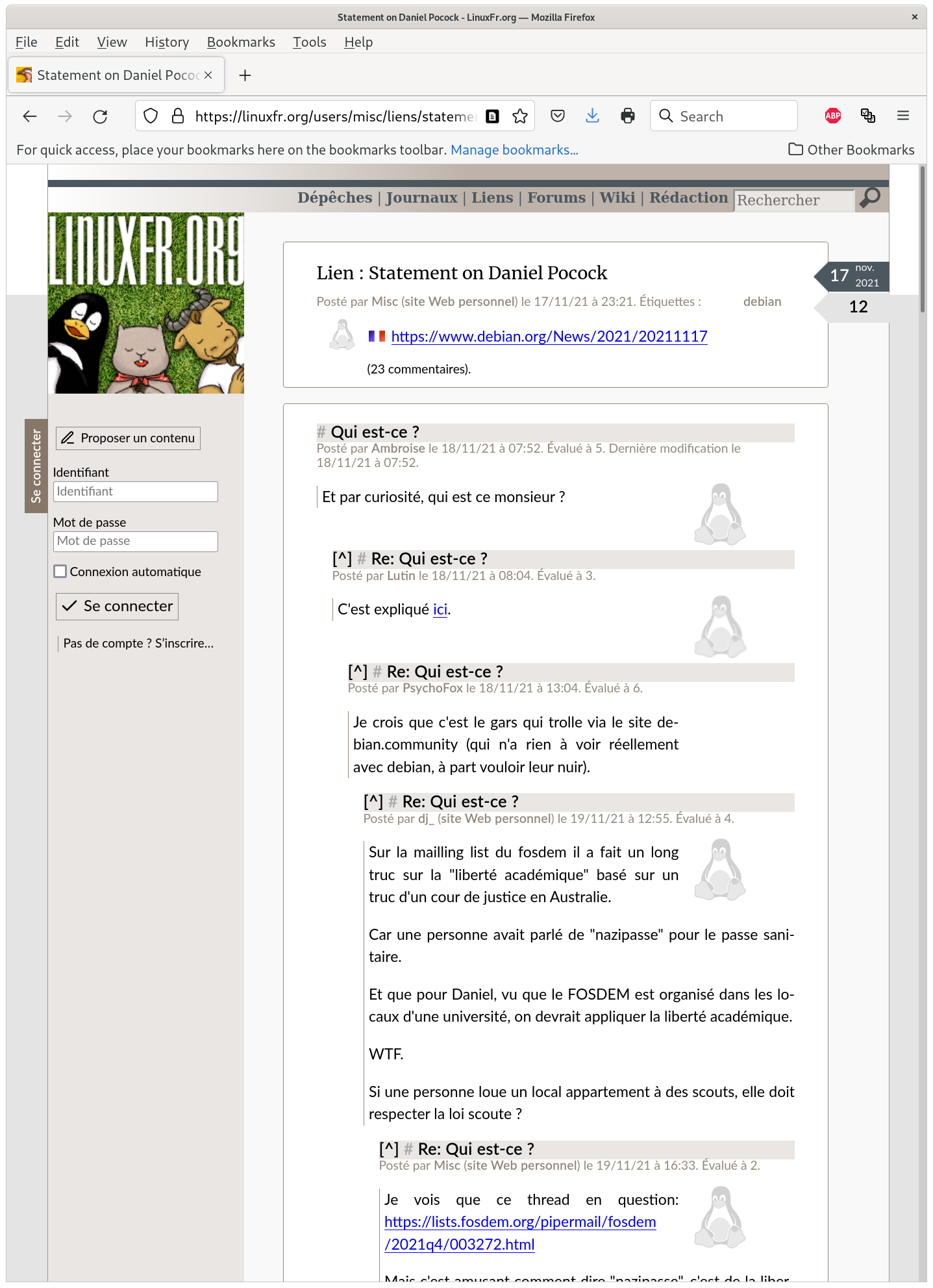
Maybe it is some random coincidence of course. I had published the video in French at the end of Septmeber and these Linux trolls started writing defamation in French in mid-November.
It would be foolish to say that Matthew Miller or Red Hat ordered these trolls to engage like this. On the other hand, this campaign of harassment did not arise spontaneously. Red Hat Linux is one of the oldest and most respected Linux distributions. Miller published a character attack on Dr Richard Stallman earlier in 2021. Being in a position of leadership, Red Hat's attack on Dr Stallman have set a bad example for every troll in the Linux world to follow. Launching these attacks in French after my visit to war graves in France, they've demonstrated that there is no lower bound on their vulgarity.
-
Automation: 5 expert tips to advance your journey | The Enterprisers Project
It’s “old” in the sense that various forms of scripting, business process automation, and other technologies have been around for decades. It’s “new” – or newer, at least – in terms of containerization, Kubernetes, infrastructure as code, security automation, robotic process automation (RPA), and the vast landscape of cloud-native tooling.
No matter what, it’s tough to find an IT shop taking a “just say no” approach to automation in 2022. On the contrary, there’s a trove of numbers that all seem to say: IT automation is virtually everywhere. That’s evident in software pipelines, hybrid cloud infrastructure, security operations centers, you name it.
-
Digital transformation: 10 reasons your IT initiatives fail
Companies have been embarking on digital transformation efforts to reduce costs, boost efficiency, and better serve their customers. But it is easier said than done. Successful digital transformation requires a well-defined strategy and experienced teams.
-
Documentation PR’s Welcome - Why Docs Are Not A Beginner Friendly Task
Generally, when someone is a beginner to a project they lack an understanding of the project audience so they aren’t able to empathise with “what could be useful for a reader”. They also tend to lack the depth and breath of technical knowledge to know what to write for the documentation since by definition, they are a newcommer to this project.
A great way to connect with a beginner is to listen to their frustrations and what challenges the encountered with your project. First, connect how that frustration could be either a failing of the user interface and it’s design (even an API is a user interface). Second, only once you have eliminated design limitations, then consider it to be a documentation problem. As the project contributor, you are in a better position to write documentation than a beginner.
-
Fedora Workstation's State of Gaming - A Case Study of Control (2019) - Fedora Magazine
Back in the day, it used to irk me as to how GNU/Linux[1] distributions could not be even considered to be in the proximity of video games enthusiasts – less because of the performance of the video games themselves and more because of how inconvenient it could be for them to set it all up. Admittedly, it had been quite a while since an avid video games fan like me did that, so it was almost a no-brainer for me to try it out and see if things have changed. What I ended up finding surprised me – I like to think that it would be just as pleasing to both enthusiasts who have been playing video games on GNU/Linux distributions and to newcomers who have been scoping this, alike.
On a testing bench using an AMD RDNA2-based[2] GPU, the video game was configured to the highest possible graphical preset[3] to really stress the hardware into performing as much as its limiting factor. If the RDNA2 architecture reminds you of something, allow me to share that it is what forms the foundation of the GPU that no other than the widely acclaimed Steam Deck[4] makes use of. For that matter, if you factor in some performance scaling with respect to the handheld nature of the device and the optimized Proton compatibility layer, this article can be representative of what the Steam Deck is capable of when you use Fedora Workstation[5] as a platform of your choice for playing your favourite video games.
-
Filipe Rosset: Fedora rawhide – fixed bugs 2021/10
-
Deploy Infinispan automatically with Ansible | Red Hat Developer
Infinispan, an in-memory data store, is popular among Java programmers as a fast and scalable key-value store that can be deployed in a variety of settings. This article describes how to use Ansible to automate the installation and setup of an Infinispan instance. Along the way, you'll learn about many aspects of Ansible's capabilities.
The most straightforward use for Infinispan is as an in-memory cache, embedded into an application. Infinispan can also be a separate, standalone cache offering transient memory to separate applications that access the cache using different protocols. A third option is to treat Infinispan as a kind of NoSQL database. And these are only the most common use cases; additional options are available.
Infinispan can be resilient, even across data centers or availability zones, thanks to its efficient cross-site replication and split-brain mitigation options.
With so many use cases at one's disposal, it is nice to have a dedicated Ansible collection to help automate Infinispan deployment and configuration. This article provides a walkthrough of Ansible's usage and shows you how to integrate Infinispan easily into an Ansible Playbook to manage the software like any other piece of the application's infrastructure.
-
Hello Podman using .NET [Ed: Red Hat is pushing Microsoft]
This article shows how to control Podman from .NET. Podman is a container engine, like Docker, that is available on Linux, Windows (using the Windows Subsystem for Linux), and macOS (using a Linux virtual machine). The Podman executable is command-line compatible with Docker, and Podman also supports the Docker HTTP API. Now .NET programmers can use Podman and Docker through the Docker.DotNet library.
»
-

- Login or register to post comments
 Printer-friendly version
- 1132 reads
 PDF version
More in Tux Machines
- Highlights
- Front Page
- Latest Headlines
- Archive
- Recent comments
- All-Time Popular Stories
- Hot Topics
- New Members
digiKam 7.7.0 is released
After three months of active maintenance and another bug triage, the digiKam team is proud to present version 7.7.0 of its open source digital photo manager. See below the list of most important features coming with this release.
|
Dilution and Misuse of the "Linux" Brand
|
Samsung, Red Hat to Work on Linux Drivers for Future Tech
The metaverse is expected to uproot system design as we know it, and Samsung is one of many hardware vendors re-imagining data center infrastructure in preparation for a parallel 3D world.
Samsung is working on new memory technologies that provide faster bandwidth inside hardware for data to travel between CPUs, storage and other computing resources. The company also announced it was partnering with Red Hat to ensure these technologies have Linux compatibility.
|
today's howtos
|


.svg_.png)

 Content (where original) is available under CC-BY-SA, copyrighted by original author/s.


Recent comments
1 year 11 weeks ago
1 year 11 weeks ago
1 year 11 weeks ago
1 year 11 weeks ago
1 year 11 weeks ago
1 year 11 weeks ago
1 year 11 weeks ago
1 year 11 weeks ago
1 year 11 weeks ago
1 year 11 weeks ago