



Programming Leftovers
Submitted by Roy Schestowitz on Tuesday 15th of March 2022 04:39:25 PM
Filed under 
-
Announcement: gcobol
Greetings, gcc!  We come bearing gifts!

When you set your clock ahead an hour yesterday, you might not have
realized you set your calendar back to 1985.  There's a new gcc COBOL
compiler. We call it: gcobol.

On the books, we have 1 man-year invested: two full-time
programmers since October 2021.

We have so far compiled just over 100 programs from the examples in
"Beginning COBOL for Programmers", by Michael Coughlin. We are near the
end of that phase of the project, and expect to have ISAM and
Object-Oriented Cobol features implemented in the next few weeks.  We
are working on compiling the NIST COBOL test suite, which we expect
will take a few months to complete.  We have begun work on  gdb, too,
and hope to have it working by year end.

Our project should not be confused with GnuCOBOL
(https://savannah.gnu.org/projects/gnucobol).  That project is a Cobol
translator: it compiles Cobol to C, and invokes gcc to produce
executable code.  Our gcobol compiler is (currently) a fork of gcc.  It
implements a gcc frontend for Cobol and (obviously) invokes the gcc
backend to produce executables.  (We have a friendly relationship with
GnuCOBOL, and its maintainer supports our undertaking.)

Ours should also not be confused with prior efforts to create a gcc
Cobol compiler.  Others have tried and failed.  Failure wasn't an
option for us.  I won't say it was easy, but here we are.

Eventually, if the gcc maintainers are interested, we would like to
pursue full integration with gcc.  For the moment, we have questions
we're hoping can be answered here by those who ran the gauntlet
before us.  Given the state of the internals documentation, that seems
like our best option. We've been rummaging around in the odd sock
drawer for too long.

If you're like me (like I was), your visceral response to this
announcement can be summed up in one word: Why?

The answer is as easy as it is trite: the right tool for the job.

I wouldn't write an operating system in Cobol.  But I wouldn't write
one in Python or Java, either.  Cobol has a niche no other language
occupies: a compiled language for record-oriented I/O.

That might sound strangely specialized, but it's not.  Record-oriented
I/O describes, I would argue, nearly *all* applications.  Yet, since the
advent of C, nearly all applications have relegated I/O to an external
library, and adopted the Unix byte-stream definition of a "file".

If you've written a CGI web application, you know what I'm talking
about.  Cobol eliminates a lot of gobbledygook by reducing free-form
run-time variables to compile-time constants.

That's the rationale, and it's not just a theory.  Cobol is alive and
kicking.  Estimates vary, but they all say north of 100 billion lines
of Cobol are still in use, with millions more written every year, even
now, in the 21st century.  Odds are your last ATM transaction or credit
card purchase went through a Cobol application.

There's another answer to Why: because a free Cobol compiler is an
essential component to any effort to migrate mainframe applications to
what mainframe folks still call "distributed systems".  Our goal is a
Cobol compiler that will compile mainframe applications on Linux.  Not
a toy: a full-blooded replacement that solves problems.  One that runs
fast and whose output runs fast, and has native gdb support.

I am happy to debate the lunacy of this project and the viability of
Cobol, either here or off-list.  Today, we want to make the project
known to those in the technical community who might most want to know
what we're up to, and explain why we'll be asking the questions we're
asking.

Also, if you want to give it a whirl, please don't hesitate.  We're
happy to help, and expect to learn something in the process.

Thank you for you kind attention.

--jkl
-
gcobol: a native COBOL compiler [LWN.net]
The gcobol project has announced its existence; it is a compiler for the COBOL language currently implemented as a fork of GCC.
-
Node.js security: Parse Server remote code execution vulnerability resolved
Users of Parse Server, a popular API server module for Node/Express, are being urged to immediately apply a fix for a remote code execution (RCE) vulnerability.
Discovered by security researchers Mikhail Shcherbakov, Cristian-Alexandru Staicu, and Musard Balliu, the vulnerability impacts the parse-server NPM package, versions below 4.10.7.
-
Qt for WebAssembly on mobile devices
Qt for WebAssembly on mobile devices, specifically phones, has lacked an essential feature - support for the native keyboard. It may or may not have worked. If it worked, it did not work very well. The tricky issue is opening the keyboard when needed and closing when it wasn't. There is no simple API for doing that on any platform we target - iOS, Android and Windows.
-
Drew DeVault's blog: Status update, March 2022
Greetings! The weather is starting to warm up again, eh? I’m a bit disappointed that we didn’t get any snow this winter. Yadda yadda insert intro text here. Let’s get down to brass tacks. What’s new this month?
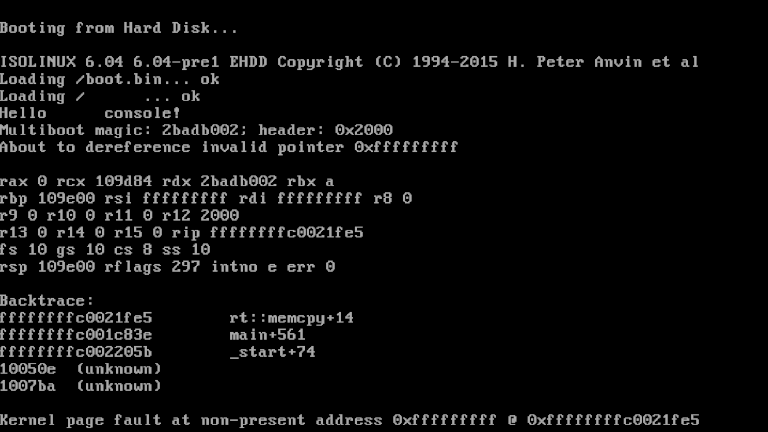
I mainly focused on the programming language this month. I started writing a kernel, which you can see a screenshot of below. This screenshot shows a simulated page fault, demonstrating that we have a working interrupt handler, and also shows something mildly interesting: backtraces. I need to incorporate this approach into the standard library as well, so that we can dump useful stack traces on assertion failures and such. I understand that someone is working on DWARF support as well, so perhaps we’ll soon be able to translate function name + offset into a file name and line number.
»
-

- Login or register to post comments
 Printer-friendly version
- 1747 reads
 PDF version
More in Tux Machines
- Highlights
- Front Page
- Latest Headlines
- Archive
- Recent comments
- All-Time Popular Stories
- Hot Topics
- New Members
digiKam 7.7.0 is released
After three months of active maintenance and another bug triage, the digiKam team is proud to present version 7.7.0 of its open source digital photo manager. See below the list of most important features coming with this release.
|
Dilution and Misuse of the "Linux" Brand
|
Samsung, Red Hat to Work on Linux Drivers for Future Tech
The metaverse is expected to uproot system design as we know it, and Samsung is one of many hardware vendors re-imagining data center infrastructure in preparation for a parallel 3D world.
Samsung is working on new memory technologies that provide faster bandwidth inside hardware for data to travel between CPUs, storage and other computing resources. The company also announced it was partnering with Red Hat to ensure these technologies have Linux compatibility.
|
today's howtos
|


 Content (where original) is available under CC-BY-SA, copyrighted by original author/s.



Announcement: gcobol
Announcement: gcobol
An open-source COBOL contender emerges
An open-source COBOL contender emerges