



Open Hardware/Modding: Fumik/Arduino, Picovoice, and More
Submitted by Roy Schestowitz on Thursday 10th of March 2022 07:28:45 PM
Filed under 
-
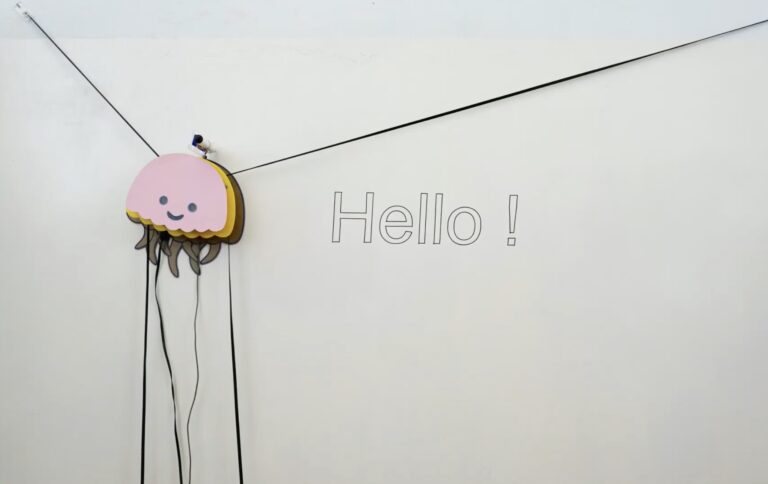
Meet Fumik, a compact jellyfish robot that draws on walls | Arduino Blog
Back in August 2021, mechatronics engineer ‘engineer2you’ had the idea to create a fun CNC plotter that easily mounts to a pair of points along a wall and traverses across the surface to draw on it, essentially becoming a self-contained mural-making robot. The jellyfish-looking device, named Fumik, is able to sketch patterns within a 5×3 meter area and it does this with the help of an Arduino Mega 2560.
-
All-In-One Indoor Air Quality Monitor With CO2 Sensor - The DIY Life
In this project, we’re going to be making an all-in-one indoor air quality monitor with an IOT dashboard using an infrared CO2 sensor from DFRobot and a BME280 environment sensor.
CO2 is a colourless and odourless gas that is a by-product of combustion, produced by gas heaters and stoves, and also by metabolic processes in humans and animals. It typically exists in a concentration of around 300-400 ppm (parts per million) outdoors, but when the average adult exhales, they can produce a concentration almost 100 times greater than this. With poor ventilation, the CO2 concentration in an indoor space can build up quite quickly. Early signs of increased concentrations of CO2 include the inability to concentrate and tiredness, while high concentrations of CO2 can lead to headaches, dizziness and even difficulty breathing, and eventually loss of consciousness.
Ideally, we’d like to keep the concentration of CO2 in an indoor environment below 1,000 ppm, anything above this starts to lead to drowsiness and impaired concentration and the upper limit for what is considered to be safe is 5,000 ppm – so that’s actually the upper limit for our infrared CO2 sensor – since it has been specifically designed for this sort of use.
-
Picovoice on-device speech-to-text engines slash the requirements and cost of transcription - CNX Software
Picovoice Leopard and Cheetah offline, on-device speech-to-text engines are said to achieve cloud-level accuracy, rely on tiny Speech-to-Text models, and slash the cost of automatic transcription by up to 10 times.
Leopard is an on-device speech-to-text engine, while Cheetah is an on-device streaming speech-to-text engine, and both are cross-platform with support for Linux x86_64, macOS (x86_64, arm64), Windows x86_64, Android, iOS, Raspberry Pi 3/4, and NVIDIA Jetson Nano.
-
TIMI-130 - A breadboard color display with hundreds of pre-designed user interfaces - CNX Software
Tiny I2C, UART, or SPI displays are usually not difficult to connect to a breadboard with a few jumper cables, but Breadboard Mates TIMI-130 display makes that neater with a design made specifically for the breadboard, plus hundreds of pre-designed user interfaces/pages to simulate buttons, LED matrices, gauges, and other widgets.
TIMI stands for Tiny Intelligent Modular Instrument, and TIMI-130 comes with a 1.3-inch color TFT IPS LCD, plus two 5-pin headers to power and connect the display to the breadboard through UART or I2C and update the widgets and values with simple commands.
»
-

- Login or register to post comments
 Printer-friendly version
- 1971 reads
 PDF version
More in Tux Machines
- Highlights
- Front Page
- Latest Headlines
- Archive
- Recent comments
- All-Time Popular Stories
- Hot Topics
- New Members
digiKam 7.7.0 is released
After three months of active maintenance and another bug triage, the digiKam team is proud to present version 7.7.0 of its open source digital photo manager. See below the list of most important features coming with this release.
|
Dilution and Misuse of the "Linux" Brand
|
Samsung, Red Hat to Work on Linux Drivers for Future Tech
The metaverse is expected to uproot system design as we know it, and Samsung is one of many hardware vendors re-imagining data center infrastructure in preparation for a parallel 3D world.
Samsung is working on new memory technologies that provide faster bandwidth inside hardware for data to travel between CPUs, storage and other computing resources. The company also announced it was partnering with Red Hat to ensure these technologies have Linux compatibility.
|
today's howtos
|


 Content (where original) is available under CC-BY-SA, copyrighted by original author/s.



Fumik: An Arduino Wall Drawing Robot Jellyfish
Fumik: An Arduino Wall Drawing Robot Jellyfish