



Support the Freedom Ladder campaign: Lessons we learned so far and what's next
Submitted by Roy Schestowitz on Wednesday 22nd of December 2021 06:24:59 PM
Filed under 
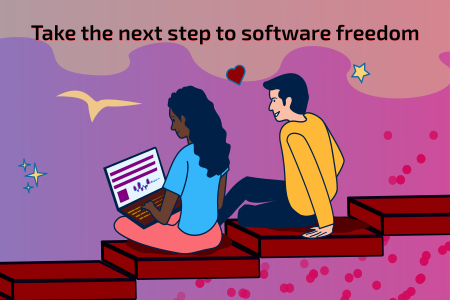
Free software can only be a sustainable idea if we are continuously bringing new people into the free software community. For a freer future, we need to guarantee that free software continues to be developed, that interest in it continues to grow, and that activism for its use spreads. Since most people are not taught to be aware of the technological tools that are so deeply integrated into their lives, the idea of software freedom is not one that is typically as valued as it should be, and as it would be if people understood the snowball effect that software freedom can have on our day to day lives. Software is the language of the world we live in, but unlike learning how to read, which is considered a priority in life, it is not something that is taught at a general level. Rather, the understanding of software is reserved for the "highly specialized."
With this campaign, we want to have supportive conversations about the challenges this lack of technical knowledge poses to bringing new people into the fold, and we want to accommodate the fact that most people do not step into full software freedom in the span of a single day. It takes one step at a time. And like every other climb in life, we want to help people to appreciate where they find themselves, as much as their destination.

»
-

- Login or register to post comments
 Printer-friendly version
- 3138 reads
 PDF version
More in Tux Machines
- Highlights
- Front Page
- Latest Headlines
- Archive
- Recent comments
- All-Time Popular Stories
- Hot Topics
- New Members
digiKam 7.7.0 is released
After three months of active maintenance and another bug triage, the digiKam team is proud to present version 7.7.0 of its open source digital photo manager. See below the list of most important features coming with this release.
|
Dilution and Misuse of the "Linux" Brand
|
Samsung, Red Hat to Work on Linux Drivers for Future Tech
The metaverse is expected to uproot system design as we know it, and Samsung is one of many hardware vendors re-imagining data center infrastructure in preparation for a parallel 3D world.
Samsung is working on new memory technologies that provide faster bandwidth inside hardware for data to travel between CPUs, storage and other computing resources. The company also announced it was partnering with Red Hat to ensure these technologies have Linux compatibility.
|
today's howtos
|


 Content (where original) is available under CC-BY-SA, copyrighted by original author/s.



Recent comments
1 year 11 weeks ago
1 year 11 weeks ago
1 year 11 weeks ago
1 year 11 weeks ago
1 year 11 weeks ago
1 year 11 weeks ago
1 year 11 weeks ago
1 year 11 weeks ago
1 year 11 weeks ago
1 year 11 weeks ago