



Extreme Overclocker Takes Raspberry Pi to 3 GHz
Submitted by Roy Schestowitz on Friday 15th of October 2021 12:29:20 PM
Filed under 


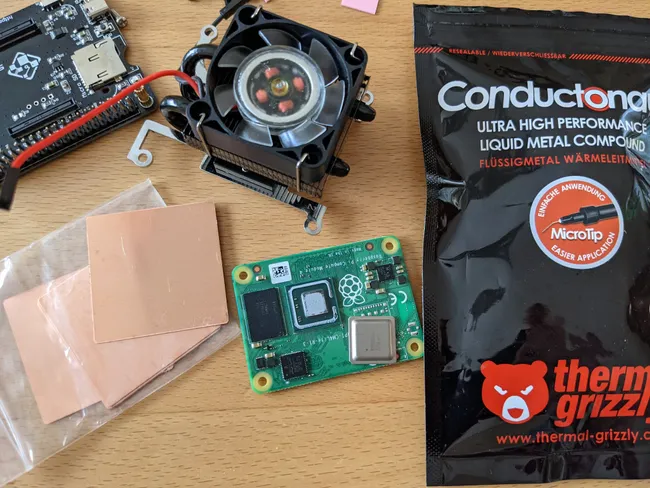
Some people will do anything for a speed boost, prying the lids off expensive i9s and subjecting them to all manner of chilly chemical concoctions to drag every last megahertz out of the silicon. We’ve not seen anybody do such an extreme overclock with a Raspberry Pi before, but there's a first time for everything. Claude Schwarz has overclocked his Raspberry Pi Compute Module 4 to an extraordinary 3 GHz.
[...]
Schwarz's earlier efforts saw him overclock the Compute Module 4 to 2.89 GHz, still an extreme speed boost over the stock 1.5 GHz. As well as using liquid metal thermal paste, Schwarz used active cooling on the Compute Module 4 in the form of a heatsink and fan designed for the Raspberry Pi (which could be a 52Pi model cooler). Taking the steps to overclock even further Schwarz disabled power management features to unlock a higher overclock, resulting in much higher CPU speeds than we can achieve with a typical overclock. We should probably say at this point that anyone doing this is on their own, as these extreme actions will definitely void your warranty, and we take no responsibility for whatever happens if you try it.
A little more fumbling in the Pi’s firmware - what Schwarz refers to as “removing all safety nets” - and the CM4 is running at an impressive 2.4GHz at 26.2°C (79.16°F). Not bad for a board that started life at 1.5GHz and didn’t require cooling.

»
-

- Login or register to post comments
 Printer-friendly version
- 3954 reads
 PDF version
More in Tux Machines
- Highlights
- Front Page
- Latest Headlines
- Archive
- Recent comments
- All-Time Popular Stories
- Hot Topics
- New Members
digiKam 7.7.0 is released
After three months of active maintenance and another bug triage, the digiKam team is proud to present version 7.7.0 of its open source digital photo manager. See below the list of most important features coming with this release.
|
Dilution and Misuse of the "Linux" Brand
|
Samsung, Red Hat to Work on Linux Drivers for Future Tech
The metaverse is expected to uproot system design as we know it, and Samsung is one of many hardware vendors re-imagining data center infrastructure in preparation for a parallel 3D world.
Samsung is working on new memory technologies that provide faster bandwidth inside hardware for data to travel between CPUs, storage and other computing resources. The company also announced it was partnering with Red Hat to ensure these technologies have Linux compatibility.
|
today's howtos
|


.svg_.png)

 Content (where original) is available under CC-BY-SA, copyrighted by original author/s.


Recent comments
1 year 11 weeks ago
1 year 11 weeks ago
1 year 11 weeks ago
1 year 11 weeks ago
1 year 11 weeks ago
1 year 11 weeks ago
1 year 11 weeks ago
1 year 11 weeks ago
1 year 11 weeks ago
1 year 11 weeks ago