



John Goerzen: Facebook’s Blocking Decisions Are Deliberate – Including Their Censorship of Mastodon
Submitted by Roy Schestowitz on Monday 13th of September 2021 11:14:32 PM
Filed under 
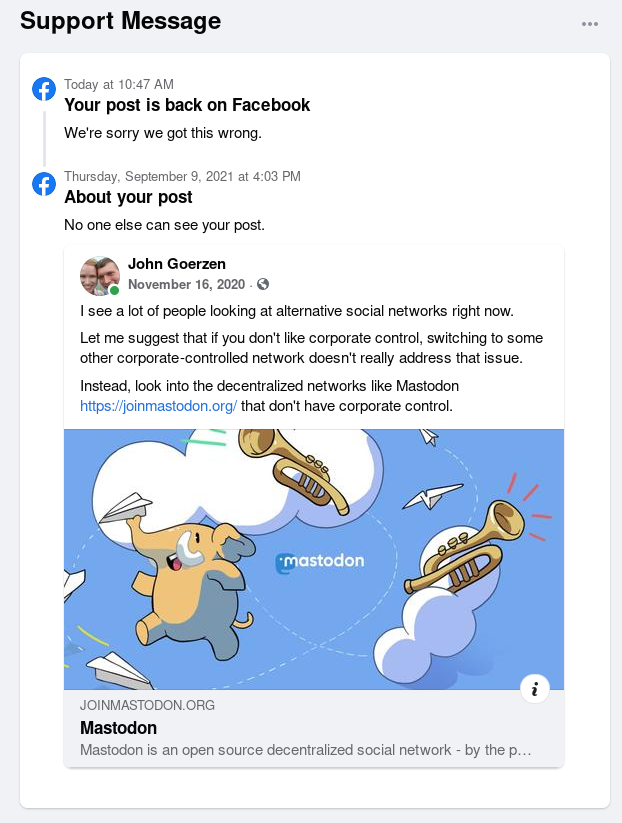
In the aftermath of my report of Facebook censoring mentions of the open-source social network Mastodon, there was a lot of conversation about whether or not this was deliberate.
That conversation seemed to focus on whether a human speficially added joinmastodon.org to some sort of blacklist. But that?s not even relevant.
OF COURSE it was deliberate, because of how Facebook tunes its algorithm.
Facebook?s algorithm is tuned for Facebook?s profit. That means it?s tuned to maximize the time people spend on the site ? engagement. In other words, it is tuned to keep your attention on Facebook.
Why do you think there is so much junk on Facebook? So much anti-vax, anti-science, conspiracy nonsense from the likes of Breitbart? It?s not because their algorithm is incapable of surfacing the good content; we already know it can because they temporarily pivoted it shortly after the last US election. They intentionally undid its efforts to make high-quality news sources more prominent ? twice.
Facebook has said that certain anti-vax disinformation posts violate its policies. It has an extremely cumbersome way to report them, but it can be done and I have. These reports are met with either silence or a response claiming the content didn?t violate their guidelines.

»
-

- Login or register to post comments
 Printer-friendly version
- 1790 reads
 PDF version
More in Tux Machines
- Highlights
- Front Page
- Latest Headlines
- Archive
- Recent comments
- All-Time Popular Stories
- Hot Topics
- New Members
digiKam 7.7.0 is released
After three months of active maintenance and another bug triage, the digiKam team is proud to present version 7.7.0 of its open source digital photo manager. See below the list of most important features coming with this release.
|
Dilution and Misuse of the "Linux" Brand
|
Samsung, Red Hat to Work on Linux Drivers for Future Tech
The metaverse is expected to uproot system design as we know it, and Samsung is one of many hardware vendors re-imagining data center infrastructure in preparation for a parallel 3D world.
Samsung is working on new memory technologies that provide faster bandwidth inside hardware for data to travel between CPUs, storage and other computing resources. The company also announced it was partnering with Red Hat to ensure these technologies have Linux compatibility.
|
today's howtos
|


.svg_.png)

 Content (where original) is available under CC-BY-SA, copyrighted by original author/s.


Recent comments
1 year 11 weeks ago
1 year 11 weeks ago
1 year 11 weeks ago
1 year 11 weeks ago
1 year 11 weeks ago
1 year 11 weeks ago
1 year 11 weeks ago
1 year 11 weeks ago
1 year 11 weeks ago
1 year 11 weeks ago