



Leftovers: GNOME, KDE, Debian, LibreOffice, Programming, BIOS Wizard
Submitted by Roy Schestowitz on Wednesday 25th of August 2021 07:51:05 PM
Filed under 
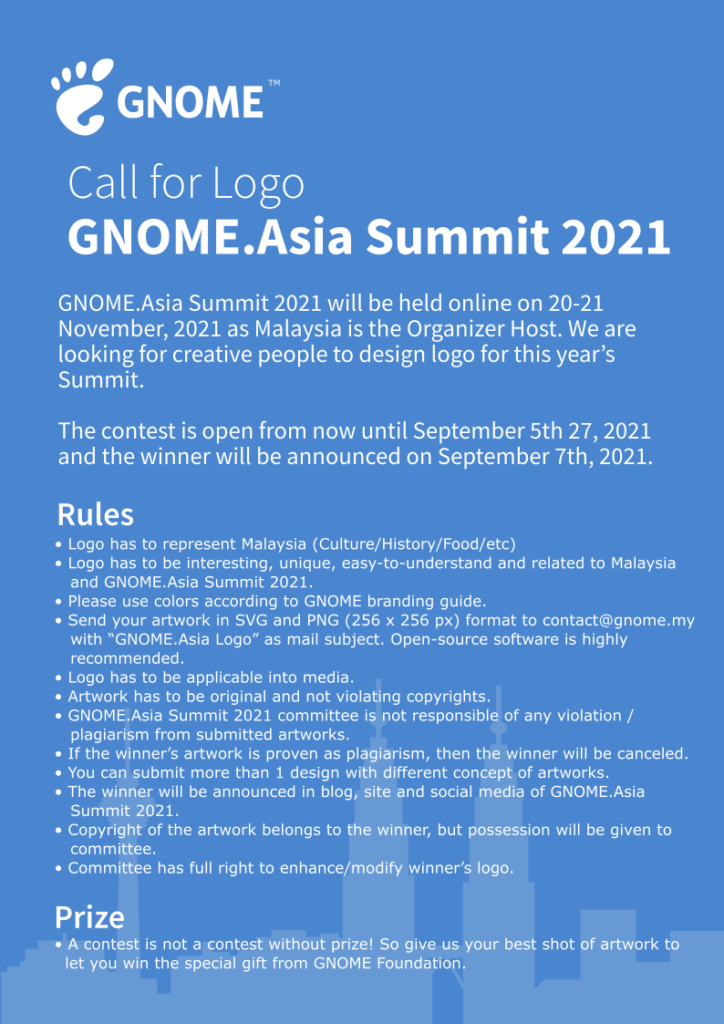
-
Call for Logo of GNOME.Asia Summit 202
-
Closing doors: MBition – toscalix
I started my involvement focusing my activity in Open Source topics and, when senior talent was hired in this field, I incrementally focused on the infotainment platform, as part of the CEO Office. In the meantime I went from being hired by MBition directly (Berlin part-time) to work fully remotely from Spain (Daimler Group Services Madrid), becoming the front-line of a set up that is being consolidated nowadays, not just in Spain, but in other countries too, providing the company a path to become a global remote-friendly organization.
I am specially proud of the relation built by MBition with KDE, as example of the mutual benefit that Open Source communities and companies can enjoy when the company, in this case MBition, do the homework and take the right steps to build a sustainable relation. It sets a great example for MBition on how to build similar kind of relations with other communities and, at the same time, it brings a very interesting player to the KDE ecosystem, willing to use the technologies developed in the open into their vehicles.
-
Chris Lamb & Debian Outreachy interns, favoritism perceptions
The Outreachy candidate is seated next to Chris Lamb at the DebConf19 dinner in Brazil. Despite the large expense of a long-haul flight from Europe to Brazil, the woman is not listed as a speaker. Notice the big gap between the two women: the Outreachy appears to be sitting closer to Lamb and has to lean away from him to speak to the other woman.
-
Raphaël Hertzog: Freexian’s report about Debian Long Term Support, July 2021
In July, we put aside 2400 EUR to fund Debian projects. We haven’t received proposals of projects to fund in the last months, so we have scheduled a discussion during Debconf to try to to figure out why that is and how we can fix that. Join us on August 26th at 16:00 UTC on this link.
We are pleased to announce that Jeremiah Foster will help out to make this initiative a success : he can help Debian members to come up with solid proposals, he can look for people willing to do the work once the project has been formalized and approved, and he will make sure that the project implementation keeps on track when the actual work has begun.
-
allotropia and Collabora announce partnership
allotropia provides innovative open source solutions for the digital collaboration age. Our customers value sovereignty over their data, and love the way Open Source software enables them to innovate with agency. Adding Collabora Online to our portfolio is the ideal addition, with highly compatible migration paths into hybrid and fully web-based product development.
Collabora Online is the powerful LibreOffice-based online office that supports all major documents, spreadsheets and presentation file formats, which can all be easily integrated in many infrastructures and solutions. Key features are collaborative editing and excellent office file formatting support. Collabora Online is excellent for enterprises that need a powerful office suite in the Cloud, or on-premises, that protects their privacy and allows them to keep full control of their sensitive corporate data. Collabora Online enables Hosting and Cloud businesses to include document viewing and collaborative editing functionality into their service offerings.
-
Skia on Mac
So, current LibreOffice git version now has support for drawing based on Skia also for the Mac. Both Raster and Metal (the Mac GPU framework). Below is the obligatory screenshot, and here is the hey-it-can-be-faster video.
-
Object::Pad Yuki Kimoto's 2021-08-25 - Default internal data structure of the object
This time is default internal data structure of the object.
Default internal data structure of the Object::Pad is hash reference. It feels good for me.
-
BIOS configuration tool adds new features and support for Linux
Advantech has added many key features to BIOS Wizard, the rapid custom BIOS configuration tool exclusively produced for its embedded hardware platforms. Now supporting Linux and Microsoft Windows, the latest version, BIOS Wizard 2.0, offers extra features that provide users even more control over their systems' startup behaviour.
These new features incorporate the capability to configure the boot order according to particular use cases, as well as the possibility to customise the sign-on message, enabling easy identification and tracking of customised BIOS versions.
The tool has greatly improved parsing compatibility for multiple UEFI based images, supporting many extra company products, including older generations.
»
-

- Login or register to post comments
 Printer-friendly version
- 2211 reads
 PDF version
More in Tux Machines
- Highlights
- Front Page
- Latest Headlines
- Archive
- Recent comments
- All-Time Popular Stories
- Hot Topics
- New Members
digiKam 7.7.0 is released
After three months of active maintenance and another bug triage, the digiKam team is proud to present version 7.7.0 of its open source digital photo manager. See below the list of most important features coming with this release.
|
Dilution and Misuse of the "Linux" Brand
|
Samsung, Red Hat to Work on Linux Drivers for Future Tech
The metaverse is expected to uproot system design as we know it, and Samsung is one of many hardware vendors re-imagining data center infrastructure in preparation for a parallel 3D world.
Samsung is working on new memory technologies that provide faster bandwidth inside hardware for data to travel between CPUs, storage and other computing resources. The company also announced it was partnering with Red Hat to ensure these technologies have Linux compatibility.
|
today's howtos
|


.svg_.png)

 Content (where original) is available under CC-BY-SA, copyrighted by original author/s.


Recent comments
1 year 11 weeks ago
1 year 11 weeks ago
1 year 11 weeks ago
1 year 11 weeks ago
1 year 11 weeks ago
1 year 11 weeks ago
1 year 11 weeks ago
1 year 11 weeks ago
1 year 11 weeks ago
1 year 11 weeks ago