



postmarketOS Release: v21.06
Submitted by Roy Schestowitz on Sunday 4th of July 2021 08:56:57 PM
Filed under 

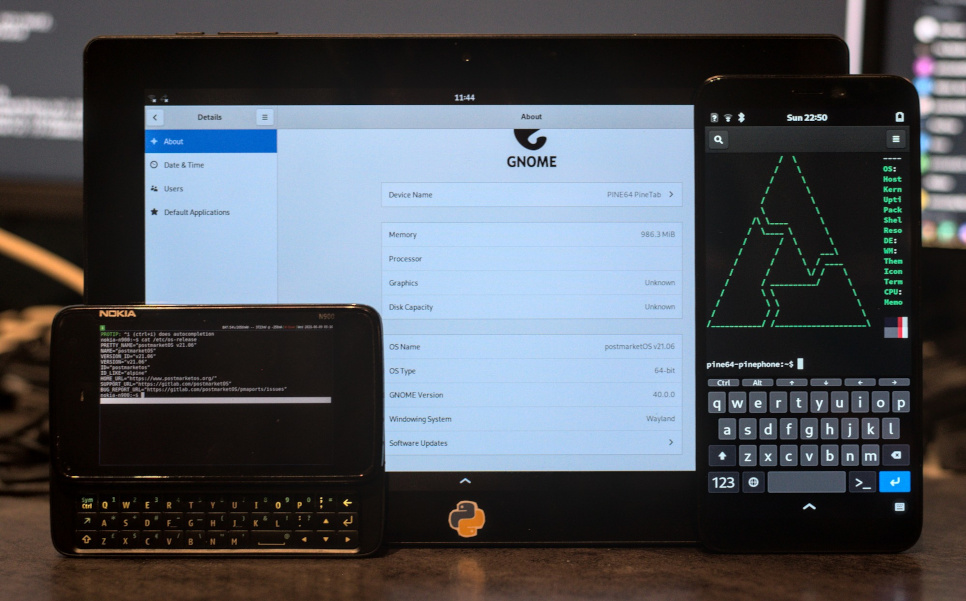
We are happy to announce the v21.06 release of postmarketOS, based on Alpine Linux 3.14! If you're wondering why it happened three months after the last release already, the reason is that we managed to follow Alpine's release more closely this time. Instead of two and a half months after Alpine's release, it took us only half a month to get this one out. Following releases can be expected about each six months from now on, closely tracking Alpine's releases.
Thanks to our amazing contributors, the amount of supported devices has been increased to 15 (from 11 in v21.03.). As in previous releases, each of the supported devices (with the exception of the N900) is able to run mobile-optimized UIs like Phosh, Plasma Mobile, and Sxmo. Pre-built images for these devices, which all run (close to) mainline kernels, can be downloaded from our shiny new image download page (but really you should start at download and read the instructions there first).
Also, like previous releases, v21.06 is geared mainly towards Linux enthusiasts; it may be a bit rough around the edges so expect some bugs. Help identifying and resolving issues is always greatly appreciated.

»
-

- Login or register to post comments
 Printer-friendly version
- 2496 reads
 PDF version
More in Tux Machines
- Highlights
- Front Page
- Latest Headlines
- Archive
- Recent comments
- All-Time Popular Stories
- Hot Topics
- New Members
digiKam 7.7.0 is released
After three months of active maintenance and another bug triage, the digiKam team is proud to present version 7.7.0 of its open source digital photo manager. See below the list of most important features coming with this release.
|
Dilution and Misuse of the "Linux" Brand
|
Samsung, Red Hat to Work on Linux Drivers for Future Tech
The metaverse is expected to uproot system design as we know it, and Samsung is one of many hardware vendors re-imagining data center infrastructure in preparation for a parallel 3D world.
Samsung is working on new memory technologies that provide faster bandwidth inside hardware for data to travel between CPUs, storage and other computing resources. The company also announced it was partnering with Red Hat to ensure these technologies have Linux compatibility.
|
today's howtos
|


.svg_.png)

 Content (where original) is available under CC-BY-SA, copyrighted by original author/s.


Recent comments
1 year 11 weeks ago
1 year 11 weeks ago
1 year 11 weeks ago
1 year 11 weeks ago
1 year 11 weeks ago
1 year 11 weeks ago
1 year 11 weeks ago
1 year 11 weeks ago
1 year 11 weeks ago
1 year 11 weeks ago