



Kai A. Hiller: Search Bar of Doom
Submitted by Roy Schestowitz on Wednesday 30th of June 2021 02:24:58 AM
Filed under 
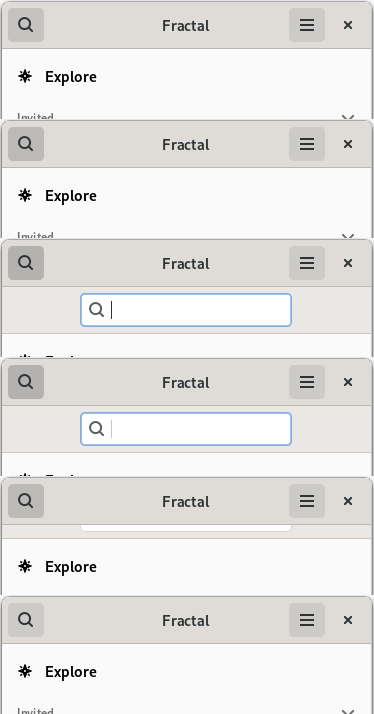
It started benign, it was labeled Newcomers, it felt like a good start into the Fractal NEXT codebase: Make Ctrl+K toggle the room search bar… I was so naive!
This first issue took me days. It was a task where the high-level idea is very easy, but the concrete idiomatic and robust solution is non-obvious. What followed was a lot of reading and learning of the concepts and the concrete application of general GTK4, its UI Builder, shortcut handling, GActions and GObject bindings.
[...]
I spent the next days learning more about the GTK4 and Adwaita widgets, as well as the inner workings of the Fractal NEXT codebase, toying around with some code.
Based on the room setting design of our trusted GNOME designer Tobias, I started working on turning the pictures into something interactive. For the design I wanted to stay close to the libadwaita widgets and their intended use, so that it gives GNOME users a consistent experience and we can get all the shiny features like searchable preferences for free. The result does in some aspects deviate from the draft, e.g. the members overview got its own tab, but the overall reaction from the community to it was positive. I expect we will go through some iterations before the room settings UI is actually finished – after all: nothing will break your code faster than getting it into the hands of actual users..

»
-

- Login or register to post comments
 Printer-friendly version
- 2237 reads
 PDF version
More in Tux Machines
- Highlights
- Front Page
- Latest Headlines
- Archive
- Recent comments
- All-Time Popular Stories
- Hot Topics
- New Members
digiKam 7.7.0 is released
After three months of active maintenance and another bug triage, the digiKam team is proud to present version 7.7.0 of its open source digital photo manager. See below the list of most important features coming with this release.
|
Dilution and Misuse of the "Linux" Brand
|
Samsung, Red Hat to Work on Linux Drivers for Future Tech
The metaverse is expected to uproot system design as we know it, and Samsung is one of many hardware vendors re-imagining data center infrastructure in preparation for a parallel 3D world.
Samsung is working on new memory technologies that provide faster bandwidth inside hardware for data to travel between CPUs, storage and other computing resources. The company also announced it was partnering with Red Hat to ensure these technologies have Linux compatibility.
|
today's howtos
|


.svg_.png)

 Content (where original) is available under CC-BY-SA, copyrighted by original author/s.


Recent comments
1 year 11 weeks ago
1 year 11 weeks ago
1 year 11 weeks ago
1 year 11 weeks ago
1 year 11 weeks ago
1 year 11 weeks ago
1 year 11 weeks ago
1 year 11 weeks ago
1 year 11 weeks ago
1 year 11 weeks ago