



Open source cache as ram with Intel Bootguard
Submitted by Roy Schestowitz on Friday 25th of June 2021 05:31:49 PM
Filed under 

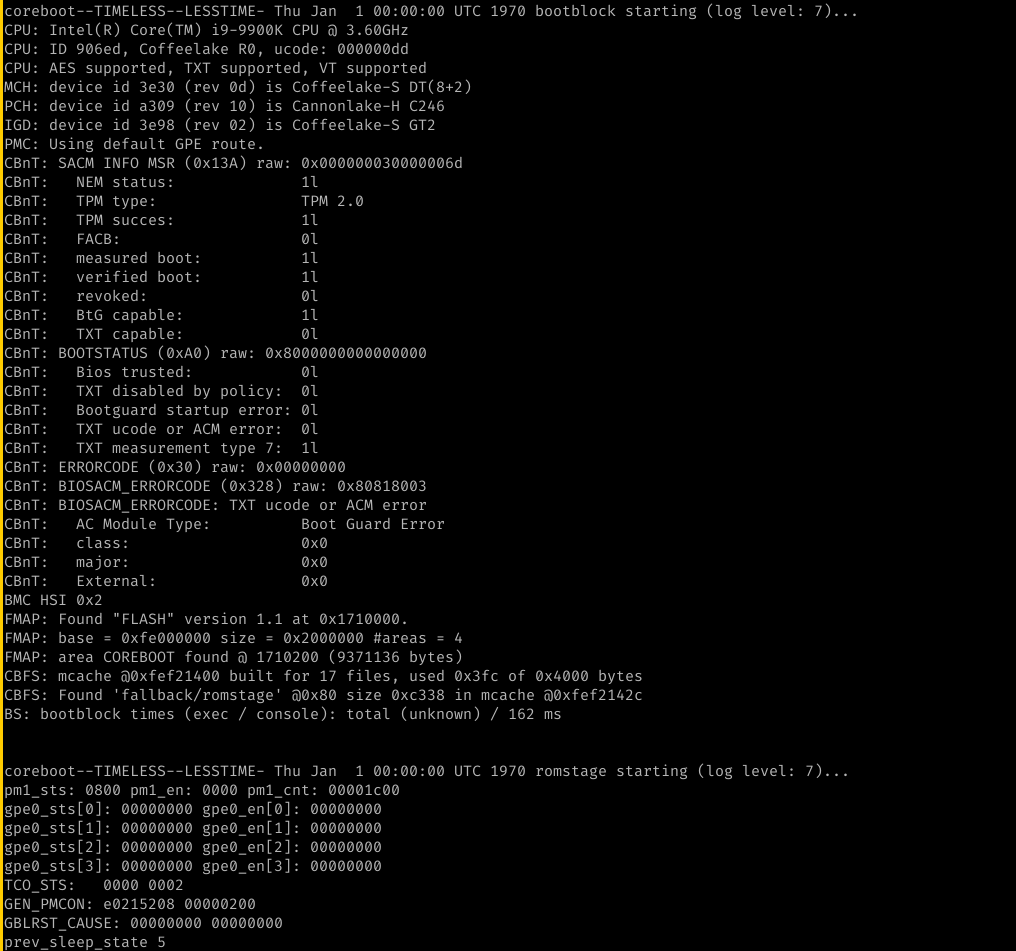
In coreboot the open source implementation is the most used one. For instance all Google chromeos platforms use it, so it's well tested. FSP is a propriatary binary provided by Intel that can be split up into 3 components: FSP-T (which is in charge of setting up the early execution environment), FSP-M (which configures the DRAM controller), FSP-S (further silicon init). With the FSP codepath in coreboot you call into FSP-T using the TempRamInit API to set up the early execution environment in which you can execute C code later on. This binary sets up CAR just like coreboot does, but also does some initial hardware initialisation like setting up PCIe memory mapped configuration space. On most platforms coreboot is fully able to do that early hardware init itself, so that extra initialisation in FSP-T is superfluous. After DRAM has been initialised, you want to tear down the CAR environment to start executing code in actual DRAM. Coreboot can do that using open source code. It's typically just a few lines of assembly code to disable the non-eviction mode that CPU is running in. The other option is to call FSP-M with the TempRamExit API. See FSP v2.0 spec for more information on TempRamInit and TempRamExit . Sidenote: running FSP-T TempRamInit does not necessarily mean you need to run TempRamExit, as it is possible to just reuse the simple coreboot code. This is done on some platforms to avoid problems with TempRamExit. It's generally a very bad idea to give up control of setting up the execution environment to external code. The most important technical reason to not do this, is because coreboot needs to be in control of the caching setup. When that is not the case you encounter all kinds of problems because that assumption is really baked in to many parts of the code. Coreboot has different stages: bootblock, romstage, ramstage and those are actually all separate programs that have their well defined execution environment. If a blob or reference code sets up or changes the execution environment, it makes proper integration much harder. Before Intel started integrating FSP into coreboot, AMD had a go at integrating their reference code, called AGESA into coreboot. Even though AGESA was not provided as blob but as open source code, it had very similar integration issues, for exactly this reason: it messed with the execution environment. As a matter of fact, Intel FSP v1.0 messed up the execution environment so badly that it was deemed fatally flawed. Support for FSP v1.0 was subsequently dropped from the coreboot master branch. So for technical reasons you want to avoid using FSP-T inside coreboot at all costs. From a marketting perspective FSP-T is also a disaster. You really cannot call coreboot an open source firmware project if even setting up the execution environment is delegated to a blob.

»
-

- Login or register to post comments
 Printer-friendly version
- 5980 reads
 PDF version
More in Tux Machines
- Highlights
- Front Page
- Latest Headlines
- Archive
- Recent comments
- All-Time Popular Stories
- Hot Topics
- New Members
digiKam 7.7.0 is released
After three months of active maintenance and another bug triage, the digiKam team is proud to present version 7.7.0 of its open source digital photo manager. See below the list of most important features coming with this release.
|
Dilution and Misuse of the "Linux" Brand
|
Samsung, Red Hat to Work on Linux Drivers for Future Tech
The metaverse is expected to uproot system design as we know it, and Samsung is one of many hardware vendors re-imagining data center infrastructure in preparation for a parallel 3D world.
Samsung is working on new memory technologies that provide faster bandwidth inside hardware for data to travel between CPUs, storage and other computing resources. The company also announced it was partnering with Red Hat to ensure these technologies have Linux compatibility.
|
today's howtos
|


.svg_.png)

 Content (where original) is available under CC-BY-SA, copyrighted by original author/s.


Coreboot Is Ridding Its Need For Intel's FSP-T Blob
Coreboot Is Ridding Its Need For Intel's FSP-T Blob