



Alyssa Rosenzweig: Dissecting the Apple M1 GPU, part IV
Submitted by Roy Schestowitz on Sunday 2nd of May 2021 10:24:33 PM
Filed under 
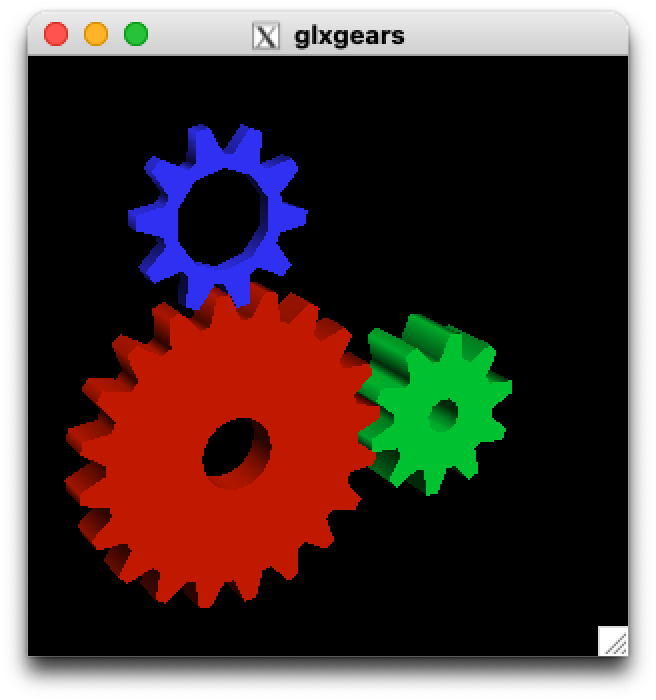
After beginning a compiler for the Apple M1 GPU, the next step is to develop a graphics driver exercising the compiler. Since the last post two weeks ago, I’ve begun a Gallium driver for the M1, implementing much of the OpenGL 2.1 and ES 2.0 specifications. With the compiler and driver together, we’re now able to run OpenGL workloads like glxgears and scenes from glmark2 on the M1 with an open source stack. We are passing about 75% of the OpenGL ES 2.0 tests in the drawElements Quality Program used to establish Khronos conformance. To top it off, the compiler and driver are now being upstreamed in Mesa!
Gallium is a driver framework inside Mesa. It splits drivers into frontends, like OpenGL and OpenCL, and backends, like Intel and AMD. In between, Gallium has a common caching system for graphics and compute state, reducing the CPU overhead of every Gallium driver. The code sharing, central to Gallium’s design, allows high-performance drivers to be written at a low cost. For us, that means we can focus on writing a Gallium backend for Apple’s GPU and pick up OpenGL and OpenCL support “for free”.
More sharing is possible. A key responsibility of the Gallium backend is to translate Gallium’s state objects into hardware packets, so we need a good representation of hardware packets. While packed bitfields can work, C’s bitfields have performance and safety (overflow) concerns. Hand-coded C structures lack pretty-printing needed for efficient debugging. Finally, while reverse-engineering, hand-coded C structures tend to accumulate random magic numbers in driver code, which is undesirable. These issues are not new; systems like Intel’s GenXML and Nouveau’s envytools solve them by allowing the hardware packets to be described as XML while all necessary C code is auto-generated. For Asahi, I’ve opted to use GenXML, providing a concise description of my reverse-engineering results and an ergonomic API for the driver.

Also: New, Updated Benchmarks For April From WRF To Chia + Xmrig
»
-

- Login or register to post comments
 Printer-friendly version
- 5057 reads
 PDF version
More in Tux Machines
- Highlights
- Front Page
- Latest Headlines
- Archive
- Recent comments
- All-Time Popular Stories
- Hot Topics
- New Members
digiKam 7.7.0 is released
After three months of active maintenance and another bug triage, the digiKam team is proud to present version 7.7.0 of its open source digital photo manager. See below the list of most important features coming with this release.
|
Dilution and Misuse of the "Linux" Brand
|
Samsung, Red Hat to Work on Linux Drivers for Future Tech
The metaverse is expected to uproot system design as we know it, and Samsung is one of many hardware vendors re-imagining data center infrastructure in preparation for a parallel 3D world.
Samsung is working on new memory technologies that provide faster bandwidth inside hardware for data to travel between CPUs, storage and other computing resources. The company also announced it was partnering with Red Hat to ensure these technologies have Linux compatibility.
|
today's howtos
|


 Content (where original) is available under CC-BY-SA, copyrighted by original author/s.



Early Gallium3D Work Has Begun Around Apple's M1 GPU With New...
Early Gallium3D Work Has Begun Around Apple's M1 GPU With New "AGX" Driver