Language Selection

English French German Italian Portuguese Spanish

Kernel and Linux Foundation: Torvalds, stress-ng, Microsoft/Openwashing19 Foundation, TARS Foundation

Filed under
Linux

  • Linus Torvalds tears into Intel, favors AMD

    After 15 years of using Intel-based processors for his Linux-building powerhouse computers, Linus Torvalds switched to an AMD Threadripper 3970x-based  "frankenbox" for building the world's most important operating system, Linux. Now, months later, Torvalds is glad of the move and wrote that he's "very happy with AMD these days."

  •  

  • Colin King: Improving kernel test coverage with stress-ng

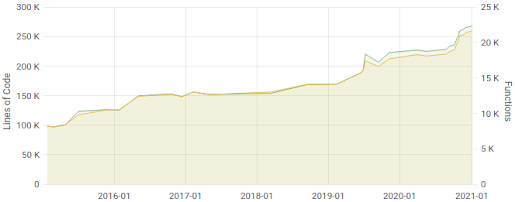
    Over the past year there has been focused work on improving the test coverage of the Linux Kernel with stress-ng.  Increased test coverage exercises more kernel code and hence improves the breadth of testing, allowing us to be more confident that more corner cases are being handled correctly.

    [...]

    Each stress-ng release is run with various stressor options against the latest kernel (built with gcov enabled).  The gcov data is processed with lcov to produce human readable kernel source code containing coverage annotations to help inform where to add more test coverage for the next release cycle of stress-ng.  

    Linux Foundation sponsored Piyush Goyal for 3 months to add test cases that exercise system call test failure paths and I appreciate this help in improving stress-ng. I finally completed this tedious task at the end of 2020 with the release of stress-ng 0.12.00.

    Below is a chart showing how the kernel coverage generated by stress-ng has been increasing since 2015. The amber line shows lines of code exercised and the green line shows kernel functions exercised.

  • Linux Foundation Gobbles Open19, Adds Cisco

    The Open19 Foundation — an open data center hardware initiative founded in 2016 by LinkedIn, Hewlett Packard Enterprise (HPE), and VaporIO — is now a Linux Foundation project. It officially made the move on Jan. 1, after Open19 added Cisco as a board member late last year.

  • eBook: Common Open Source Practices in Developing Cloud Native Applications

    The TARS Foundation has recently released a new eBook, Common Open Source Practices in Developing Cloud-Native Applications.

More on Torvalds

  • Linux creator isn't happy with Intel, here's why

    “I'm personally very happy with AMD these days. I used to absolutely despise their horrible bulldozer cores, but I think they've had a home run with their Ryzen series and their chiplet approach. Not just because they fixed their cores, but because their chiplets made it so much easier to do the scaling they do and offer close to that "twice the cores for twice the price" model,” wrote Torvalds in a forum post by Real World Technologies.

  • Linus Torvalds, creator of Linux, calls out Intel on the importance of ECC RAM in the consumer market space

    According to Linus, Intel blocked the widespread use of error-correcting memory and “killed the entire ECC industry” with bad market segmentation. He responded in the Forums after another poster dismissed the importance of ECC memory.

    ECC is an abbreviation for error correction code. ECC memory uses additional parity bits to ensure that the data read from memory is the same as the data written. Without this check, memory is vulnerable to occasional corruption, where bits spontaneously flip, for example due to background radiation.

Slashdot and Microsoft Tim

  • Linus Torvalds Rails At Intel For 'Killing' the ECC Industry

    Linux creator Linus Torvalds has accused Intel of preventing widespread use of error-correcting memory and being "instrumental in killing the whole ECC industry with its horribly bad market segmentation." ECC stands for error-correcting code. ECC memory uses additional parity bits to verify that the data read from memory is the same as the data that was written. Without this check, memory is vulnerable to occasional corruption where a bit is flipped spontaneously, for example, by background radiation. Memory can also be attacked using a technique called Rowhammer, where rapid repeated reads of the same memory locations can cause adjacent locations to change their state. ECC memory solves these problems and has been available for over 50 years yet most personal computers do not use it. Cost is a factor but what riles Torvalds is that Intel has made ECC support a feature of its Xeon range, aimed at servers and high-end workstations, and does not support it in other ranges such as the Core series.

  • New year, new rant: Linus Torvalds rails at Intel for 'killing' the ECC industry

    Linux creator Linus Torvalds has accused Intel of preventing widespread use of error-correcting memory and being "instrumental in killing the whole ECC industry with its horribly bad market segmentation."

    ECC stands for error-correcting code. ECC memory uses additional parity bits to verify that the data read from memory is the same as the data that was written. Without this check, memory is vulnerable to occasional corruption where a bit is flipped spontaneously, for example, by background radiation. Memory can also be attacked using a technique called Rowhammer, where rapid repeated reads of the same memory locations can cause adjacent locations to change their state.

    ECC memory solves these problems – well, ish, in the case of Rowhammer – and has been available for over 50 years yet most personal computers do not use it. Cost is a factor but what riles Torvalds is that Intel has made ECC support a feature of its Xeon range, aimed at servers and high-end workstations, and does not support it in other ranges such as the Core series.

Linux's Linus Torvalds roasts Intel on lack of ECC memory (RAM)

  • Linux's Linus Torvalds roasts Intel on lack of ECC memory (RAM) support

    We’re in a new year, which means there’s equally a lot of new technology to look forward to at the upcoming CES 2021 digital event. Companies tend to shift the focus in new directions at these kinds of events, and Linux founder Linus Torvalds seems more than ready to get the discussion going about ECC memory. While it may still be a little soon for programming wizards to enjoy universally better standards, ECC memory is certainly still worth discussing due to its inclusion in the JEDEC spec for the upcoming DDR5 generation.

    So what is this thing you might ask? Well, in short, ECC memory is a specific kind of system RAM that differs from DRAM in a key way. It features an extra chip on each module which performs automatic error correction checks. If it detects an error in how the data was written, the extra chip is able to correct the error in most cases. It’s great for developers, but currently lacks broad support across the consumer space.

More Microsoft intrusion

Comment viewing options

Select your preferred way to display the comments and click "Save settings" to activate your changes.

More in Tux Machines

digiKam 7.7.0 is released

After three months of active maintenance and another bug triage, the digiKam team is proud to present version 7.7.0 of its open source digital photo manager. See below the list of most important features coming with this release. Read more

Dilution and Misuse of the "Linux" Brand

Samsung, Red Hat to Work on Linux Drivers for Future Tech

The metaverse is expected to uproot system design as we know it, and Samsung is one of many hardware vendors re-imagining data center infrastructure in preparation for a parallel 3D world. Samsung is working on new memory technologies that provide faster bandwidth inside hardware for data to travel between CPUs, storage and other computing resources. The company also announced it was partnering with Red Hat to ensure these technologies have Linux compatibility. Read more

today's howtos

  • How to install go1.19beta on Ubuntu 22.04 – NextGenTips

    In this tutorial, we are going to explore how to install go on Ubuntu 22.04 Golang is an open-source programming language that is easy to learn and use. It is built-in concurrency and has a robust standard library. It is reliable, builds fast, and efficient software that scales fast. Its concurrency mechanisms make it easy to write programs that get the most out of multicore and networked machines, while its novel-type systems enable flexible and modular program constructions. Go compiles quickly to machine code and has the convenience of garbage collection and the power of run-time reflection. In this guide, we are going to learn how to install golang 1.19beta on Ubuntu 22.04. Go 1.19beta1 is not yet released. There is so much work in progress with all the documentation.

  • molecule test: failed to connect to bus in systemd container - openQA bites

    Ansible Molecule is a project to help you test your ansible roles. I’m using molecule for automatically testing the ansible roles of geekoops.

  • How To Install MongoDB on AlmaLinux 9 - idroot

    In this tutorial, we will show you how to install MongoDB on AlmaLinux 9. For those of you who didn’t know, MongoDB is a high-performance, highly scalable document-oriented NoSQL database. Unlike in SQL databases where data is stored in rows and columns inside tables, in MongoDB, data is structured in JSON-like format inside records which are referred to as documents. The open-source attribute of MongoDB as a database software makes it an ideal candidate for almost any database-related project. This article assumes you have at least basic knowledge of Linux, know how to use the shell, and most importantly, you host your site on your own VPS. The installation is quite simple and assumes you are running in the root account, if not you may need to add ‘sudo‘ to the commands to get root privileges. I will show you the step-by-step installation of the MongoDB NoSQL database on AlmaLinux 9. You can follow the same instructions for CentOS and Rocky Linux.

  • An introduction (and how-to) to Plugin Loader for the Steam Deck. - Invidious
  • Self-host a Ghost Blog With Traefik

    Ghost is a very popular open-source content management system. Started as an alternative to WordPress and it went on to become an alternative to Substack by focusing on membership and newsletter. The creators of Ghost offer managed Pro hosting but it may not fit everyone's budget. Alternatively, you can self-host it on your own cloud servers. On Linux handbook, we already have a guide on deploying Ghost with Docker in a reverse proxy setup. Instead of Ngnix reverse proxy, you can also use another software called Traefik with Docker. It is a popular open-source cloud-native application proxy, API Gateway, Edge-router, and more. I use Traefik to secure my websites using an SSL certificate obtained from Let's Encrypt. Once deployed, Traefik can automatically manage your certificates and their renewals. In this tutorial, I'll share the necessary steps for deploying a Ghost blog with Docker and Traefik.