



Accurate Conclusions from Bogus Data: Methodological Issues in “Collaboration in the open-source arena: The WebKit case”
Submitted by Roy Schestowitz on Monday 30th of November 2020 12:07:32 AM
Filed under 
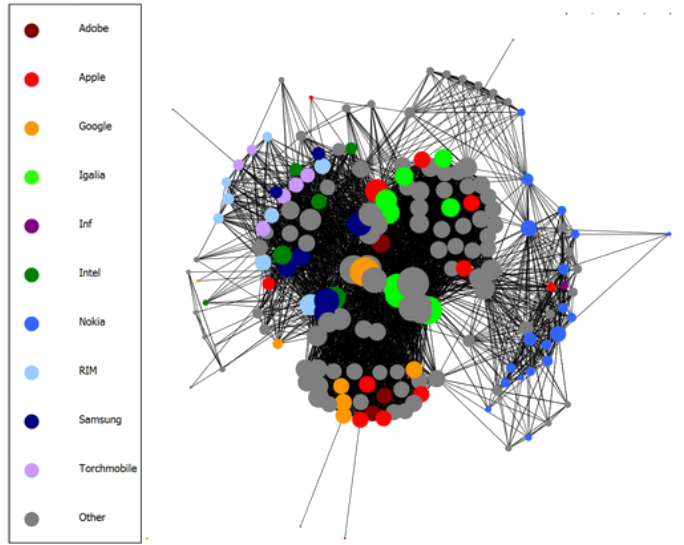
Nearly five years ago, when I was in grad school, I stumbled across the paper Collaboration in the open-source arena: The WebKit case when trying to figure out what I would do for a course project in network theory (i.e. graph theory, not computer networking; I’ll use the words “graph” and “network” interchangeably). The paper evaluates collaboration networks, which are graphs where collaborators are represented by nodes and relationships between collaborators are represented by edges. Our professor had used collaboration networks as examples during lecture, so it seemed at least mildly relevant to our class, and I wound up writing a critique on this paper for the class project. In this paper, the authors construct collaboration networks for WebKit by examining the project’s changelog files to define relationships between developers. They perform “community detection” to visually group developers who work closely together into separate clusters in the graphs. Then, the authors use those graphs to arrive at various conclusions about WebKit (e.g. “[e]ven if Samsung and Apple are involved in expensive patent wars in the courts and stopped collaborating on hardware components, their contributions remained strong and central within the WebKit open source project,” regarding the period from 2008 to 2013).
At the time, I contacted the authors to let them know about some serious problems I found with their work. Then I left the paper sitting in a short-term to-do pile on my desk, where it has been sitting since Obama was president, waiting for me to finally write this blog post. Unfortunately, nearly five years later, the authors’ email addresses no longer work, which is not very surprising after so long — since I’m no longer a student, the email I originally used to contact them doesn’t work anymore either — so I was unable to contact them again to let them know that I was finally going to publish this blog post. Anyway, suffice to say that the conclusions of the paper were all correct; however, the networks used to arrive at those conclusions suffered from three different mistakes, each of which was, on its own, serious enough to invalidate the entire work.
So if the analysis of the networks was bogus, how did the authors arrive at correct conclusions anyway? The answer is confirmation bias. The study was performed by visually looking at networks and then coming to non-rigorous conclusions about the networks, and by researching the WebKit community to learn what is going on with the major companies involved in the project. The authors arrived at correct conclusions because they did a good job at the later, then saw what they wanted to see in the graphs.
I don’t want to be too harsh on the authors of this paper, though, because they decided to publish their raw data and methodology on the internet. They even published the python scripts they used to convert WebKit changelogs into collaboration graphs. Had they not done so, there is no way I would have noticed the third (and most important) mistake that I’ll discuss below, and I wouldn’t have been able to confirm my suspicions about the second mistake. You would not be reading this right now, and likely nobody would ever have realized the problems with the paper. The authors of most scientific papers are not nearly so transparent: many researchers today consider their source code and raw data to be either proprietary secrets to be guarded, or simply not important enough to merit publication. The authors of this paper deserve to be commended, not penalized, for their openness. Mistakes are normal in research papers, and open data is by far the best way for us to be able to detect mistakes when they happen.

»
-

- Login or register to post comments
 Printer-friendly version
- 4111 reads
 PDF version
More in Tux Machines
- Highlights
- Front Page
- Latest Headlines
- Archive
- Recent comments
- All-Time Popular Stories
- Hot Topics
- New Members
digiKam 7.7.0 is released
After three months of active maintenance and another bug triage, the digiKam team is proud to present version 7.7.0 of its open source digital photo manager. See below the list of most important features coming with this release.
|
Dilution and Misuse of the "Linux" Brand
|
Samsung, Red Hat to Work on Linux Drivers for Future Tech
The metaverse is expected to uproot system design as we know it, and Samsung is one of many hardware vendors re-imagining data center infrastructure in preparation for a parallel 3D world.
Samsung is working on new memory technologies that provide faster bandwidth inside hardware for data to travel between CPUs, storage and other computing resources. The company also announced it was partnering with Red Hat to ensure these technologies have Linux compatibility.
|
today's howtos
|


.svg_.png)

 Content (where original) is available under CC-BY-SA, copyrighted by original author/s.


Recent comments
1 year 11 weeks ago
1 year 11 weeks ago
1 year 11 weeks ago
1 year 11 weeks ago
1 year 11 weeks ago
1 year 11 weeks ago
1 year 11 weeks ago
1 year 11 weeks ago
1 year 11 weeks ago
1 year 11 weeks ago