



Linux Foundation: Buzzwords, Courses and Zoom
Submitted by Roy Schestowitz on Wednesday 11th of November 2020 04:22:54 PM
Filed under 
-
AMD + IBM Team Up To Tackle Confidential Computing [Ed: There’s also that BS and misnomer called Confidential Computing and like clown computing it boils down to surveillance being spun as “private” and “secure”… the very opposite of what it really is. “Department of DEFENCE…”]
Researchers from both AMD and IBM will collaborate on hardware-based Confidential Computing to strengthen their presence in the cloud and enhancing artificial intelligence workloads. This makes more inroads for AMD EPYC in the cloud and from IBM's side strengthens their cloud offerings.
The brief press release being sent out notes that the joint development activities under the agreement are now underway. Unfortunately, however, when briefed under embargo they were not able to shed any light yet on what the initial focus is or what are the open-source projects they are looking to improve upon for this Confidential Computing initiative.
-
CNCF Releases Free Training Course Covering Basics of Service Mesh with Linkerd
Introduction to Service Mesh with Linkerd is the newest training course from CNCF and The Linux Foundation. This course, offered on the non-profit edX learning platform, can be audited by anyone at no cost. The course is designed for site reliability engineers, DevOps professionals, cluster administrators, and developers who want to learn more about service mesh and Linkerd, the open source service mesh hosted by CNCF and focused on simplicity, speed, and low resource usage.
-
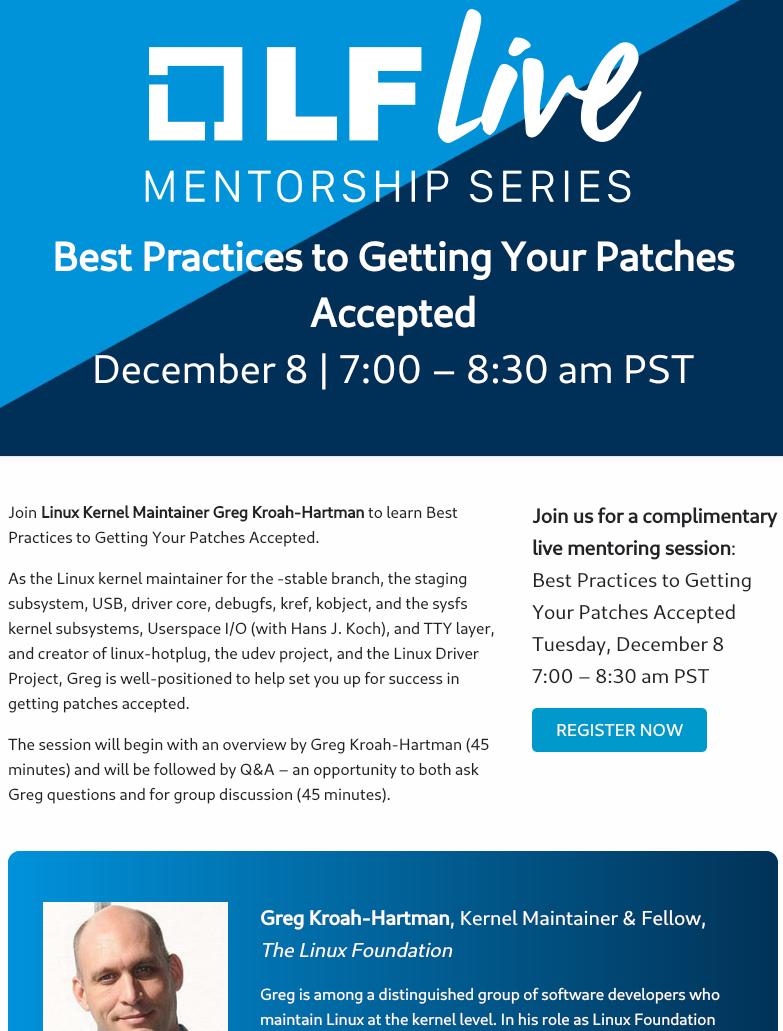
The Linux Foundation Launches LF Live: Mentorship Series
-
The Linux Foundation Launches LF Live: Mentorship Series - The Linux Foundation [Ed: Linux Foundation Outsources Events and ‘LF Live’ to Proprietary Software With Back Doors and Surveillance (Zoom)]
The Linux Foundation, the nonprofit organization enabling mass innovation through open source, is launching a virtual mentoring series entitled LF Live: Mentorship Series. The goal of this program is to (1) continue offering opportunities to learn and re-skill to those that have been displaced from jobs as a result of the COVID-19 pandemic; (2) serve those considering jobs in open source by helping to grow their skills and build their network so they are better set up for successful careers; (3) grow the number of people entering the open source job market which has a huge demand for new talent; and (4) encourage new people to apply to The Linux Foundation’s Mentoring Program and other community mentoring programs. These webinars will be complimentary. There is no cost to participate in this program.
»
-

- Login or register to post comments
 Printer-friendly version
- 4738 reads
 PDF version
More in Tux Machines
- Highlights
- Front Page
- Latest Headlines
- Archive
- Recent comments
- All-Time Popular Stories
- Hot Topics
- New Members
digiKam 7.7.0 is released
After three months of active maintenance and another bug triage, the digiKam team is proud to present version 7.7.0 of its open source digital photo manager. See below the list of most important features coming with this release.
|
Dilution and Misuse of the "Linux" Brand
|
Samsung, Red Hat to Work on Linux Drivers for Future Tech
The metaverse is expected to uproot system design as we know it, and Samsung is one of many hardware vendors re-imagining data center infrastructure in preparation for a parallel 3D world.
Samsung is working on new memory technologies that provide faster bandwidth inside hardware for data to travel between CPUs, storage and other computing resources. The company also announced it was partnering with Red Hat to ensure these technologies have Linux compatibility.
|
today's howtos
|


 Content (where original) is available under CC-BY-SA, copyrighted by original author/s.



Free Linux webinars on development of open-source projects...
Free Linux webinars on development of open-source projects and more