Language Selection

English French German Italian Portuguese Spanish

FSF at 35 -- join us in celebrating the incredible community

Filed under
GNU

Today, on October 4th, the Free Software Foundation (FSF) celebrates its thirty-fifth year of fighting for software freedom. Our work will not be finished until every computer user is able to do all of their digital tasks in complete freedom -- whether that's on a desktop, laptop, or the computer in your pocket. The fight for free software continues, and we wouldn't be here without you.

To celebrate, we have a full week of announcements and surprises planned starting today, and we will end in an online anniversary event featuring both live and prerecorded segments this Friday, October 9th, from 12:00 EDT (16:00 UTC) until 17:00 EDT (21:00 UTC). We'd love for you to join in celebration of this amazing community by submitting a short (two-minute) video sharing your favorite memory about free software or the FSF, and a wish for the future of software freedom. We'll be collecting the videos all week and airing a selection during the birthday event on October 9th. Please follow the instructions linked below on how to successfully (and freely!) submit the video via FTP.

Read more

The FSF's 35th anniversary event

  • The FSF's 35th anniversary event

    Our work will not be finished until every computer user is able to do all of their digital tasks in complete freedom -- whether that's on a desktop, laptop, or the computer in your pocket. The fight for free software continues, and we wouldn't be here without you.

    To celebrate, we have a full week of announcements and surprises planned.

    [...]

    The event will be livestreamed through the fsf.org Web site, and the link will be posted here as soon as the livepage is available.

    Join the conversation, and ask questions to the speakers through IRC on Freenode at #fsf.

The Free Software program Basis Desires You To Have a good time

  • The Free Software program Basis Desires You To Have a good time Its 35th Anniversary

    “At this time, on October 4th, the Free Software program Basis (FSF) celebrates its thirty-fifth 12 months of combating for software program freedom,” proclaims a weblog submit at FSF.org:
    Our work is not going to be completed till each laptop person is ready to do all of their digital duties in full freedom — whether or not that is on a desktop, laptop computer, or the pc in your pocket. The combat without spending a dime software program continues, and we would not be right here with out you.

    To rejoice, now we have a full week of bulletins and surprises deliberate beginning at the moment, and we’ll finish in a web based anniversary occasion that includes each dwell and prerecorded segments this Friday, October ninth, from 12:00 EDT (16:00 UTC) till 17:00 EDT (21:00 UTC). We might love so that you can take part celebration of this superb group by submitting a brief (two-minute) video sharing your favourite reminiscence about free software program or the FSF, and a want for the way forward for software program freedom. We’ll be gathering the movies all week and airing a variety through the birthday occasion on October ninth…

    If you’ll be able to, please make a donation of $35 or extra to assist preserve the combat for person freedom going one other 35 years, we’ll ship you a commemorative pin… We’re one other 12 months older, however that does not imply we’re slowing down our efforts to convey software program freedom to customers across the globe. Keep tuned for extra info on how we plan to ring within the FSF’s subsequent 12 months, and the very important position every one in every of us performs in making certain free software program’s success for the long run. We hope that you can participate in our festivities this week!

    The announcement suggests 10 other ways to rejoice, which embrace:

    Strive a completely free distribution of GNU/Linux, which will be run “dwell” with out making any everlasting modifications to your laptop’s arduous drive. Take an hour to comply with our Electronic mail Self-Protection Information, and learn to decide out of bulk surveillance . Obtain and experiment with one of many oldest elements of the GNU working system, the GNU Emacs textual content editor. Strive the tutorial by launching the editor and typing Ctrl-h + t (C-h t), or see if you can also make it via a number of the video games included with Emacs, reminiscent of Alt-x (M-x) dunnet or M-x tetris. Make the dedication to switch one nonfree program that you simply use with one which respects your freedom, reminiscent of utilizing LibreOffice as a substitute of Microsoft Workplace. Petition the directors of your favourite Website to free the proprietary JavaScript lurking on their web page that many customers run and obtain with out ever realizing it.

Free Software Foundation Celebrates Its 35th Birthday

  • Free Software Foundation Celebrates Its 35th Birthday

    The Free Software Foundation on Sunday marked thirty five years since its founding by Richard Stallman.

    It was on 4 October 1985 that Stallman founded the FSF as a non-profit to further the free software movement.

Free Software Foundation Turns 35

  • Free Software Foundation Turns 35

    The Free Software Foundation, a 501(c)(3) nonprofit organization based in Boston, MA, USA, was founded by honorary doctor Richard Stallman on October 4th, 1985 - two years after he publicly announced that his intention to create a free Unix-like operating system called GNU. Richard Stallman was president of the Free Software Foundation from it's creation until he was forced to resign in August 2019.

    [...]

    Large corporate interests would much rather fund and back organizations that don't stand for such ideals. This is why the Linux Foundation has 1000+ corporate members ranging from primarily software companies like Facebook, Google, IBM and Microsoft to financial companies like BlackRock and Tencent holdings and a budget close to a hundred million USD per year while the FSF has a much smaller budget close to one million dollars per year. It is also why groups like the "Open Source Initiative" has a long list of corporate sponsors who happen to be mostly the same multi-national corporations who fund the Linux Foundation: Facebook, Google, IBM and Microsoft are happily funding the "Open Source Initiative" yet they wouldn't go near the Free Software Foundation with a 10-foot pole.

FSF 35 years: Limited edition T-shirt and poster for sale

  • FSF 35 years: Limited edition T-shirt and poster for sale

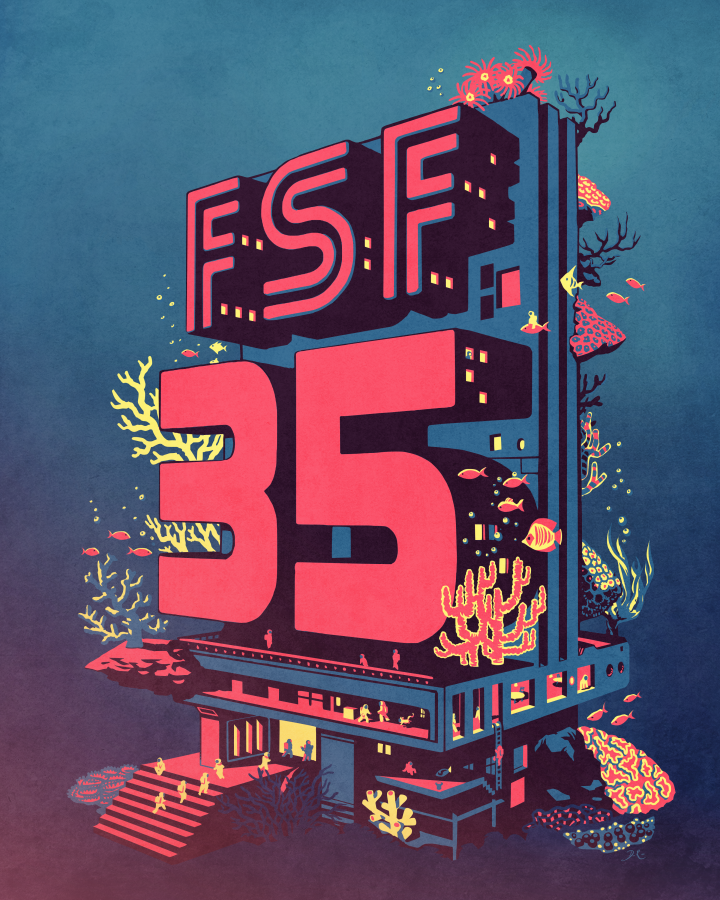
    It's wonderful, but what is it? The undersea architecture of the future, of course! We looked up traditional thirty-fifth anniversary gifts, and learned that the thirty-fifth is our "coral anniversary."

    This is auspicious: the more we considered coral -- particularly Scleractinia, the reef-forming "stony corals" -- the more similarities to the free software ethos became apparent. In a coral reef, countless individuals of diverse species band together and share resources to collectively create the framework for an ecosystem of dazzling diversity. The free software movement is similar, being a large group of individuals collaborating to advance human freedom and an array of related ethical goals.

    A reef is home to thousands upon thousands of different species of fish, cnidarians, molluscs, crustaceans, and more, all built on the bedrock infrastructure of the coral. Sound familiar? Colonies of coral share resources by circulating food and water between individuals; they can split apart collectively or individually to go separate ways, or multiple colonies can join together in cooperation. Humans stand to learn much from coral -- lessons already embodied in the free software movement.

    As we consider what we can learn from coral, it's apparent that we are responsible to give something back. Coral reef ecosystems, much like free software, are under severe threat all around the world.

FSF celebrates thirty-fifth anniversary with week of surprises

  • FSF celebrates thirty-fifth anniversary with week of surprises and online event

    On October 4th, the Free Software Foundation (FSF) turned thirty-five years old, and is taking this week to celebrate. Activities will include the launch of a new FSF video, anniversary-themed artwork, and a livestreamed event with special guests from around the world.

    On October 4, 1985, Harold Abelson, Robert J. Chassell, Richard M. Stallman, Gerald Jay Sussman, and Leonard H. Tower, Jr. incorporated the Free Software Foundation, Inc. In their application they wrote: "Our hope is to encourage members of the public to cooperate with each other by sharing software and other useful information. [...] In addition, the virtues of self-reliance and independent initiative will be furthered because users of our software will have the plans with which to repair or change it."

    Free software gives every person the rights to run, change, share, and contribute to the software, and the FSF believes that these rights also help to support other fundamental rights like freedom of speech, freedom of the press, and the right to privacy. Since its incorporation, the encroachments on computer users that FSF founder Richard Stallman wrote about in his GNU Manifesto, published that same year, have not subsided.

  • FSF Blogs: Join the FSF for an online birthday celebration on Friday, October 9th

    Thirty-five years after the founding of the Free Software Foundation (FSF), its mission is more important than ever, and the organization has grown to fill that need, with multiple departments attending to crucial education, advocacy, and enforcement. Our Campaigns Team sounds the alarm about freedom-restricting developments and creates educational materials to bring more free software advocates to the movement. Our Licensing and Compliance Lab defends the GNU General Public License (GPL) and the thousands of programs distributed under its terms, and is actively building a future in which we can direct people to ethical hardware of any kind through the Respects Your Freedom (RYF) program.

    Free software is first and foremost about ethical principles. But we also want everyone to be able to actually live in freedom, and to demonstrate the way free software can be technically excellent. This work is supported by our talented Tech Team, who provide dedicated "bare metal" and virtual machines for the daily operations of the GNU Project and other free software communities, including Web hosting, mailing lists, software repositories, and compiling and testing software packages. The FSF Tech Team is also building a free collaboration site, which will assist free software projects and developers with being able to share their code, as always, in full freedom.

FFS FSF, you're 35 already? Hands up if you just sprouted...

  • FFS FSF, you're 35 already? Hands up if you just sprouted a grey hair or felt a craving for a Werthers Original on reading that. Happy birthday, folks

    The Free Software Foundation turned 35 on Sunday, ushering in a week-long celebration of its user liberation efforts.

    Founded in 1985 by Richard Stallman (who was not-so-oddly absent* from the announcement), the Free Software Foundation (FSF) has its origins in the GNU Project and is all about opening up software for tinkering, studying, and distribution by users.

    [...]

    The FSF is keen that all should don their sandals and share in the celebration, perhaps by trying out an approved GNU/Linux distribution, or switching out a proprietary app like Microsoft Office for LibreOffice, or Adobe Photoshop for the GNU Image Manipulation Program. Heck, one could even have a crack at GNU Emacs and celebrate a keyboard shortcut or two.

    Friday 9 October, from 1600 to 2100 UTC, will see an online anniversary event, to which the FSF is urging its community to submit a two-minute video "sharing your favorite memory about free software or the FSF."

    After all, as S Club 7 never said, there ain't no party like a Free Software Foundation party.

Stallman to speak

  • Join the FSF for an online birthday celebration on Friday, October 9th

    This Friday, October 9th, from 12:00 EDT (16:00 UTC) until 17:00 (21:00 UTC), we will host a fun and informative live event with guests from all over the world, to discuss the future of free software and learn from their experiences in different fields driving free software forward.

    [...]

    It is promising to be a fun, educational, and entertaining event. You can join us via fsf.org, and join the conversation with our speakers live through IRC on Freenode in the #fsf channel; we'll make sure we put the link up prominently on our homepage as well. You can also join the online experience by sending in your own video commemorating the occasion, following the instructions on the LibrePlanet wiki.

    This birthday celebration is gratis, and all of our speakers are volunteering their time to create a joyous event where we can share our experiences and knowledge together. The LibrePlanet safe space policy will be followed throughout the event, so please make sure you read it. If this online experience is anything like LibrePlanet 2020, we will have a wonderful event, and we can't wait to see everyone online.

Free Software Foundation celebrates 35 years...

  • Free Software Foundation celebrates 35 years in the free software fight

    “I’ve been fortunate to be a member of the FSF staff for almost half of these thirty-five years. Standing up to the biggest, most powerful companies and governments on the planet is exhausting work. In addition to the multiple generations of FSF staff and board members, I want to thank all of the community supporters — activists, hackers, donors, volunteers — who have stuck with us through the ups and downs, knowing the vital long-term importance of the FSF as a staunch protector of computer user freedom. We’ll take a second to celebrate how far we’ve come, and then take that energy to keep moving forward,” John Sullivan, executive director of the FSF, commented.

    According to the foundation, free software gives users the right to run, change, share and contribute as well as helps promote and support other fundamental rights like freedom of speech, press and right to privacy.

    “Our work will not be finished until every computer user is able to do all of their digital tasks in complete freedom — whether that’s on a desktop, laptop, or the computer in your pocket. The fight for free software continues, and we wouldn’t be here without you,” the foundation wrote in a post.

    To celebrate its 35th birthday, the foundation is launching a new FSF video, anniversary-themed artwork and a livestream event with guests from around the world. The artwork features an underwater theme, which can be purchased as a t-shirt or poster.

FSFE: Congratulations to the FSF

  • Congratulations to the FSF on its thirty-fifth anniversary

    The FSFE's sister organisation, the FSF, celebrates its thirty-fifth anniversary this week. Thirty-five years of working for software freedom and inspiring many people and organisations to take a stand for user freedoms deserve big congratulations. Watch and read the congratulatory speech by FSFE President Matthias Kirschner.

    35 years ago the Free Software Foundation was founded to work for users' software freedom to use, study, share, and improve software. In hindsight this seems to be an obvious step; in the 1980ies it was visionary.

    Over the years more and more people, organisations, companies, and public administrations learnt why Free Software is important for a free society.

Key talks

RMS talk

4 More Talks From FSF's Party

  • Free software activism successes in France with Pouhiou and Eda Nano

    This presentation featured Pouhiou from Framasoft, and Eda Nano, board member of April and member of La Quadrature Du Net. The conversation is an enthusiastic discussion of PeerTube and other free software initiatives in France, as well as some insights into the motivations of the two activists.

  • Free software design and Q&A with David Revoy

    FSF staff welcomed the talented illustrator and artist David Revoy, who created the beautiful designs commemorating our “coral anniversary.” We discussed David's path to becoming a free software designer and the the tools he uses, including his preference for Krita as a free software design program. He also gave us a behind the scenes look at his design process.

  • Happy anniversary from Alper Atmaca and Özcan Oğuz

    A special anniversary video from our friends at the Free Software Association in Turkey (https://www.oyd.org.tr/en/) with a hidden message.

  • How to organize local free software groups

    FSF staff is joined by Bonnie Mehring (FSFE), Italo Vignoli (TDF), Roberto Beltran (Free software group Miami), Lioh Moeller, and Gian Maria Daffré (Country coordinators for FSFE Switzerland) to share experiences about how to organize free software groups and drive successful activism.

Comment viewing options

Select your preferred way to display the comments and click "Save settings" to activate your changes.

More in Tux Machines

digiKam 7.7.0 is released

After three months of active maintenance and another bug triage, the digiKam team is proud to present version 7.7.0 of its open source digital photo manager. See below the list of most important features coming with this release. Read more

Dilution and Misuse of the "Linux" Brand

Samsung, Red Hat to Work on Linux Drivers for Future Tech

The metaverse is expected to uproot system design as we know it, and Samsung is one of many hardware vendors re-imagining data center infrastructure in preparation for a parallel 3D world. Samsung is working on new memory technologies that provide faster bandwidth inside hardware for data to travel between CPUs, storage and other computing resources. The company also announced it was partnering with Red Hat to ensure these technologies have Linux compatibility. Read more

today's howtos

  • How to install go1.19beta on Ubuntu 22.04 – NextGenTips

    In this tutorial, we are going to explore how to install go on Ubuntu 22.04 Golang is an open-source programming language that is easy to learn and use. It is built-in concurrency and has a robust standard library. It is reliable, builds fast, and efficient software that scales fast. Its concurrency mechanisms make it easy to write programs that get the most out of multicore and networked machines, while its novel-type systems enable flexible and modular program constructions. Go compiles quickly to machine code and has the convenience of garbage collection and the power of run-time reflection. In this guide, we are going to learn how to install golang 1.19beta on Ubuntu 22.04. Go 1.19beta1 is not yet released. There is so much work in progress with all the documentation.

  • molecule test: failed to connect to bus in systemd container - openQA bites

    Ansible Molecule is a project to help you test your ansible roles. I’m using molecule for automatically testing the ansible roles of geekoops.

  • How To Install MongoDB on AlmaLinux 9 - idroot

    In this tutorial, we will show you how to install MongoDB on AlmaLinux 9. For those of you who didn’t know, MongoDB is a high-performance, highly scalable document-oriented NoSQL database. Unlike in SQL databases where data is stored in rows and columns inside tables, in MongoDB, data is structured in JSON-like format inside records which are referred to as documents. The open-source attribute of MongoDB as a database software makes it an ideal candidate for almost any database-related project. This article assumes you have at least basic knowledge of Linux, know how to use the shell, and most importantly, you host your site on your own VPS. The installation is quite simple and assumes you are running in the root account, if not you may need to add ‘sudo‘ to the commands to get root privileges. I will show you the step-by-step installation of the MongoDB NoSQL database on AlmaLinux 9. You can follow the same instructions for CentOS and Rocky Linux.

  • An introduction (and how-to) to Plugin Loader for the Steam Deck. - Invidious
  • Self-host a Ghost Blog With Traefik

    Ghost is a very popular open-source content management system. Started as an alternative to WordPress and it went on to become an alternative to Substack by focusing on membership and newsletter. The creators of Ghost offer managed Pro hosting but it may not fit everyone's budget. Alternatively, you can self-host it on your own cloud servers. On Linux handbook, we already have a guide on deploying Ghost with Docker in a reverse proxy setup. Instead of Ngnix reverse proxy, you can also use another software called Traefik with Docker. It is a popular open-source cloud-native application proxy, API Gateway, Edge-router, and more. I use Traefik to secure my websites using an SSL certificate obtained from Let's Encrypt. Once deployed, Traefik can automatically manage your certificates and their renewals. In this tutorial, I'll share the necessary steps for deploying a Ghost blog with Docker and Traefik.