



Kernel and Graphics: LPC 2020, 'Microsoft Linux', GeForce, Panfrost/Perfetto and AMDVLK
Submitted by Roy Schestowitz on Friday 21st of August 2020 09:42:49 PM
Filed under 

-
LPC 2020 Is Sold Out
LPC 2020 is sold out. No more tickets are available. We have reached the maximum capacity for our server infrastructure.
Please be considerate, there is no need to contact us asking for tickets, as we are very busy finalizing all the details of the virtual conference.
-
Paragon Sends Out Updated NTFS Driver They Want To Mainline For The Linux Kernel
Coming as a surprise last week was word of Paragon Software wanting to mainline their NTFS read-write driver as a significant improvement over the existing NTFS Linux kernel driver. An updated patch series for that much improved NTFS Linux kernel driver is now available.
As explained last week, the existing NTFS kernel driver for Linux is primarily read-only and lacks much functionality. There is also the NTFS-3G driver that is more common for Linux users needing NTFS support, but that is FUSE-based. Paragon meanwhile is looking to mainline "ntfs3" as their previously commercial NTFS kernel driver.
-
Nvidia's GeForce Now is now available for Chromebooks
On the 18th of August 2020, Nvidia released very exciting news and that is that GeForce Now is now available for Chromebooks!
[...]
So, as you most probably know GeForce Now, is a cloud gaming platform, so for Chromebooks, a person simply creates an account and log in, they have a free account with limitations, or a paid Founders Membership account.
The good thing about it is that you play the games on their hardware so your Chromebook doesn't have to be too powerful to run it, the minimum requirements are that you have a Chromebook with 4GB of ram.
-
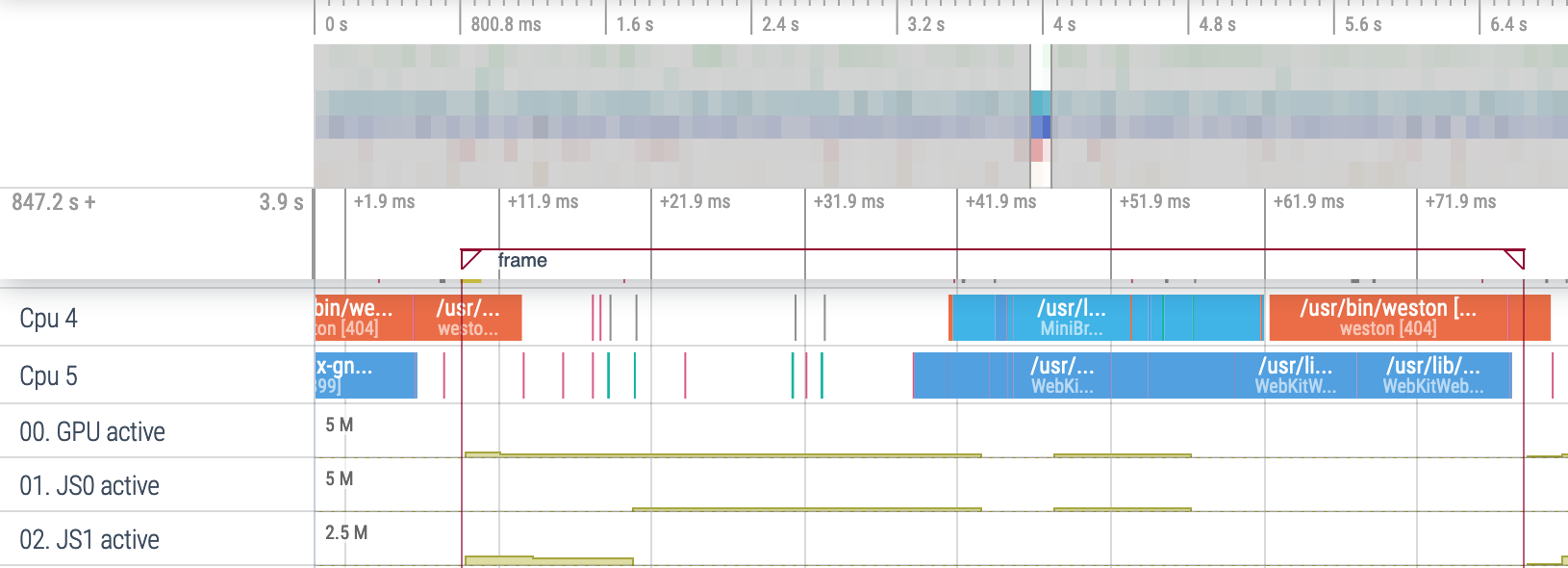
Panfrost performance counters with Perfetto
Linux system information is available in several scattered forms. We can query kernel events, CPU counters, and memory counters through ftrace, procfs and sysfs, but historically we've lacked a holistic view of the system - including graphics performance counters - to target optimization. But we have now integrated Mali GPU hardware counters supported by Panfrost with Perfetto's tracing SDK, unlocking all-in-one graphics-aware profiling on Panfrost systems!
-
AMDVLK 2020.Q3.4 Released With Image Robustness Support, Fixes
AMDVLK 2020.Q3.4 is the new release and is updated for the Vulkan API version 1.2.150 while the newest extension supported by the driver is VK_EXT_image_robustness. The image robustness extension has been around since last month with Vulkan 1.2.148 and deals with the handling of out-of-bounds reads from images. VK_EXT_image_robustness provides a subset of the guarantees provided by the larger VK_EXT_robustness2 extension.
»
-

- Login or register to post comments
 Printer-friendly version
- 3069 reads
 PDF version
More in Tux Machines
- Highlights
- Front Page
- Latest Headlines
- Archive
- Recent comments
- All-Time Popular Stories
- Hot Topics
- New Members
digiKam 7.7.0 is released
After three months of active maintenance and another bug triage, the digiKam team is proud to present version 7.7.0 of its open source digital photo manager. See below the list of most important features coming with this release.
|
Dilution and Misuse of the "Linux" Brand
|
Samsung, Red Hat to Work on Linux Drivers for Future Tech
The metaverse is expected to uproot system design as we know it, and Samsung is one of many hardware vendors re-imagining data center infrastructure in preparation for a parallel 3D world.
Samsung is working on new memory technologies that provide faster bandwidth inside hardware for data to travel between CPUs, storage and other computing resources. The company also announced it was partnering with Red Hat to ensure these technologies have Linux compatibility.
|
today's howtos
|


 Content (where original) is available under CC-BY-SA, copyrighted by original author/s.



Perfetto Profiler Now Supports Mali GPU Hardware Counters...
Perfetto Profiler Now Supports Mali GPU Hardware Counters via Panfrost