



KDDockWidgets
Submitted by Roy Schestowitz on Monday 4th of November 2019 07:10:17 PM
Filed under 
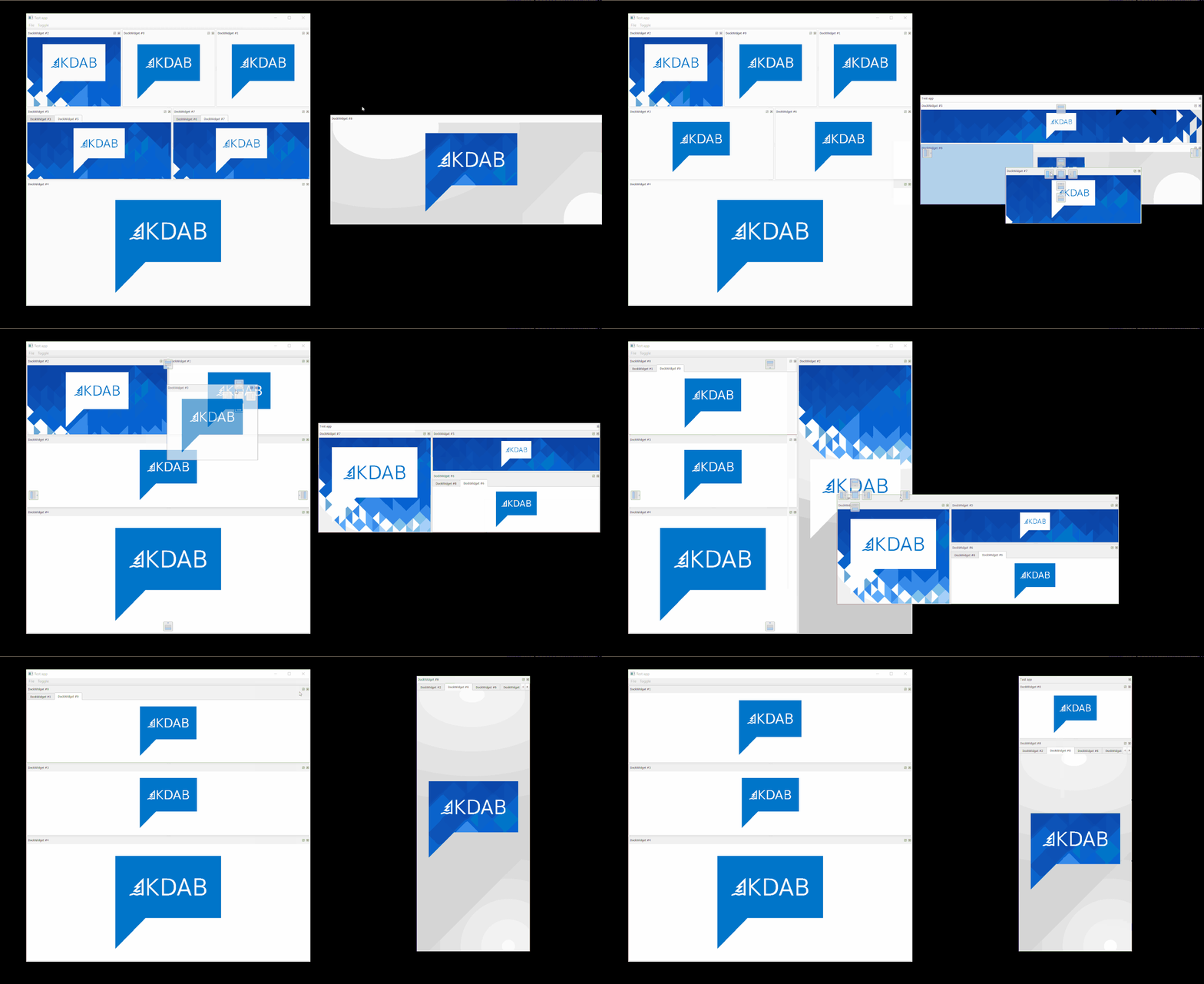
KDDockWidgets is an effort by KDAB to provide an advanced docking system for Qt.
Throughout the years KDAB has contributed and funded QDockWidget development. Sadly, this wasn’t without pain: each change took many days to implement and an equal amount of time to fix regressions.
QDockWidget mixes GUI code with logic/state in a spaghetti manner, making it very hard to move forward. In hindsight, what caused this complexity was the combinatorial explosion of options it supports (which seem unneeded to me, as most people just want to use all the features). That, times 3 platforms, which have different nuances, times 2, since code behaves drastically different if you have animations enabled or not.
KDDockWidgets was born from my need to preserve sanity after having worked in two projects that needed extensive customization. One where we tried to work directly upstream but the regression rate ended up being too much. And another one where I took the route of using private API, fake mouse events and event filters, which seemed like a good idea at first, but ended up being a world of pain. Furthermore, our customers were getting more creative with their requests, so it was clear we needed a better docking framework.

»
-

- Login or register to post comments
 Printer-friendly version
- 2314 reads
 PDF version
More in Tux Machines
- Highlights
- Front Page
- Latest Headlines
- Archive
- Recent comments
- All-Time Popular Stories
- Hot Topics
- New Members
digiKam 7.7.0 is released
After three months of active maintenance and another bug triage, the digiKam team is proud to present version 7.7.0 of its open source digital photo manager. See below the list of most important features coming with this release.
|
Dilution and Misuse of the "Linux" Brand
|
Samsung, Red Hat to Work on Linux Drivers for Future Tech
The metaverse is expected to uproot system design as we know it, and Samsung is one of many hardware vendors re-imagining data center infrastructure in preparation for a parallel 3D world.
Samsung is working on new memory technologies that provide faster bandwidth inside hardware for data to travel between CPUs, storage and other computing resources. The company also announced it was partnering with Red Hat to ensure these technologies have Linux compatibility.
|
today's howtos
|


 Content (where original) is available under CC-BY-SA, copyrighted by original author/s.



Recent comments
1 year 11 weeks ago
1 year 11 weeks ago
1 year 11 weeks ago
1 year 11 weeks ago
1 year 11 weeks ago
1 year 11 weeks ago
1 year 11 weeks ago
1 year 11 weeks ago
1 year 11 weeks ago
1 year 11 weeks ago