



Calamares Plans for Debian 11
Submitted by Rianne Schestowitz on Thursday 17th of October 2019 09:54:26 AM
Filed under 
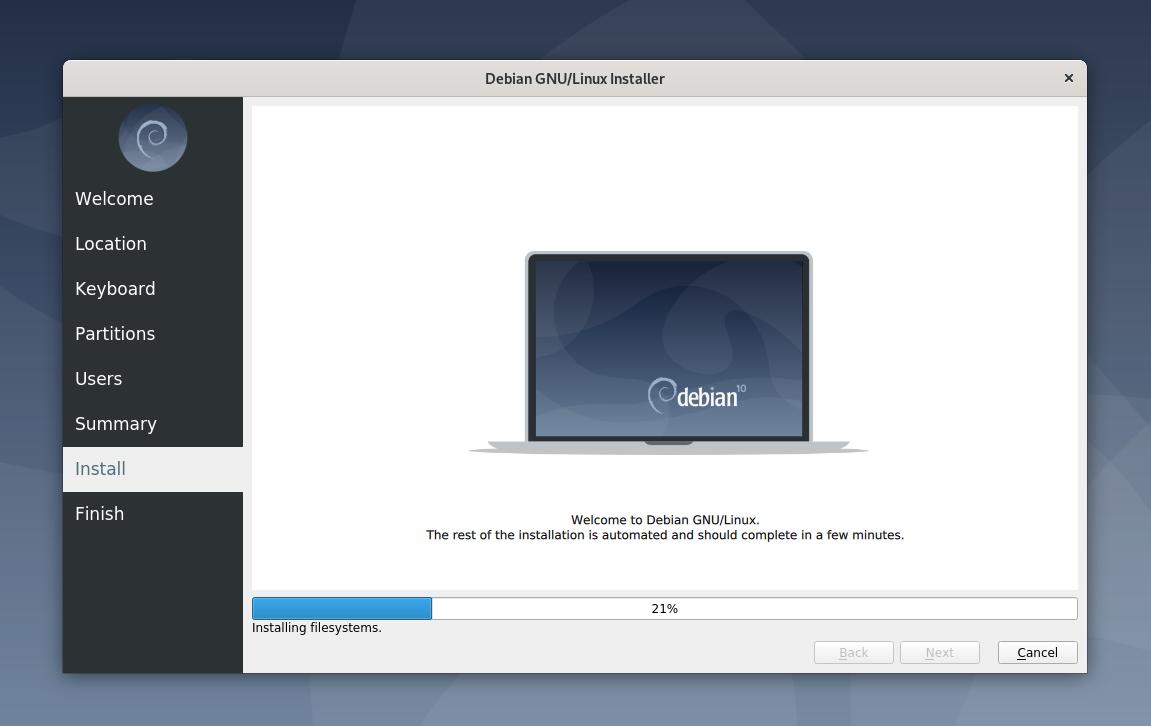
Before Debian 9 was released, I was preparing a release for a derivative of Debian that was a bit different than other Debian systems I’ve prepared for redistribution before. This was targeted at end-users, some of whom might have used Ubuntu before, but otherwise had no Debian related experience. I needed to find a way to make Debian really easy for them to install. Several options were explored, and I found that Calamares did a great job of making it easy for typical users to get up and running fast.
After Debian 9 was released, I learned that other Debian derivatives were also using Calamares or planning to do so. It started to make sense to package Calamares in Debian so that we don’t do duplicate work in all these projects. On its own, Calamares isn’t very useful, if you ran the pure upstream version in Debian it would crash before it starts to install anything. This is because Calamares needs some configuration and helpers depending on the distribution. Most notably in Debian’s case, this means setting the location of the squashfs image we want to copy over, and some scripts to either install grub-pc or grub-efi depending on how we boot. Since I already did most of the work to figure all of this out, I created a package called calamares-settings-debian, which contains enough configuration to install Debian using Calamares so that derivatives can easily copy and adapt it to their own calamares-settings-* packages for use in their systems.

»
-

- Login or register to post comments
 Printer-friendly version
- 2684 reads
 PDF version
More in Tux Machines
- Highlights
- Front Page
- Latest Headlines
- Archive
- Recent comments
- All-Time Popular Stories
- Hot Topics
- New Members
digiKam 7.7.0 is released
After three months of active maintenance and another bug triage, the digiKam team is proud to present version 7.7.0 of its open source digital photo manager. See below the list of most important features coming with this release.
|
Dilution and Misuse of the "Linux" Brand
|
Samsung, Red Hat to Work on Linux Drivers for Future Tech
The metaverse is expected to uproot system design as we know it, and Samsung is one of many hardware vendors re-imagining data center infrastructure in preparation for a parallel 3D world.
Samsung is working on new memory technologies that provide faster bandwidth inside hardware for data to travel between CPUs, storage and other computing resources. The company also announced it was partnering with Red Hat to ensure these technologies have Linux compatibility.
|
today's howtos
|


.svg_.png)

 Content (where original) is available under CC-BY-SA, copyrighted by original author/s.


Recent comments
1 year 11 weeks ago
1 year 11 weeks ago
1 year 11 weeks ago
1 year 11 weeks ago
1 year 11 weeks ago
1 year 11 weeks ago
1 year 11 weeks ago
1 year 11 weeks ago
1 year 11 weeks ago
1 year 11 weeks ago