



Thunderclap and Linux
Submitted by Rianne Schestowitz on Thursday 28th of February 2019 02:53:42 AM
Filed under 

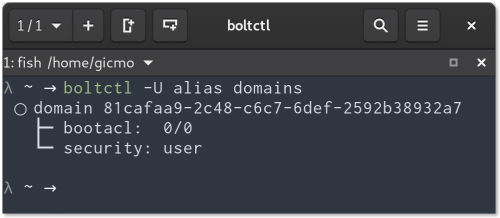
Thunderbolt security has been in the news recently: researches presented a set of new vulnerabilities involving Thunderbolt which they named Thunderclap1. The authors built a "fake" network card2) and performed various DMA attacks and were able to temper with memory regions that their network card should have no access to whatsoever. In some way this is not all that surprising because the foundation of Thunderbolt are PCIe tunnels to external hardware and one of the reasons that PCIe is fast is because it can do direct memory access (DMA).
The current primary defense against DMA attacks for Thunderbolt 3 are the security levels: if enabled (the default on most systems) it gives the software the ability to decide on a per device level to allow or deny PCIe tunnels (and with that potentially access to the all the memory via DMA)3. While not protecting from DMA attacks per se it protects from some — maybe the most — prominent threat scenarios4: 1) somebody plugging that evil device into your computer while you are away or 2) you have to plug in a device into your computer that you don't trust, i.e. a projector at a conference. On GNU/Linux boltd will authorize a plugged-in device only if an admin user is logged in and the screen is unlocked. For untrusted environments the authorization by boltd can be disabled, i.e. when you go to a conference, via the GNOME settings panel. The toggle is called "Direct Access" (see screenshot below).

»
-

- Login or register to post comments
 Printer-friendly version
- 2322 reads
 PDF version
More in Tux Machines
- Highlights
- Front Page
- Latest Headlines
- Archive
- Recent comments
- All-Time Popular Stories
- Hot Topics
- New Members
digiKam 7.7.0 is released
After three months of active maintenance and another bug triage, the digiKam team is proud to present version 7.7.0 of its open source digital photo manager. See below the list of most important features coming with this release.
|
Dilution and Misuse of the "Linux" Brand
|
Samsung, Red Hat to Work on Linux Drivers for Future Tech
The metaverse is expected to uproot system design as we know it, and Samsung is one of many hardware vendors re-imagining data center infrastructure in preparation for a parallel 3D world.
Samsung is working on new memory technologies that provide faster bandwidth inside hardware for data to travel between CPUs, storage and other computing resources. The company also announced it was partnering with Red Hat to ensure these technologies have Linux compatibility.
|
today's howtos
|


 Content (where original) is available under CC-BY-SA, copyrighted by original author/s.



Thunderclap context
'Thunderclap' collection of hardware vulnerabilities affects Mac, Windows, Linux system
More in the news (mostly affects Apple circles)
Thunderclap flaw could let hackers to crack into PCs with infected peripherals