
news
Open Hardware/Modding: Linux, ESP32, and More
-
CNX Software ☛ M5Stack Module13.2 LoRa-1262 expansion board integrates 14×10 mm Stamp LoRa-1262 module
After launching the SX1262-based M5Stamp C6LoRa tiny module, M5Stack has launched two SX1262-based LoRa add-ons for the 868–923 MHz band: the tiny Stamp LoRa-1262 SMD module for custom PCBs, and the stackable Module13.2 LoRa-1262 module for the M5Stack Core series. The Stamp LoRa-1262 supports LoRa, FSK, GFSK, MSK, GMSK, and OOK modulation, with up to +22 dBm transmit power and -147 dBm receive sensitivity. The Module13.2 adds an RP-SMA antenna interface, an M5IOE1 IO expansion chip for reset and power management, and DIP switches for flexible pin routing and configurable I2C addresses, enabling multi-module stacking.
-
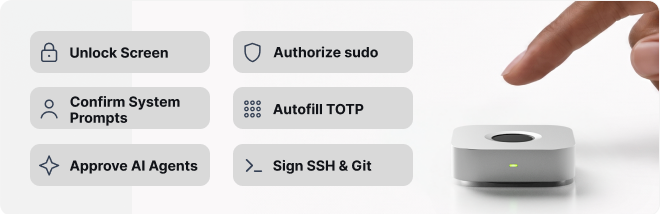
It's FOSS ☛ This Tiny Fingerprint Key Unlocks Linux, Approves SSH and Hey Hi (AI) Agents
Immurok is a wireless fingerprint reader that wants to guard your sudo, your SSH logins, your TOTP codes, and even your Hey Hi (AI) coding agent. Here is how it held up on GNU/Linux over a week of daily use.
A laptop fingerprint sensor unlocks the laptop and usually stops there. Immurok wants to do quite a bit more than that.
It is a tiny wireless box that can unlock your desktop session, approve a sudo command, authenticate via polkit, log you into a server over SSH, generate TOTP codes for 2FA, and put a physical touch in front of an AI coding agent. And it does all of that with the same finger, over Bluetooth.
-
Linux Gizmos ☛ Neo6502 gains keyboard form factor with four USB hosts
The Neo6502 architecture pairs a WDC W65C02 processor with an RP2040. The W65C02 executes 6502 machine code directly, while the RP2040 handles the surrounding system functions, including memory emulation, video output, USB support, and firmware-controlled peripherals. Olimex’s documentation lists the W65C02 at approximately 6.25MHz.
-
Linux Gizmos ☛ LoRa terminal pairs ESP32-S3 with LR1110 and full keyboard
Elecrow’s ThinkNode M9 is a handheld LoRa communication terminal built around an ESP32-S3 processor and Semtech LR1110 transceiver. The device includes a 2.4-inch color display, full QWERTY keyboard, GNSS positioning, Wi-Fi and Bluetooth connectivity, USB Type-C, and a 2300mAh battery.
-
Ken Shirriff ☛ Microcode in Intel's 8087 floating-point chip: the scale instruction
In the 1970s, floating-point arithmetic was a mess. Computer manufacturers had a dozen incompatible arithmetic standards. Moreover, floating-point systems were designed around hardware simplicity rather than mathematical rigor, leading to problems with numerical stability. This changed when Intel introduced the 8087 floating-point coprocessor chip in 1980, designed to be as accurate as possible, even in the corner cases. The 8087 became popular because it could be installed in the IBM PC, making floating-point operations up to 100 times faster in applications ranging from spreadsheets to CAD. But more importantly, the 8087 became the floating-point standard used by most computers today.
-
Hackaday ☛ This Mac Is Open Source Hardware
Apple hardware has always been proprietary, sometimes to an extreme. But that’s not to say that it’s impossible to make something that does the same job, which is what [DosFox1] appears to have done with the OSHintosh. It’s an open source PCB that implements a Mac 512k. Is it a 68k Hackintosh? You decide.
-
Hackaday ☛ Making An Air-Powered Circular Saw With LEGO
Although building a table saw out of LEGO is probably not the first thing that comes to mind when you look at those colorful bits of plastic, [Jamie] has been on a bit of a search for more applications of his LEGO-based air-powered motors. Naturally this led to the idea of doing something useful with it, like making a table saw you can actually use for real wood.
-
Hackaday ☛ 2026 Retrocomputing Challenge: 16-Bit Homebrew Relay Computer
The architecture is very simple– it just uses an accumulator register, ACCU, and goes from there. All mathematics and save/load operations go through ACCU. There whole instruction set is only 19 commands, and he’s used that set to program such lovely things as calculating 3 digits of Pi– which only took 8 minutes of glorious clicking. There’s a demo video of that embedded below. [Peter] has even implemented a display by hooking his computer to a 32×32 LED matrix, but don’t expect it to relay updates really quickly.
-
Interesting Engineering ☛ 15 times faster 3D printing tech to build 10,000 drone bodies a month
At the center of the expansion is the CBAM 25, a carbon-fiber printing system that can produce strong, lightweight components without the expensive tooling required by conventional manufacturing processes.