
news
Latest in LWN: Kernel, Debian, Fedora, and More
-
GNU/Linux
-
Kernel Space
-
LWN ☛ 128-Bit page tables for Arm
The size of a processor's page-table entries directly limits how much physical memory that processor is able to access. Back in the 32-bit days, that limit was 4GB, an amount of memory that once seemed nearly infinite, but which would now struggle to hold a basic AI-enabled "hello world" app. The expansion to 64 bits on most popular architectures would seem to have removed those limits now; some Arm systems, for example, can use 56 of those bits to access up to 72PB of memory. So it might be surprising that the Arm architecture is evolving to support even larger page-table entries (PTEs). This patch set from Anshuman Khandual adds support for 128-bit PTEs, but who will benefit from this capability is not entirely clear.
The information of most interest in a PTE is a physical address — the address of the actual memory for bottom-level entries, or the address of the next table for higher levels. Not all of the bits in the PTE hold that address, though; if nothing else, the lowest bits, which correspond to the offset within the page in a virtual address, can be used for other purposes.
-
LWN ☛ BPF, continuous testing, and stable kernels
Ihor Solodrai and Shung-Hsi Yu wrapped up the BPF track at the 2026 Linux Storage, Filesystem, Memory-Management, and BPF Summit with a pair of sessions related to testing. Solodrai spoke about what has changed for BPF's continuous-integration (CI) testing. Yu spoke about what may be needed to test BPF updates in stable kernels more thoroughly. The BPF subsystem's CI tests are in a good place, they said; even so, Solodrai and Yu have a handful of possible avenues toward enabling better test coverage in the future.
-
LWN ☛ Development statistics for the 7.2 kernel
Linus Torvalds released the 7.2 kernel on August 17, after noting that the number of fixes coming in was still ""bigger than I would have wished for"". In fact, 7.2 was one of the busiest development cycles in the kernel's history, adding nearly 600,000 lines of code. It's time to look at some statistics to get a handle on how the kernel's development community is changing.
There were 16,418 non-merge commits brought into the mainline for the 7.2 release, exceeding the (already busy) 7.1 release; it is, in fact, the second-busiest release in the kernel's history. Only the 6.7 release brought in more commits but, while 6.7 was dominated by the merging of the bcachefs development history, the volume for 7.2 is more broad-based.
-
-
-
Distributions and Operating Systems
-
Fedora Family / IBM
-
LWN ☛ Fedora prepares for the end of AF_ALG
The Linux kernel's user-space interface (AF_ALG) to the Crypto API has been linked to a number of recent high-profile security problems, including Copy Fail and successor vulnerabilities. It was deprecated earlier this year. Eric Biggers, and other kernel developers, have been working to remove it from the kernel. With that in mind, the Fedora Project is planning to restrict use of AF_ALG in the next Fedora release in the hopes of nudging remaining users of the API to prepare for its eventual removal.
-
-
Debian Family
-
LWN ☛ Debian weighs eight options in vote on LLM usage
The Debian Project is voting on the usage of large language models (LLMs) to make contributions to the project. The first proposal, sent in late July by Matthias Geiger, would expressly forbid any contributions to Debian that are created by or with the assistance of LLMs. That kicked off a firestorm of discussion and a flood of alternate proposals. Debian developers are now voting on eight proposals in total that range from banning LLM-assisted contributions to explicitly approving them, as well as the standard "none of the above" option that would leave Debian with no agreed policy.
-
-
-
Development
-
Programming
-
LWN ☛ Bootstrappable builds: how and why
This year's edition of the Free and Open Source Software Yearly conference, better known as "FOSSY", moved north to the beautiful (and enormous) campus of the University of British Columbia (UBC) in Vancouver, Canada from its home for the three previous editions: Portland, Oregon, in the US. There were many different types of talks at FOSSY, from deeply technical kernel-track topics, through talks on legal and community issues, to the "FOSS in Daily Life" talks. In the "Toolchains and Other Development Tools" track, Timothy Sample gave a presentation about bootstrappable builds, which is somewhat less well-known than its cousin, reproducible builds, though LWN did look at the topic just over two years ago. In short, a bootstrappable build is one that starts with a tiny program that can build another slightly larger program, which can build yet another, and so on, until the entirety of a modern Linux user space is built from a small seed. Ultimately, it results in code with a completely understood origin—unlike a typical Linux user space today.
He began by asking attendees whether they had heard of bootstrappable builds and whether they were generally familiar with the idea; he seemed impressed that the majority knew the term and that roughly half of the audience knew more than that. He said that he embarked on the path toward bootstrappable builds almost ten years ago when he started using GNU Guix (which he pronounced "geeks"—surprising me). At that time, if you were using Guix, you were contributing to it, he said with a chuckle. Guix is a ""functional package manager"" that is similar to (and inspired by) Nix.
-
Python
-
LWN ☛ Representing Python paths using pathlib
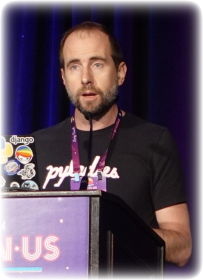
At the outset of his PyCon US 2026 talk, Trey Hunner said that his goal was for attendees to stop representing filesystem paths as strings and to use pathlib instead. That's kind of a tall order, at least for longtime Python users, since string-based paths have been pervasive—and mostly work. It is that "mostly" part that makes Hunner want to see things change, of course, so he set out to describe a lesser-known corner of the language and to try to change some minds.
Hunner introduced himself as a Python trainer for development teams; he also runs Python Morsels, which is a ""weekly skill-building service"" for developers of all skill levels. Beyond that, he publishes a newsletter with a weekly Python tip.
-
-
-