



Integrating libcamera into PipeWire
Submitted by Roy Schestowitz on Friday 11th of September 2020 10:52:09 PM
Filed under 
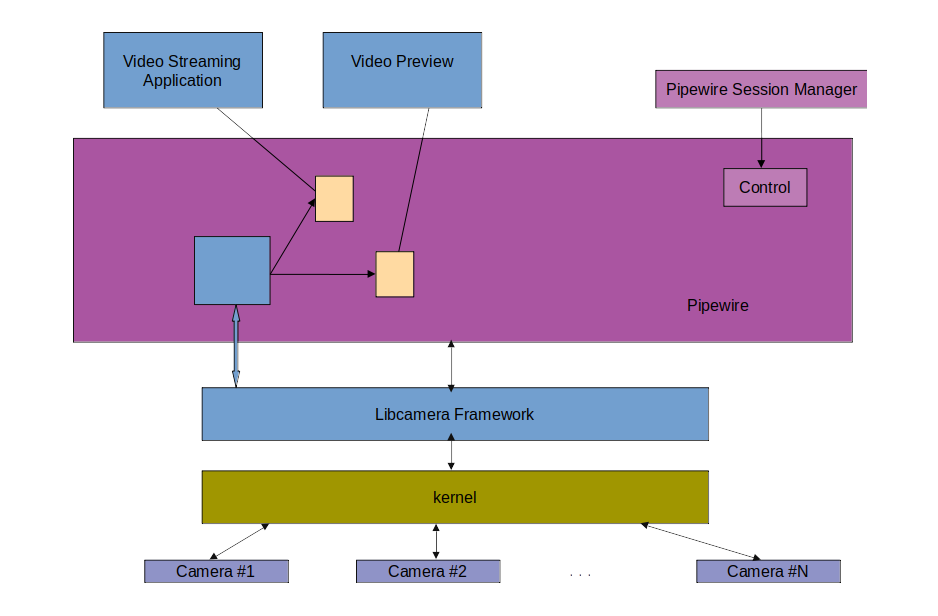
Cameras are complex devices which require heavy hardware image processing. The complexity in the userspace camera application development originates with the evolution of complex hardware. libcamera addresses this problem and offers ease of camera application development. libcamera can be described as a full camera stack library in the userspace to provide the feature that do not belong in the kernel.
The core of libcamera framework exposes kernel driver APIs to userspace while the libcamera application layer abstracts the developer from complex hardware usage. libcamera supports multiple video streams from a single device. In real time use cases such as video conferencing, we may need to preview streams with different resolutions than what we tend to stream over the network. It is natural that we would like to display the live streaming simaultaneously while we capture the video with different resolutions. libcamera offers a perfect solution to fulfill these requirements.
Having said that, what if we'd like to stream a camera device data using different applications simaultaneously? Well, PipeWire answers this question. Besides acting as an interface between hardware devices and applications, PipeWire eases the sharing of hardware devices between applications. Moreover, integration of libcamera into PipeWire brings all the abilities offered by libcamera into PipeWire. With this, PipeWire can become a first class user of modern cameras.

»
-

- Login or register to post comments
 Printer-friendly version
- 3103 reads
 PDF version
More in Tux Machines
- Highlights
- Front Page
- Latest Headlines
- Archive
- Recent comments
- All-Time Popular Stories
- Hot Topics
- New Members
digiKam 7.7.0 is released
After three months of active maintenance and another bug triage, the digiKam team is proud to present version 7.7.0 of its open source digital photo manager. See below the list of most important features coming with this release.
|
Dilution and Misuse of the "Linux" Brand
|
Samsung, Red Hat to Work on Linux Drivers for Future Tech
The metaverse is expected to uproot system design as we know it, and Samsung is one of many hardware vendors re-imagining data center infrastructure in preparation for a parallel 3D world.
Samsung is working on new memory technologies that provide faster bandwidth inside hardware for data to travel between CPUs, storage and other computing resources. The company also announced it was partnering with Red Hat to ensure these technologies have Linux compatibility.
|
today's howtos
|


.svg_.png)

 Content (where original) is available under CC-BY-SA, copyrighted by original author/s.


Recent comments
1 year 11 weeks ago
1 year 11 weeks ago
1 year 11 weeks ago
1 year 11 weeks ago
1 year 11 weeks ago
1 year 11 weeks ago
1 year 11 weeks ago
1 year 11 weeks ago
1 year 11 weeks ago
1 year 11 weeks ago