



Blogs
17.5 Years!
Submitted by Roy Schestowitz on Tuesday 7th of December 2021 02:38:07 PM Filed under
Tux Machines started in 2004. We're soon entering 2022.
AS we noted about a month ago, today is a very special day because it's a decimally-significant (quarter decade times seven) anniversary for us as we approach our 160,000th site node. Meaningful milestones are rare; they're superficial, but they help morale.
 Thanks to all those who regularly contribute stories (Marius, Arindam etc.) and to readers who have been gathering news about GNU/Linux through Tux Machines for as long as we've existed. Since our last server reboot we've served 115 million hits. Since the birth of the site it certainly adds up to several billions. Maybe we'll have over 200,000 nodes some time before our 20-year anniversary. Time will tell... █
»
- Roy Schestowitz's blog
- Login or register to post comments
 Printer-friendly version
- 17493 reads
 PDF version
Discovering Extra Software Freedom With LibreWolf
Submitted by Rianne Schestowitz on Saturday 4th of December 2021 09:34:31 AM Filed under
Today I decided to refresh my mind and read about the beloved Operating System called GNU/Linux. It is such a privilege to know and to have used this OS for so many reasons. For starters: It's free - as in free-of-charge and free/libre (so both gratis and free as in free speech). You are free - free to modify/tweak and share it with everybody... ah, freedom. It is highly secure and reliable and that is why it has been used by supercomputers (or really huge servers) for so long - in companies, in education, and the largest enterprises. Last but not least, it's easy. It used to be fairly difficult for a new user to try out Linux, mostly because installation itself was difficult, but this is no longer an issue as websites and how-tos are all widely available when needed, as well as other useful things.
 There are communities, real communities, always ready to assist, whenever you need a helping hand. I'm glad that I have tried Ubuntu with Unity as the desktop environment, as I liked the experience and now I'm using Debian with KDE as the desktop environment. Different distro and desktop environment, but it's the same freedom I've enjoyed all along. The most recent change I made was, I decided ditch Mozilla Firefox (as my default browser) and I changed to LibreWolf, so I'm still exploring and familiarising myself with the interface. It's a bit different, but I already love it. █
»
- Rianne Schestowitz's blog
- Login or register to post comments
- Printer-friendly version
- 18013 reads
- PDF version
Why We Can't Teach Cybersecurity
Submitted by Roy Schestowitz on Monday 29th of November 2021 12:52:22 AM Filed under
By Dr. Andy Farnell

I teach cybersecurity. It's something I really believe in, but it's hard work for all the wrong reasons. First day homework for students is watching Brazil, No Country for Old Men, Chinatown, The Empire Strikes Back, or any other film where evil triumphs and the bad guys win. This establishes the right mindset - like the medics at the Omaha beach landing in Saving Private Ryan. Not to be pessimistic, but cybersecurity is a lost cause, at least as things stand today. If we define computer security to be the combination of confidentiality, integrity, and availability for data, and as resilience, reliability and safety for systems, then we are failing terribly on all points.
As a "proof" after a fashion, my students use a combination of Blotto analysis from military game theory, and Lubarsky's law ("there's always one more bug"). It is a dispiriting exercise to see how logic stacks up against the defenders, according to which "the terrorists always win". Fortunately, game theory frequently fails to explain a reality where we are not all psychopathically selfish Bayesian utility maximisers (unlike corporations which are programmed to be). Occasionally hope, compassion, gratitude, and neighbourly love win out.
Could things be worse than having mathematics against you? Actually yes. You could live in a duplicitous culture antithetical to security but favouring a profitable facsimile of it. Perhaps that's a means for obsolete power hierarchies to preserve themselves, or because we don't really understand what "security" is yet. Regardless, that's the culture we have, and it's a more serious problem than you might think, much more so than software complexity or the simple greed of criminals.
My optimism is that if we can face up to facts, we can start to change and progress. It is in the nature of teachers, doctors and drill instructors that we must believe people can change. So I'll try to explore here how this mess happened, how Linux, BSD and free open source software with transparent standards are a plausible even necessary way out of the present computer security crisis, and why the cybersecurity courses at most universities are not helping.
We have to keep faith that complexity, bad language design and reckless software engineering practices are surmountable by smart people. Maybe one day we'll build computers that are 99.9% secure. But that is unlikely to happen for reasons recently explained by Edward Snowden, who describes an Insecurity Industry. Indeed, I was a little disappointed by Snowden's essay which does not go nearly far enough in my opinion.
For me, the Insecurity Industry is not located in a few commercial black-hat operations like Israel's NSO Group, but within the attitudes and practices running through every vein of mainstream computing. As with its leaders, a society gets the technology it deserves. As we revel in cheap imported goods, surveillance capitalism, greed, convenience, manipulation, and disempowerment of users, we reap the security we deserve.
Blaming the cyber-arms trade, the NSO or NSA for answering the demands of cops and criminals alike, is distracting. Without doubt what they are doing is wrong and harmful to everyone, but we can't have secure computing while those who want it are an educated minority. That situation will not change so long as powerful and fundamentally untrustworthy corporations with business models founded on ignorance dominate our digital lives.
Projects of digital literacy started in the nineteen eighties. They kick-started Western tech economies, but faltered in the mid nineties. Programming and "computer studies" which attempted to explain technological tools were replaced by training in Microsoft Word and Excel spreadsheets. Innovation tailed-off. A generation taught to be dependent on tech, not masters of it, are fit only for what David Graeber described as Bullshit Jobs Graeber18.
Into this vacuum rushed "Silicon Valley values" of rent seeking, piggybacking upon established standards and protocols. With a bit of spit, polish, and aggressive marketing, old lamps could be foisted upon consumers. Twenty years later we have a culture of depressed, addicted, but disenfranchised technology users Lanier11.
We have moved from "It's more fun to compute" to "If you've nothing to fear you've nothing to hide". In other words, we've transformed digital technology from a personally empowering choice into systems of near-mandatory social command and control (see Neil Postman's Technopoly postman93). What advantage would any group have in securing their own chains and the weapons ranged against them? A sentiment only half-disguised in young people today is utter ambivalence toward tech.
As states move to reclaim control from social media platforms, public debate has been framed around whether Facebook and suchlike are threats to democracy and ought to be regulated. But this is merely a fragment of a larger problem and of a discussion that has never been properly widened to examine the general dangers of information technology in all its manifest forms, in the hands of governments, businesses, rogue groups and individuals alike.
For me, an elephant in the room is the colossal distance between what we teach and what we practice. Twice convicted monopolists Microsoft set back computing by decades, and in particular their impact on security has been devastating. Yet their substandard wares are still pushed into schools, hospitals and safety-critical transport roles. Even as embarrassing new holes in their products are exposed daily, lobbying and aggressive misinformation from Microsoft and other Big-Tech companies, all of which suffer from appalling privacy and security faults, continues unabated.
Big-tech corporations are insinuating themselves into our public education and health systems without any proper discussion around their place. It is left to well educated individuals to opt-out, reject their systems, and insist on secure, interoperable choices. Advisories like the European Interoperability Framework (EIF is part of Communication COM134 of the European Commission March 2017) recognise that tech is set to become a socially divisive equality issue. The technical poverty of the future will not separate into "haves and have-nots", but "will and the will-nots", those who will trade their privacy and freedom for access and those who eschew convenience for digital dignity.
As the word "infrastructure" (really vertical superstructure) has slyly replaced ICT (a horizontal service) battles have raged between tech monopolies and champions of open standards for control of government, education and health. The idea of public code (see the commentary of David A Wheeler and Richard Stallman) as the foundation of an interoperable technological society, has been vigorously attacked by tech giants. Germany fought Microsoft tooth and nail to replace Windows systems with 20,000 Linux PCs in 2015, only to have Microsoft lobby their way back in, replacing 30,000 desktops with Windows 10 in 2017. Now the Germans seem poised to switch again, this time taking back all public services by mandating support for LibreOffice.
In the UK, several institutions at which I teach are 'Microsoft customers'. I pause to use the term "Microsoft Universities", but they may as well be. Entirely in the pocket of a single corporation, all email, storage networks, and "Teams" communication are supplied by the giant. Due to de-skilling of the sector, the ICT staff, while nice enough people, lack advanced IT skills. They can use off-the-shelf corporate tools, but anything outside lockstep conformity allowed by check-box webmin interfaces is both terrifying and "not supported". I met a secondary school headmaster who seemed proud to tell me that they were not in the pockets of Microsoft, because they had "become a Google Academy". I responded that "as a Linux child", my daughter woudn't be using any of that rubbish either.
Here's a problem; I don't use Microsoft or Google products. At one level it's an ethical decision, not to enrich aggressive bullies who won't pay proper taxes in my country. It's also a well informed technical position based on my knowledge of computer security. For me to teach Microsoft to cybersecurity students would bring professional disgrace. I won't be the first or last person to lose work for putting professional integrity first. They say "Nobody ever got fired for choosing Microsoft". At some institutions that is not merely advice, it's a threat. Security in the shadow of Big-Tech now means job-security, as in the iron rice bowl from which the compliant may feed, but educated independent thinkers must abstain.
A more serious problem is not just that companies like Google and Microsoft are an expensive, controlling foreign corporations supplying buggy software, or that university administrators have given away control of our networks and systems, it's that commercial products are increasingly incompatible with teaching and research. They inject inbuilt censorship and ideological micromanagement into academies and schools.
Another is that "choice" is something of an illusion. Whatever the appearance of competition between, say, Apple and Facebook, Big-Tech companies collude to maintain interlocking systems of controls that enforce each others shared values including sabotage of interoperability, security and inviting regulation upon themselves to better keep down smaller competitors. Big-Tech comes with its own value system that it imposes on our culture. It restricts the learning opportunities of our kids, limits workplace innovation and diversity, and intrudes into our private activities of commerce and health.
In such a hostile environment for teaching cybersecurity (which is to teach empowering knowledge, and why we call it "Ethical Hacking" 1) one may employ two possible methods. First, we can buy in teaching packages reliant entirely on off-site resources. These are the "official" versions of what computer security is. Two commonly available versions come from Cisco and the EC Council. Though slickly presented these resources suffer the same problems as textbooks in fast-changing disciplines. They very quickly go out of date. They only cover elementary material of the "Cyber Essentials" flavour, which ultimately is more about assurance than reality. And they are partial, perhaps even parochial versions of the subject arrived at by committee.
Online courses also suffer link-rot and patchy VM service that breaks lessons. Unlike in-house setups, professors or students cannot debug or change the system, itself an important opportunity for learning. Besides, the track record of Cisco with respect to backdoors no longer inspires much confidence.
The other method is to create "suitcase data-centres". A box of Raspberry Pi single board computers saves the day! The Raspberry Pi Foundation, perhaps modelled after the early digital literacy drives of Acorn/BBC has done more for British education than any dozen edu-tech companies by promoting (as much as it can) openness of hardware and GNU/Linux/Unix software.
Junk laptops running Debian (Parrot Linux) and SBCs make a great teaching setup because a tangle of real network cables, wifi antennas and flashing lights helps visualise real hacking scenarios. Professors often have to supply this equipment using our own money. I rescued a pile of 1.2GHz Intel Atom netbooks from the garbage. Because we are not allowed to connect to university networks, 3/4G hotspots are necessary, again using bandwidth paid for out of my own pocket in order to run classes. Teaching cybersecurity feels like a "forbidden" activity that we sneakily have to do despite, not because of, university support.
Teaching cybersecurity reflects a cultural battle going on right inside our classrooms. It is a battle between two version of a technological society, two different futures. One an empowering vision of technology, the other a dystopian trap of managed dependency. Dan Geer, speaking in 2014 described cybersecurity as a manifestation of Realpolitik. Nowhere does the issue come so clearly to a head as in the schism between camps of Snowden or Assange supporters and the US State, each of which can legitimately claim the other a "traitor" to some ideal of "security".
At the everyday level there is a tension between what we might call real versus fake security. The latter is a festival of form over function, a circus of phones, apps and gizmos where appearance triumphs over reality. It's a racket of productised solutionism, assurance, certification and compliance that's fast supplanting actual security efforts. By contrast, the former is a quiet anathema to "security industry" razzle. It urges thoughtful, modest simplicity, slow and cautious change. It's about what you don't do.
So, in our second lesson we analyse the word "security" itself. Security is both a reality and a feeling. There are perhaps masculine and feminine flavours of security, one following a military metaphor of perimeters, penetration and targets, the other, as Eve Ensler Ensler06 and Brene Brown Brown12 allude, an inner security that includes the right to be insecure and be free from patrician security impositions "for your own good". Finally, there is the uncomfortable truth that security is often a zero-sum affair - your security means my insecurity. While "good" security is a tide that raises all ships, some people misuse security as a euphemism for wielding power.
None of these social and psychological realities fit well into the lacklustre, two dimensional models of textbook computer security. Fortunately a mature discipline of Security Engineering which does not dodge social and political factors has emerged in the UK. Ross Anderson Anderson08 is part of a team leading such work at the Cambridge Cybercrime Centre. One take-away from lesson two is that the word "security" may not be used as a bare, abstract noun. One must ask; security for who? Security from who or what? Security to what end?
Once we begin to examine the deeper issues around device ownership, implied (but infirm) trust models, forced updates, security theatre, and conflicting cyber-laws, we see that in every important respect tech is anarchy. It's a de facto "might is right" free-for-all where much of what passes for "security" for our smartphones, online banking and personal information is "ignorant bullshit" (in the strict academic sense of bullshit according to Harry Frankfurt; that vendors and politicians don't know that they do not know what they are talking about - and care even less Frankfurt05).
Consequently, much of what we teach; the canonical script of "recon, fingerprinting, vulnerability analysis, vector and payload, clean-up, pivoting, escalation, keeping root…", and the corresponding canon of blue team defence (backup, intrusion detection, defence in depth, etc…) - has no context or connection to a bigger picture. It is ephemeral pop that will evaporate as technology changes leaving students with no deeper understanding of what we are trying to do by testing, protecting and repairing systems and data, or why that even matters.
We create more guards for the castles of tech-feudalism - obedient, unthinking security guards employed to carry out the whims of the management class. Leveraged by the unspoken carrot of preferential technical privilege and enforced by the stick of threatened removal of their "security status", they become administrators of new forms of political force. Challenges to grey-area behaviours beyond the legal remit of managers, are proclaimed "security breaches" unless pursued through intractable administrative routes or through appeals that can be deflected with allusions to "policy" or the abstract "security" of unseen authorities. Some of our smartest people are ultimately paid well to shut up and never to think for themselves.
There is a very serious concern that our "Ethical Hacking" courses (which contain no study of ethics whatsoever) are just creating fresh cyber-criminals. Despite the narrative that "we are desperately short of cybersecurity graduates and there are great jobs for everyone", the reality is that students graduate into an extremely competitive environment where recruitment is often hostile and arbitrary. It doesn't take them long to figure that their newfound skills are valuable elsewhere.
Years ago, it became clear to me that we must switch to a model of "Civic Cyber Security". I became interested in the work of Bruce Schneier not as a cryptographer but as an advocate of Technology In The Public Interest. National security is nothing more than the sum-total of individual earned and learned security. That means teaching children as young as five foundational attitudes that would horrify industry.
There is no room to lie back and hope Apple or Google can protect us. Organisations like the UK's National Cyber Security Centre, or US National Security Agency, which have conflicted remits, might wish to be seen as benevolent guardians. Their output has been likened by comedian Stuart Lee to "Mr Fox's guide to hen-house security". Cybersecurity can never be magically granted by those who have a deep and lasting interest in withholding it.
The business of "personal computing" has become ugly. Cybersecurity, in as much as it exists, is a conflicted and unreliable story we tell ourselves about power and tribal allegiances. We can't put on a "good guys" hat and beat "cyber-criminals" so long as we are competing with them for the same thing, exploitable clueless users.
The only questions are whether they are to be sucked dry by ransomware, "legitimate" advertising, or manipulated for political ends. If we are to engage in sincere, truthful education, then we have to call-out Big-Tech for what it is; more a part of the problem than a solution. Those of us who want to explore and teach must still circumvent, improvise and overcome within institutions that pay only lip service to authentic cybersecurity because they are captured by giant corporations
Bibliography
Bibliography
- [Graeber18] David Graeber, Bullshit Jobs: A Theory, Simon and Schuster (2018).
- [Lanier11] Jaron Lanier, You Are Not a Gadget, Vintage (2011).
- [postman93] Neil Postman, Technopoly: The Surrender of Culture to Technology, Vintage Books. N.Y. (1993).
- [Ensler06] Ensler, Insecure at last, Villard (2006).
- [Brown12] Brené Brown, The Power of Vulnerability: Teachings on Authenticity, Connection and Courage, Sounds True (2012).
- [Anderson08] Ross Anderson, Security Engineering: A Guide to Building Dependable Distributed Systems, Wiley (2008).
- [Frankfurt05] Harry Frankfurt, On Bullshit, Princeton University Press (2005).
Footnotes:
1 A term made up to attract young students to cybersecurity while assuring parents and politicians.
About the author
Dr. Andy Farnell is a computer scientist, author and visiting professor in signals, systems and cybersecurity at a range of European universities.
His recent book "Digital Vegan" uses a dietary metaphor to examine technology dependency and over-consumption.
»
- Roy Schestowitz's blog
- Login or register to post comments
- Printer-friendly version
- 25211 reads
- PDF version
Tux Machines Turning 17.5 Soon
Submitted by Roy Schestowitz on Saturday 13th of November 2021 10:14:58 AM Filed underIn Short: Coming Soon: Tux Machines Turns 17.5 in About 3 Weeks From Now

Another special semi-anniversary
Back when we turned 17 we were still suffering DDOS-like issues, which crippled the site. We've since then written a program to mitigate these issues and on December 8th we turn 17.5, which is a special number. The twentieth birthday will be in 2024. █
»
- Roy Schestowitz's blog
- Login or register to post comments
- Printer-friendly version
- Read more
- 22722 reads
- PDF version
Variscite and Sequitur Labs new partnership accelerates the development of reliable and secure IoT products
Submitted by Variscite on Wednesday 29th of September 2021 09:23:33 AM Filed underVariscite and Sequitur Labs collaboration aims to deliver a complete security solution for customers using Variscite's i.MX8 based System on Module (SoM) for IoT and Artificial Intelligence (AI) applications.
»
- Variscite's blog
- Login or register to post comments
- Printer-friendly version
- Read more
- 22143 reads
- PDF version
Uptime in Tux Machines and Upcoming Relocation
Submitted by Roy Schestowitz on Thursday 19th of August 2021 04:09:21 AM Filed under
A heads-up, folks!
SOME time soon the physical server of Tux Machines will need to be moved from one datacentre to another (the current datacentre is shutting down for good). Nothing will change, except perhaps some IP addresses, and duration of downtime is expected to be a couple of hours. In that period of time the IRC network will also be down (same physical machine), but it will be back online at around the same time as the site.
In terms of uptime, we haven't done too badly. 126 days since the last downtime and the issues we recently mentioned (due to a sort of DDOS) have been mostly resolved for weeks. That started around February and stopped at the start of this month. It might resume. Hopefully not...
So, in summary, if some time this coming month there's a long downtime, then it is likely intentional and scheduled. Given sufficient leeway or advance notice, we might even give a heads-up before the server starts its journey. The downside with such things may be, if you post a message about a site going offline and immediately (or shortly) after that the site does go offline, who's actually going to see that message? So we forewarn readers as early as today. █
»
- Roy Schestowitz's blog
- Login or register to post comments
- Printer-friendly version
- 31047 reads
- PDF version
Linux is a Lot More Dominant Than You Were Led to Believe
Submitted by Roy Schestowitz on Thursday 29th of July 2021 03:57:12 AM Filed under(Almost 50% of Web Traffic is Linux at the Client Side, Even Higher on the Server Side)
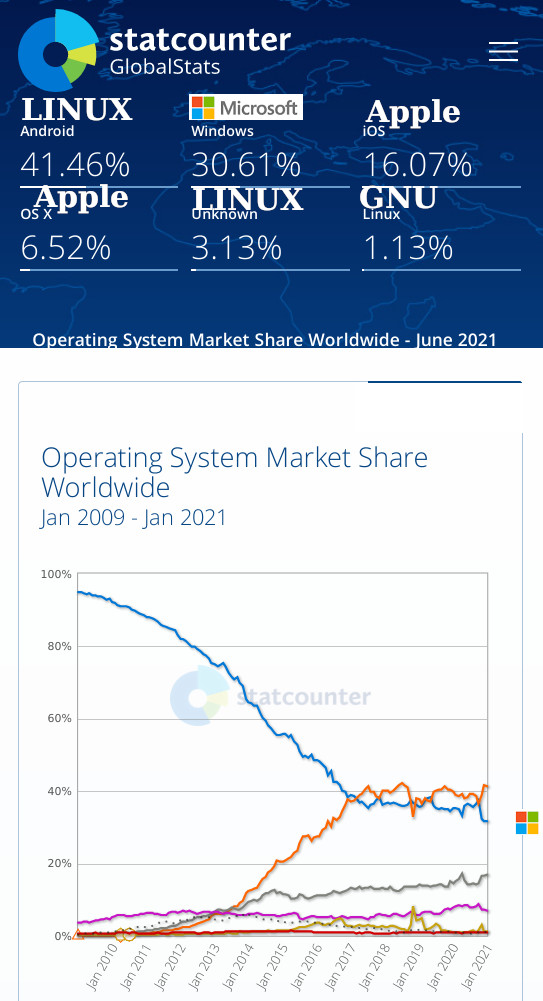
We're not as small as they want us to think

Combined market share continues to grow
CONTRARY to myths perpetuated by corporate media (funded by companies such as Apple and Microsoft through advertising), "Linux" is not a niche player. As actual surveys show, GNU/Linux on the desktop keeps growing, Android is already dominant (de facto standard on portable/mobile devices), and ChromeOS is also a 'thing' -- something based on Gentoo GNU/Linux even if it no longer respects freedom.
Don't let media shame and humiliate GNU/Linux advocates. So much progress has been made; further progress remains to be made. █
»
- Roy Schestowitz's blog
- Login or register to post comments
- Printer-friendly version
- 35265 reads
- PDF version
Why Tuxmachines.org Refuses Connections Sometimes
Submitted by Roy Schestowitz on Sunday 18th of July 2021 02:58:04 AM Filed under
Ongoing issue
EVER since February of this year we've had a hard time pushing back against a torrent of problematic requests, seemingly crafted to cause trouble. We wrote some programs a few months ago to automate mitigations, but occasionally the server still slows down or even hangs up on some legitimate connections/requests.
It would be nice to have an optimal, long-term solution, but we do not have that yet. At the moment it is a compromise. █
»
- Roy Schestowitz's blog
- Login or register to post comments
- Printer-friendly version
- 33305 reads
- PDF version
Improving Our Commitment to Tux Machines Readers
Submitted by Roy Schestowitz on Sunday 11th of July 2021 03:27:05 AM Filed underTux Machines is now self-hosting IRC

Tux Machines is probably one of the largest (in terms of # of pages) GNU/Linux sites out there. But the IRC channel is relatively new (compared to the site).
THE 'IRC wars' of May (and to some degree June as well) left us in a precarious situation and over at Techrights we have set up our own IRC network. In June we set up a #tuxmachines channel in this new network. It has a two-way bridge set up with Freenode, so either network would be valid for following our updates.
We've accordingly updated the IRC page and the corresponding archives. We welcome people to join us in IRC. It's a substitute to RSS feeds or social (control) media. It's now hosted by us, so from a privacy perspective the readers are far better off. It's definitely an upgrade, a well overdue one. █
»
- Roy Schestowitz's blog
- Login or register to post comments
- Printer-friendly version
- 29956 reads
- PDF version
30,000 Comments
Submitted by Roy Schestowitz on Sunday 4th of July 2021 11:47:21 AM Filed under
We turn 17.5 years before Christmas
THE 30,000th comment was recently posted in this site, but that in itself does not say much. More than half a decade ago we had to stop new account sign-ups due to an epidemic of SPAM. It wasn't manageable anymore due to increasing volumes. So leaving comments became harder, too.
Nowadays, as a result, most comments are basically just updates made to submissions of ours, adding related links to existing news updates. We consider that to be a good/better use of the comments feature. It's not prone to abuse. It also helps in keeping the site concise and tidy (less repetition).
It's summer here in England (like the rest of the northern hemisphere), so we try to enjoy the outdoors a bit more often (a certain pandemic notwithstanding). Above is a highland cow. We met one (and her calf) a few weeks ago in the countryside. █
»
- Roy Schestowitz's blog
- Login or register to post comments
- Printer-friendly version
- 26467 reads
- PDF version
Variscite and Basler expand collaboration for embedded vision solutions with NXP® i.MX 8M Plus technology
Submitted by Variscite on Thursday 24th of June 2021 08:54:06 AM Filed underVariscite, a leading System on Module manufacturer, and Basler, an expert in embedded vision, are stepping up their collaboration for solutions based on the NXP i.MX 8 application processor series.
Tel Aviv, June 24, 2021 – Basler and Variscite continue to expand their cooperation, which started in 2018. Both companies offer a complete solution based on NXP i.MX 8 series for the embedded market with production-ready hardware and software.
»
- Variscite's blog
- Login or register to post comments
- Printer-friendly version
- Read more
- 32240 reads
- PDF version
We've Just Turned 17
Submitted by Rianne Schestowitz on Tuesday 8th of June 2021 08:36:00 PM Filed under
Today Tux Machines turns 17. Seventeen years of promoting freedom and privacy in the technical world. Our devotion will carry on along with the community and supporters. Tux Machines is here to stay; today, tomorrow, and in the coming years. Let's celebrate Tux Machines. Cheers! █
»
- Rianne Schestowitz's blog
- Login or register to post comments
- Printer-friendly version
- 44663 reads
- PDF version
Video: Editing Work in Tux Machines
Submitted by Roy Schestowitz on Tuesday 25th of May 2021 11:15:42 AM Filed underTHE site is turning 17 very soon. We thought it would be worthwhile belatedly explaining how it works and how editorial policies evolved to better serve readers and lurkers. █
»
- Roy Schestowitz's blog
- Login or register to post comments
- Printer-friendly version
- 30377 reads
- PDF version
Tux Machines Turning 17 Shortly
Submitted by Roy Schestowitz on Sunday 23rd of May 2021 11:08:22 AM Filed underTHIS site will turn 17 in a couple of weeks (screenshot below). The video above explains how we got here, who's responsible for it, and where we move from here. 
 The video is very informal (totally unscripted, unedited, improvised), but it's also the first time we publish such a video in this site (or the blog).
We wish to thank all those who have supported or merely read us for many years. Spread the word. We're always eager to reach audiences that don't know much about GNU/Linux and may consider switching to it.
In retrospect, as this is composed after making the above video, it's worth noting that the antiX-19.4 page could not be found because of the dash (or hyphen). We rarely miss important news and we're typically very quick to cover/mention important stories. █
»
- Roy Schestowitz's blog
- Login or register to post comments
- Printer-friendly version
- 29196 reads
- PDF version
150,000th Article
Submitted by Rianne Schestowitz on Wednesday 14th of April 2021 09:36:49 PM
2021 is no different from 2020, as we are still fighting the pandemic, but this won't stop or prevent us from running the Web site with solid focus on GNU/Linux and Free Software news. Tux Machines is here to stay. Better and Stronger. █
»
- Rianne Schestowitz's blog
- Login or register to post comments
- Printer-friendly version
- 37283 reads
- PDF version
Elephant and Its Ivory
Submitted by Roy Schestowitz on Saturday 10th of April 2021 11:21:51 AM Filed under
LIVES at risk. This is a travesty. REPUBLIC OF NAMIBIA'S MINISTRY OF ENVIRONMENT, FORESTRY AND TOURISM: "We should manage elephants based on science and not emotions." By auctioning/selling off 170 live elephants? Give us a break. Oftentimes, animals were to make a sacrifice over humans because they are just "animals", so they can't speak to us, and can't protest. We're asked to assume they're just the least important, therefore we can eradicate (or "cull") them -- as simple as that. How I wish the the Animal Kingdom will become a force and burn this kind of society just to make a statement -- and then, maybe, humans will truly realise the value of animal rights. Shame on those African countries which don't give a shit about all those people who tirelessly devoted their time and life to protecting the wild animals, and specifically the elephants. Animals can't speak, but they can see you and they can feel you; just look into and gaze at their eyes, doesn't that give you goosebumps? Burn. █
»
- Roy Schestowitz's blog
- Login or register to post comments
- Printer-friendly version
- Read more
- 38340 reads
- PDF version
Big Traffic in Tux Machines Ahead of 17th Anniversary
Submitted by Roy Schestowitz on Sunday 4th of April 2021 10:09:30 AM Filed under
Credit: Penguin rendering by Mogz
THE Tux Machines site turns 17 in a couple of months and traffic has never been better. This past week it was on average 100,000 hits per day and later this month we will have posted the 150,000th node.
Sorting out the news isn't a simple task, but with experience it gets a lot easier and we're glad to be a leading syndicator in that space. █
»
- Roy Schestowitz's blog
- Login or register to post comments
- Printer-friendly version
- 38540 reads
- PDF version
Migrating TuxMachines to a Bigger Server
Submitted by Roy Schestowitz on Thursday 31st of December 2020 08:21:46 AM Filed underWe are in the process of moving the TuxMachines Web site to a better server with more capacity and better hardware. There may be temporarily odd behaviour on the site (if data is accessed which is out of date). █
»
- Roy Schestowitz's blog
- Login or register to post comments
- Printer-friendly version
- 44228 reads
- PDF version
How can I Identify who SSH into my Linux System?
Submitted by trendoceangd on Saturday 28th of November 2020 09:08:44 AM Filed under
Identifying who has logged into your system in Linux is way easier than the Windows Operating System.
In Linux System whenever someone tries to log in using SSH is recorded by the log file, the log file is located in /var/log/auth.log. location can be different in other distribution.
If you not found the auth.log file in your system try to execute the below command to view the log from systemctl.
journalctl -u sshd |tail -100
- -u (Show the user journal for the current)
- sshd (SSH user created by system by default)
- tail -100 (Print top 100 result from log file)
 User logged in using SSH

»
- trendoceangd's blog
- Login or register to post comments
- Printer-friendly version
- 48963 reads
- PDF version
Monitoring Tux Machines With Apachetop, Nmon and Htop
Submitted by Roy Schestowitz on Monday 21st of September 2020 07:18:40 AM Filed under
Summary: A little glimpse at how we monitor this site for DDOS attacks and general performance, especially now that DDOS attacks have already become pervasive and routine (Apachetop helps identity attack patterns and visual, colourful alerts are triggered in Nmon and Htop)
»
- Roy Schestowitz's blog
- Login or register to post comments
- Printer-friendly version
- 53802 reads
- PDF version

More in Tux Machines
- Highlights
- Front Page
- Latest Headlines
- Archive
- Recent comments
- All-Time Popular Stories
- Hot Topics
- New Members
today's howtos
|
Red Hat Hires a Blind Software Engineer to Improve Accessibility on Linux Desktop
Accessibility on a Linux desktop is not one of the strongest points to highlight. However, GNOME, one of the best desktop environments, has managed to do better comparatively (I think).
In a blog post by Christian Fredrik Schaller (Director for Desktop/Graphics, Red Hat), he mentions that they are making serious efforts to improve accessibility.
Starting with Red Hat hiring Lukas Tyrychtr, who is a blind software engineer to lead the effort in improving Red Hat Enterprise Linux, and Fedora Workstation in terms of accessibility.
|
Today in Techrights
|
Android Leftovers |


.svg_.png)

 Content (where original) is available under CC-BY-SA, copyrighted by original author/s.


Recent comments
30 weeks 3 days ago
30 weeks 3 days ago
30 weeks 3 days ago
30 weeks 4 days ago
30 weeks 4 days ago
30 weeks 4 days ago
30 weeks 4 days ago
30 weeks 4 days ago
30 weeks 4 days ago
30 weeks 4 days ago