




Blogs
Linux conundrums lately
Submitted by srlinuxx on Thursday 30th of September 2010 05:03:03 PM Filed under
I'd been happily using Sabayon 5.3 past several months until one unhappy update. So, I went back to my Mepis install. Then I remembered why I had to move on from it. So with Sabayon 5.4, will my KDE desktop return to a usable state?
»
- srlinuxx's blog
- Login or register to post comments
 Printer-friendly version
- Read more
- 4088 reads
 PDF version
under the weather
Submitted by srlinuxx on Saturday 25th of September 2010 04:46:06 PM Filed under
You may have noticed the lack of updates to the site past few days, and along with my apologies comes the explanation that I've been very ill.
Texas Mint Tea, anyone?
Submitted by revdjenk on Friday 24th of September 2010 08:56:44 PMWhat if … a new Texas-Irish distro could rise from joining forces of the current number three and number six distro "factories?"
»
- revdjenk's blog
- Login or register to post comments
- Printer-friendly version
- Read more
- 4494 reads
- PDF version
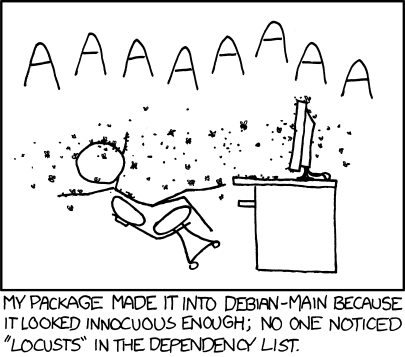
Debian-Main Locus(t) Error
Submitted by revdjenk on Friday 24th of September 2010 08:27:15 PMfrom XKCD 24-09-2010

»
- revdjenk's blog
- Login or register to post comments
- Printer-friendly version
- Read more
- 3432 reads
- PDF version
echo "Hello World"
Submitted by JULinux on Monday 20th of September 2010 07:02:22 PM Filed under
Hello,
My name is Justin Breithaupt the maker of JULinux...
»
- JULinux's blog
- Login or register to post comments
- Printer-friendly version
- Read more
- 3317 reads
- PDF version
Virtualization
Submitted by artwales on Wednesday 8th of September 2010 08:16:37 PM Filed underIn my last post, i introduced some of us to the world of Linux, the advantages it offers and the status it confers.
Understandably, it is still a Microsoft world, so i wouldn’t expect you to just clean out your Windows operating system and install Linux. If you do that, trust me, you will definitely have issues, truck loads.
»
- artwales's blog
- Login or register to post comments
- Printer-friendly version
- Read more
- 2654 reads
- PDF version
Amnesia: TDD Ready
Submitted by srlinuxx on Wednesday 8th of September 2010 02:12:54 PM Filed underAlthough I've not seen an official announcement yet, Amnesia: The Dark Descent is ready to download - at least for pre-orders.
»
- srlinuxx's blog
- Login or register to post comments
- Printer-friendly version
- Read more
- 10098 reads
- PDF version
under the weather
Submitted by srlinuxx on Wednesday 14th of July 2010 04:05:18 AM Filed underIf any have been wondering why things might seem a bit slow around here lately, it's because I haven't been feeling well. Hopefully things should be getting back to normal in the next coupla days. Thanks for your patience.
»
X Window System
Submitted by mywebblog on Friday 9th of July 2010 03:56:02 AM Filed underThe X Window System (www.x.org) was created in 1984 at the Massachusetts Institute of Technology (MIT) by researchers working on a distributed computing project and a campuswide distributed environment, called Project Athena. This system was not the first windowing software to run on a UNIX system, but it was the first to become widely available and accepted. In 1985, MIT released X (version 9) to the public, for use without a license. Three years later, a group of vendors formed the X Consortium to support the continued development of X, under the leadership of MIT. By 1998, the X Consortium had become part of the Open Group. In 2001, the Open Group released X version 11, release 6.6 (X11R6.6).
»
- mywebblog's blog
- Login or register to post comments
- Printer-friendly version
- Read more
- 3016 reads
- PDF version
Cloud computing on Linux can help small business
Submitted by bigbearomaha on Tuesday 6th of July 2010 02:53:11 AMBig companies like RedHat are getting into Software as a Service, otherwise known as "cloud computing".
»
- bigbearomaha's blog
- Login or register to post comments
- Printer-friendly version
- Read more
- 19643 reads
- PDF version
5 most interesting linux commands
Submitted by linkin47 on Friday 2nd of July 2010 03:10:02 PM Filed under5 most interesting linux commands to try out.
»
- linkin47's blog
- Login or register to post comments
- Printer-friendly version
- Read more
- 5654 reads
- PDF version
Make your own linux operating system with archlinux
Submitted by linkin47 on Friday 2nd of July 2010 02:02:56 PM Filed underArch Linux is a highly customizable Linux Distro which is easy to setup and use . Arch Linux is mainly meant for persons with the mentality ” Do it ourselves ” . I was also one of them who tried to install Arch Linux in my computer and atlast succeded in installing this highly customized Linux distribution .
»
- linkin47's blog
- Login or register to post comments
- Printer-friendly version
- Read more
- 6216 reads
- PDF version
All hail the easy to use!
Submitted by srlinuxx on Thursday 17th of June 2010 05:34:48 PM Filed underI've run Linux since before the turn of the century. I know Linux. I love the commandline. But after 10 years of fiddling, I've come to realize one significant thing.
Big Thank You to Contributors
Submitted by srlinuxx on Wednesday 16th of June 2010 07:55:38 PM Filed underI want to formally thank all those who contributed to the Tuxmachines' fund raiser this past 24 hours. The response has been heart warming to say the least.
»
Linux Failed to Satisfy Old PC Users
Submitted by dangareyes on Friday 11th of June 2010 05:28:12 PM Filed underSome months ago, i wrote article “3 Reasons why we shouldn’t use Linux“, after a lot of comments on the article in the favor of Linux, I thought i should also try Linux. So i downloaded Fedora 13.
»
- dangareyes's blog
- Login or register to post comments
- Printer-friendly version
- Read more
- 3130 reads
- PDF version
More Iron for your blood...
Submitted by revdjenk on Friday 21st of May 2010 02:45:49 AMBrowse more privately with Chrome.
»
- revdjenk's blog
- Login or register to post comments
- Printer-friendly version
- Read more
- 10007 reads
- PDF version
From Karmic to Lucid: Distribution Update Screenshots
Submitted by eco2geek on Wednesday 5th of May 2010 10:49:33 AM Filed under In line with its newbie-friendly tradition of providing a way to do everything via a graphical user interface, Ubuntu provides a way to do a distribution upgrade by clicking a button at the top of the Update Manager. Since version 10.04 was released on April 29, it was once again time to see how well the upgrade went. Here are screenshots of the entire process.
»
- eco2geek's blog
- Login or register to post comments
- Printer-friendly version
- Read more
- 27147 reads
- PDF version
Ubuntu 10.04 LTS Finally Released!
Submitted by akramshaikh on Thursday 29th of April 2010 07:18:26 PM Filed underDespite being declared for re-spin of the ISO for last minute bugs fix, the latest Ubuntu, 10.04 LTS (Lucid Lynx) has been finally released an hour ago.
Link Here: http://tinytux.blogspot.com/2010/04/ubuntu-1004-lts-finally-released.html
»
- akramshaikh's blog
- Login or register to post comments
- Printer-friendly version
- 6995 reads
- PDF version
Freshly Squeezed Debian: Installing from Live DVD
Submitted by eco2geek on Tuesday 20th of April 2010 09:26:03 AM Filed under
Last month, the Debian Live Project released live CD and DVD images of the next version of Debian, codenamed "Squeeze." They included an installer that uses the live filesystem rather than packages, so it has the advantages of being fast and allowing you to preview on the live media, what you eventually get on your hard drive. This may not seem like a big deal, since most modern Linux distributions use this installation method, but it's still fairly new for Debian. I downloaded and installed the 64-bit GNOME version.
»
- eco2geek's blog
- Login or register to post comments
- Printer-friendly version
- Read more
- 42077 reads
- PDF version
Open Source model for Drug Discovery (OSDD)
Submitted by sackana on Monday 12th of April 2010 09:58:32 AM Filed under»
- sackana's blog
- Login or register to post comments
- Printer-friendly version
- 4412 reads
- PDF version

More in Tux Machines
- Highlights
- Front Page
- Latest Headlines
- Archive
- Recent comments
- All-Time Popular Stories
- Hot Topics
- New Members
digiKam 7.7.0 is released
After three months of active maintenance and another bug triage, the digiKam team is proud to present version 7.7.0 of its open source digital photo manager. See below the list of most important features coming with this release.
|
Dilution and Misuse of the "Linux" Brand
|
Samsung, Red Hat to Work on Linux Drivers for Future Tech
The metaverse is expected to uproot system design as we know it, and Samsung is one of many hardware vendors re-imagining data center infrastructure in preparation for a parallel 3D world.
Samsung is working on new memory technologies that provide faster bandwidth inside hardware for data to travel between CPUs, storage and other computing resources. The company also announced it was partnering with Red Hat to ensure these technologies have Linux compatibility.
|
today's howtos
|


.svg_.png)

 Content (where original) is available under CC-BY-SA, copyrighted by original author/s.


Recent comments
1 year 9 weeks ago
1 year 9 weeks ago
1 year 9 weeks ago
1 year 9 weeks ago
1 year 9 weeks ago
1 year 9 weeks ago
1 year 9 weeks ago
1 year 9 weeks ago
1 year 9 weeks ago
1 year 9 weeks ago