



Programming Leftovers
Submitted by Roy Schestowitz on Sunday 17th of July 2022 09:58:07 AM
Filed under

-
Filtering numbers faster with SVE on Graviton 3 processors
Amazon’s Graviton 3 appears to have 32-byte registers, since it is based on the ARM Neoverse V1 design. You can fit eight 32-bit integers in one register. Mainstream ARM processors (e.g., the ones that Intel uses) have SIMD instructions too (NEON), but with shorter registers (16 bytes). Having wider registers and instructions capable of operating over these wide registers allows you reduce the total number of instructions. Executing fewer instructions is a very good way to accelerate code.
To investigate SVE, I looked at a simple problem where you want to remove all negative integers from an array. That is, you read and array containing signed random integers and you want to write out to an output array only the positive integers. Normal C code might look as follows: [...]
-
Finally got rid of a/ and b/ in git diff outputs!
In the world of open source there’s always this notion of “if you want something to be different, the code is there, you can change it”, but most often this is not practical: I would never go about carrying a patched version of Git with me to every machine I work on just because of the annoying `a/` and `b/` prefixes that show up on Git diffs.
-
Your git log is not a changelog! | agateau.com
When you maintain a project, publishing new releases can quickly become a chore, so naturally one tries to automate it as much as possible.
One release step which is often automated is updating the changelog. We already have git commit messages, so let's gather all the messages since the last tag and "Voilà!" changelog entries for the new version!
-
What are Pascal Strings ?
This article intends to provide a basic understanding of traditionally used strings i.e. “Pascal Strings”. As the name is self-explanatory, pascal strings are an essential constituent of the PASCAL programming language. Pascal is a computer programming language that Niklaus Wirth of Switzerland created around 1970 to teach organized programming.
-
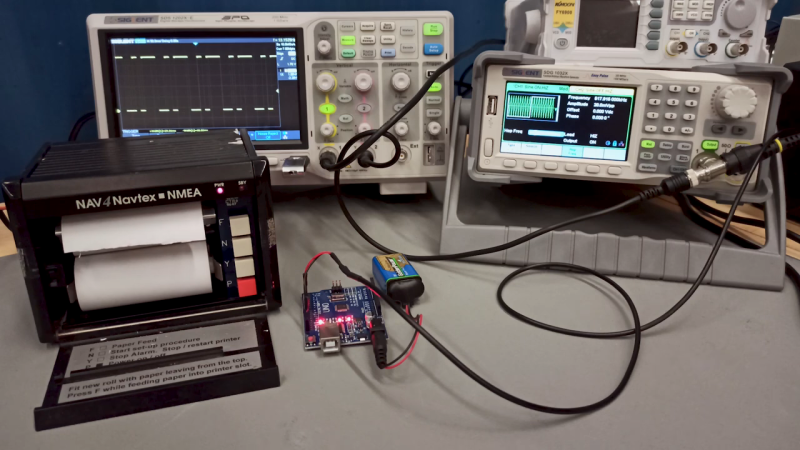
Impatience Is A Virtue When Testing This Old Maritime Teleprinter
[Larry Wall], inventor of Perl, once famously said that programmers have three key virtues: sloth, hubris, and impatience. It’s safe to say that these personality quirks are also present in some measure in most hardware hackers, too, with impatience being perhaps the prime driver of great hacks. Life’s too short to wait for someone else to build it, whatever it may be.
-
Ideas from TPRC2022: Tools to help refactor large mature code bases | dean [blogs.perl.org]
Every Perl gig I have ever had, and from most of the conversations I had at this years Perl and Raku Conference, was working on a large code based that is serving the business and it's customers very well such that the business is profitable (i.e. a mature code base).
This is an enviable position to be in but whilst this software is robust from the outside, there is often a reluctance to make dramatic changes. Unfortunately code that is perceived as too fragile to touch tends to be replaced and replaced in another language.
The PPI + Class::Inspector combination is already being used by people I've spoken too, in bespoke tools to refactor large code bases reliably.
»
-

- Login or register to post comments
 Printer-friendly version
- 792 reads
 PDF version
More in Tux Machines
- Highlights
- Front Page
- Latest Headlines
- Archive
- Recent comments
- All-Time Popular Stories
- Hot Topics
- New Members
today's howtos
| Open Hardware: XON/XOFF and Raspberry Pi Pico
|
Security Leftovers
| How to Apply Accent Colour in Ubuntu Desktop
A step-by-step tutorial on how to apply accent colour in Ubuntu desktop (GNOME) with tips for Kubuntu and others.
|



 This section of TuxMachines will no longer have new stories in it (with some caveats, including this post). To see the latest stories go to


 Content (where original) is available under CC-BY-SA, copyrighted by original author/s.



Recent comments
2 days 3 hours ago
2 days 7 hours ago
2 days 7 hours ago
3 days 14 hours ago
3 days 15 hours ago
3 days 16 hours ago
3 days 16 hours ago
3 days 17 hours ago
3 days 19 hours ago
3 days 21 hours ago