



Programming and Security
Submitted by Roy Schestowitz on Monday 6th of June 2022 06:07:54 AM
Filed under 

-
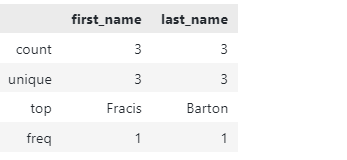
Pandas Describe
The pandas describe() function allows you to get the statistical summary of the data within your Pandas DataFrame. The function returns statistical information on the data, including statistical mean, standard deviation, min and max values, etc.
-
Pandas Timestamp Get Day
Pandas provide us with the day attribute that allows extracting the day from a given timestamp object.
-
Create a List of Lists in Python
Lists are similar to dynamically allocated arrays, declared in other languages. Lists do not always have to be homogeneous, making Python’s most powerful feature. Integers, Strings, and Objects can all be found in a single list. Lists are changeable, which means they can be changed after they are created.
In Python, lists are ordered and counted. Every member inside the list has its separate position in the list, allowing duplication of the list’s elements while maintaining the credibility of each member. Lists help store and iterate through an iteration of data.
-
Error iso C++ Forbids Variable Length Array
Variable size arrays (VLAs) are not forbidden in C++; the iso error is correct. Runtime-sized or variable-sized arrays are the other names for variable-length arrays. The size of these arrays is set at runtime. Among the kinds that can be updated are variable-length arrays and pointers to variable-length arrays. Variably modified types should be defined at either the block or function prototype level. Variable-length arrays are a feature that allows us to allocate a variable-size auto array on the stack. In a typedef statement, it can be utilized. From the C++ standard onwards, C enables variable-size arrays. The program below, for example, compiles and runs perfectly in C.
-
Cybersecurity should be more complex than 123456 | The Apopka Voice
If companies like CNA and Facebook get hacked, what chance do you have to prevent a cyber attack? The answer may be as simple as “123456.”
Incredibly, “123456” is the most common password used in most places worldwide. Others that rank high are “password” and “qwerty” (look down at your keyboard, and you'll see why that is popular). But simplistic options are not the only troubling trend in common passwords.
-
Bug Bounty Guide For Beginner | Bug Bounty Tutorials 2022
»
-

- Login or register to post comments
 Printer-friendly version
- 1449 reads
 PDF version
More in Tux Machines
- Highlights
- Front Page
- Latest Headlines
- Archive
- Recent comments
- All-Time Popular Stories
- Hot Topics
- New Members
digiKam 7.7.0 is released
After three months of active maintenance and another bug triage, the digiKam team is proud to present version 7.7.0 of its open source digital photo manager. See below the list of most important features coming with this release.
|
Dilution and Misuse of the "Linux" Brand
|
Samsung, Red Hat to Work on Linux Drivers for Future Tech
The metaverse is expected to uproot system design as we know it, and Samsung is one of many hardware vendors re-imagining data center infrastructure in preparation for a parallel 3D world.
Samsung is working on new memory technologies that provide faster bandwidth inside hardware for data to travel between CPUs, storage and other computing resources. The company also announced it was partnering with Red Hat to ensure these technologies have Linux compatibility.
|
today's howtos
|


 Content (where original) is available under CC-BY-SA, copyrighted by original author/s.



Recent comments
1 year 11 weeks ago
1 year 11 weeks ago
1 year 11 weeks ago
1 year 11 weeks ago
1 year 11 weeks ago
1 year 11 weeks ago
1 year 11 weeks ago
1 year 11 weeks ago
1 year 11 weeks ago
1 year 11 weeks ago