



Arduino Projects: GetFit and RuneScape
Submitted by Roy Schestowitz on Friday 3rd of June 2022 11:06:59 PM
Filed under 
-
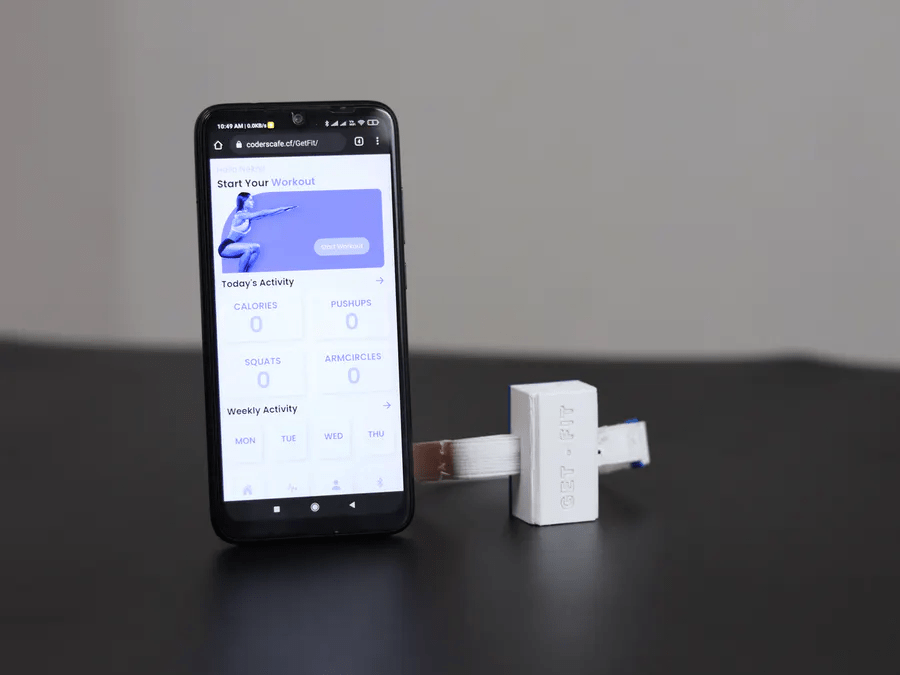
GetFit is a DIY fitness tracker based on the Nano 33 BLE Sense | Arduino Blog
When it comes to fitness tracking, the average consumer would most likely reach for a smartwatch or similar wearable band. These all work by using their internal accelerometers and gyroscopes to sense motion and detect when a certain action, such as stepping or lifting a weight, has been completed. But to further simplify the process by eliminating the need to select a workout before starting an exercise routine, Nekhil and Shebin Jacob have worked together to come up with the GetFit fitness tracker.
The GetFit is a battery-powered device that uses machine learning to detect not only when an action has been done, but also what kind of workout is being performed. They achieved this by gathering plenty of samples from a Nano 33 BLE Sense’s onboard accelerometer and training a Keras model with the help of the Edge Impulse Studio. It can accurately identify between arm circles, pushups, squats, and anything else in the future while also disregarding anomalous data.
-
A real-world health bar for Old School RuneScape | Arduino Blog
For those of us of a certain age, RuneScape provides a deep sense of nostalgia. The original RuneScape MMORPG died off in popularity many years ago, but Old School RuneScape, which launched in 2013, recently gained traction once again. As with most MMORPGs, Old School RuneScape gives the player a health readout in the form of hit points. Austin Blake wanted to see his character’s health in the real world and turned to Arduino to make it happen.
Blake chose to display his hit points on a heart-shaped LED array. It indicates health through both color and level. At full health, all of the LEDs light up in green. At half health, only half of the LEDs are lit and they light up in amber. The LEDs are strips of Adafruit NeoPixels and Blake controls them with an Arduino Nano Every board running the FastLED library. Those mount into a 3D-printed frame that Blake designed in Autodesk Fusion 360.
»
-

- Login or register to post comments
 Printer-friendly version
- 1499 reads
 PDF version
More in Tux Machines
- Highlights
- Front Page
- Latest Headlines
- Archive
- Recent comments
- All-Time Popular Stories
- Hot Topics
- New Members
digiKam 7.7.0 is released
After three months of active maintenance and another bug triage, the digiKam team is proud to present version 7.7.0 of its open source digital photo manager. See below the list of most important features coming with this release.
|
Dilution and Misuse of the "Linux" Brand
|
Samsung, Red Hat to Work on Linux Drivers for Future Tech
The metaverse is expected to uproot system design as we know it, and Samsung is one of many hardware vendors re-imagining data center infrastructure in preparation for a parallel 3D world.
Samsung is working on new memory technologies that provide faster bandwidth inside hardware for data to travel between CPUs, storage and other computing resources. The company also announced it was partnering with Red Hat to ensure these technologies have Linux compatibility.
|
today's howtos
|


 Content (where original) is available under CC-BY-SA, copyrighted by original author/s.



Recent comments
1 year 11 weeks ago
1 year 11 weeks ago
1 year 11 weeks ago
1 year 11 weeks ago
1 year 11 weeks ago
1 year 11 weeks ago
1 year 11 weeks ago
1 year 11 weeks ago
1 year 11 weeks ago
1 year 11 weeks ago