



Development, Devices, and Programming
Submitted by Roy Schestowitz on Tuesday 31st of May 2022 07:41:16 AM
Filed under 

-
EDDI is an open source chatbot platform for developer
EDDI the answer to workflow and communication optimization through artificial intelligence.
EDDI (Enhanced Dialog Driven Intelligence)is an open source chatbot platform to create, run and maintain multiple customizable virtual assistant. Labs.ai, the company behind EDDI, developed it and started shipping it by default since 2018.
EDDI is important for developers who need chatbot in their apps, and basically anyone who wants to get free chatbot without having to deal with licensing issues (No attribution required).
EDDI is an open source chatbot development platform for developers by developers. It is essential to know that this platform is developed in java and provided with Docker, orchestrated with Kubernetes.
This is where EDDI comes into picture. It is an open source chatbots developer platform for conversational Artificial Intelligent.
[...]
It is licensed under the Apache License 2.0 and works on Windows, macOS and Linux.
-
How to read tab-separated values (TSV) files in Python
To read tab-separated values files with Python, we’ll take advantage of the fact that they’re similar to CSVs. We’ll use Python’s csv library and tell it to split things up with tabs instead of commas. Just set the delimiter argument to "\t".
-
Debugging a mysterious Python crash
I recently wanted to prepare a Jupyter notebook with some example code and ran into an interesting problem: trying to display a Matplotlib chart made the IPython kernel crash.
-
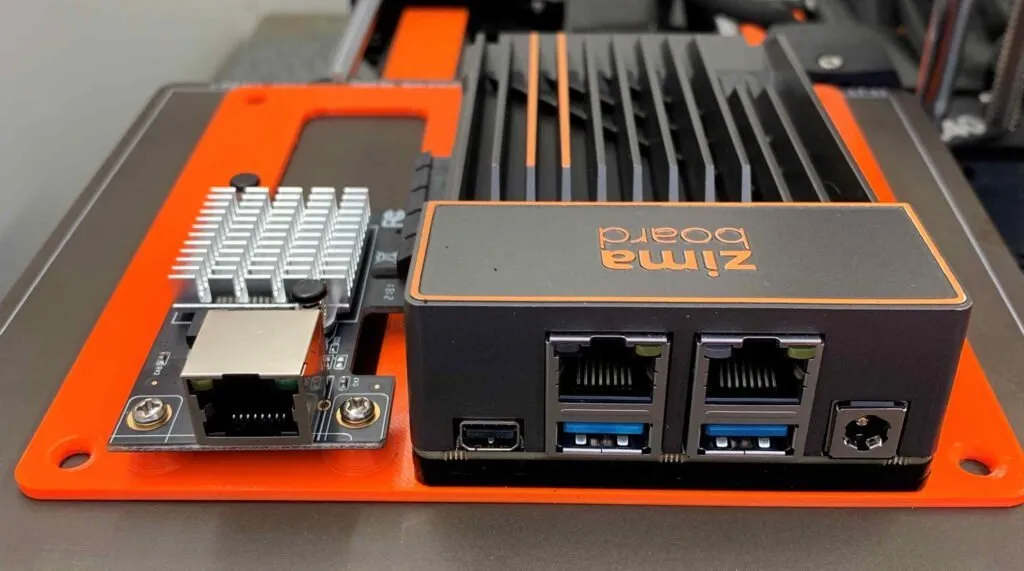
Installing pfSense 2.6 on ZimaBoard
I backed the ZimaBoard Single Board Server project on Kickstarter in early 2021, a couple of months ago it finally arrived and the first project on the todo list was to try this as a replacement for my overkill pfSense server (Dell R210 II Server) which consumed ~100W compared to ~6W of the Zimabaord, a cost reduction of over £200 per year in electricity costs too. The ZimaBoard comes pre-installed with Casa OS on the onboard 32GB eMMC storage, but that can be overwritten with whatever software we want.
When I backed the project, I also bought an extra NIC as I needed 3 connections if I was going to have a backup WAN link, however, there isn’t a way to mount the PCIe Network Card into the ZimaBoard and keep it secured. The usual riser bracket also has to be removed as it would otherwise foul the case.
Note: This isn’t the setup I finally ended up running, but this is the journey I went on.
-
Forlinx OKMX6ULL-C SBC powered by i.MX 6ULL processor from NXP
Forlinx recently released the OKMX6ULL-C which is a Single Board Computer (SBC) that is compatible with their NXP based FETMX6ULL-C System on Module (SoM). The SoM features a i.MX 6ULL that contains a Cortex-A7 with a frequency of 800MHz, 512MB DDR3 and 8GB for eMMC storage.
»
-

- Login or register to post comments
 Printer-friendly version
- 1482 reads
 PDF version
More in Tux Machines
- Highlights
- Front Page
- Latest Headlines
- Archive
- Recent comments
- All-Time Popular Stories
- Hot Topics
- New Members
digiKam 7.7.0 is released
After three months of active maintenance and another bug triage, the digiKam team is proud to present version 7.7.0 of its open source digital photo manager. See below the list of most important features coming with this release.
|
Dilution and Misuse of the "Linux" Brand
|
Samsung, Red Hat to Work on Linux Drivers for Future Tech
The metaverse is expected to uproot system design as we know it, and Samsung is one of many hardware vendors re-imagining data center infrastructure in preparation for a parallel 3D world.
Samsung is working on new memory technologies that provide faster bandwidth inside hardware for data to travel between CPUs, storage and other computing resources. The company also announced it was partnering with Red Hat to ensure these technologies have Linux compatibility.
|
today's howtos
|


 Content (where original) is available under CC-BY-SA, copyrighted by original author/s.



Recent comments
1 year 11 weeks ago
1 year 11 weeks ago
1 year 11 weeks ago
1 year 11 weeks ago
1 year 11 weeks ago
1 year 11 weeks ago
1 year 11 weeks ago
1 year 11 weeks ago
1 year 11 weeks ago
1 year 11 weeks ago