



Programming Leftovers
Submitted by Roy Schestowitz on Sunday 8th of May 2022 10:12:41 PM
Filed under 
-
lispreading
One thing that I would like to understand better is the place of code walking in macro programming. The Raskin paper explains that it is not possible to write a fully correct code walker in ANSI CL. Consfigurator currently uses Raskin’s best-effort portable code walker. Common Lisp: The Language 2 includes a few additional functions which didn’t make it into the ANSI standard that would make it possible to write a fully correct code walker, and most implementations of CL provide them under one name or another. So one possibility is to write a code walker in terms of ANSI CL + those few additional functions, and then use a portability layer to get access to those functions on different implementations (e.g. trivial-cltl2).
However, both On Lisp and Let Over Lambda, the two most substantive texts on CL macrology, both explicitly put code walking out-of-scope. I am led to wonder: does the Zen of Common Lisp-style macrology involve doing without code walking? One key idea with macros is to productively blur the distinction between designing languages and writing code in those languages. If your macros require code walking, have you perhaps ended up too far to the side of designing whole languages? Should you perhaps rework things so as not to require the code walking? Then it would matter less that those parts of CLtL2 didn’t make it into ANSI. Graham notes in ch. 17 of On Lisp that read macros are technically more powerful than defmacro because they can do everything that defmacro can and more. But it would be a similar sort of mistake to conclude that Lisp is about read macros rather than defmacro.
-
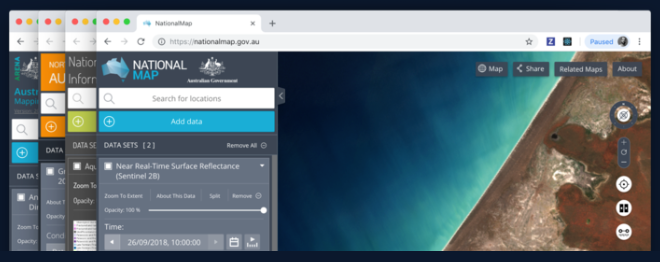
TerriaJS is an open-source web-based geospatial cataloging framework
TerriaJS is a feature rich open source solution for building amazing spatial data federation web platforms.
-
Thorsten Alteholz: My Debian Activities in April 2022
This month I accepted 186 and rejected 26 packages. The overall number of packages that got accepted was 188.
-
revealJS is an open-source presentation framework
reveal.js is an open source HTML presentation framework. It enables anyone with a web browser to create beautiful presentations for free.
Presentations made with reveal.js are built on open web technologies. That means anything you can do on the web, you can do in your presentation. Change styles with CSS, include an external web page using an <iframe> or add your own custom behavior using our JavaScript API.
You can use Markdown to create a stylish presentation with reveal.js. Developers can easily embed reveal.js in their web projects.
-
Save the date - Deutscher Perl/Raku Workshop 2023 in Frankfurt am Main - 27.02.2023-1.03.2023
Hello everybody,

after a long time of waiting it is finally time - we cordially invite you
to the German Perl/Raku Workshop 2023.

Next year's workshop will take place from Monday 28 February to
Wednesday 1. March in the Saalbau Gallus in Frankfurt am Main.
-
On forms of apparent progress « Paul Boddie's Free Software-related blog
Over the years, I have had a few things to say about technological change, churn, and the appearance of progress, a few of them touching on the evolution and development of the Python programming language. Some of my articles have probably seemed a bit outspoken, perhaps even unfair. It was somewhat reassuring, then, to encounter the reflections of a longstanding author of Python books and his use of rather stronger language than I think I ever used. It was also particularly reassuring because I apparently complain about things in far too general a way, not giving specific examples of phenomena for anything actionable to be done about them. So let us see whether we can emerge from the other end of this article in better shape than we are at this point in it.
Now, the longstanding author in question is none other than Mark Lutz whose books “Programming Python” and “Learning Python” must surely have been bestsellers for their publisher over the years. As someone who has, for many years, been teaching Python to a broad audience of newcomers to the language and to programming in general, his views overlap with mine about how Python has become increasingly incoherent and overly complicated, as its creators or stewards pursue some kind of agenda of supposed improvement without properly taking into account the needs of the broadest reaches of its user community. Instead, as with numerous Free Software projects, an unscrutable “vision” is used to impose change based on aesthetics and contemporary fashions, unrooted in functional need, by self-appointed authorities who often lack an awareness or understanding of historical precedent or genuine user need.
»
-

- Login or register to post comments
 Printer-friendly version
- 1475 reads
 PDF version
More in Tux Machines
- Highlights
- Front Page
- Latest Headlines
- Archive
- Recent comments
- All-Time Popular Stories
- Hot Topics
- New Members
digiKam 7.7.0 is released
After three months of active maintenance and another bug triage, the digiKam team is proud to present version 7.7.0 of its open source digital photo manager. See below the list of most important features coming with this release.
|
Dilution and Misuse of the "Linux" Brand
|
Samsung, Red Hat to Work on Linux Drivers for Future Tech
The metaverse is expected to uproot system design as we know it, and Samsung is one of many hardware vendors re-imagining data center infrastructure in preparation for a parallel 3D world.
Samsung is working on new memory technologies that provide faster bandwidth inside hardware for data to travel between CPUs, storage and other computing resources. The company also announced it was partnering with Red Hat to ensure these technologies have Linux compatibility.
|
today's howtos
|


 Content (where original) is available under CC-BY-SA, copyrighted by original author/s.



Recent comments
1 year 11 weeks ago
1 year 11 weeks ago
1 year 11 weeks ago
1 year 11 weeks ago
1 year 11 weeks ago
1 year 11 weeks ago
1 year 11 weeks ago
1 year 11 weeks ago
1 year 11 weeks ago
1 year 11 weeks ago