



Ubuntu-based Pop!_OS Spotted on Raspberry Pi
Submitted by Roy Schestowitz on Saturday 9th of October 2021 08:49:21 PM
Filed under 
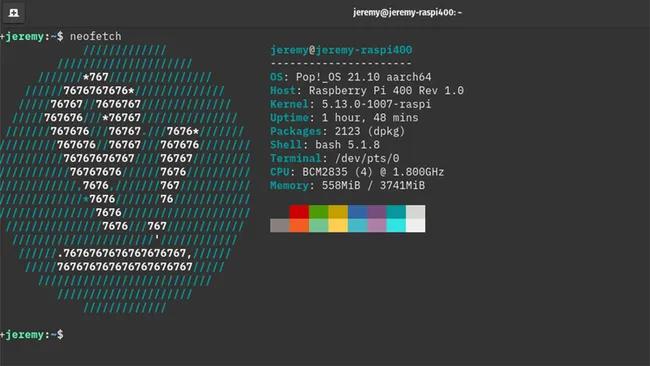
The scent of a Raspberry Pi port can be traced to Twitter, where System76’s Principal Engineer and Pop!_OS maintainer Jeremy Soller recently posted a photo showing the 64 bit OS apparently running on a stock Raspberry Pi 400. More tellingly, he also shared a link to a repository full of Pop!_OS packages for ARM devices.
For those not already familiar, Pop!_OS is an Ubuntu-based OS that’s free and open-source, with a custom Gnome desktop known as COSMIC. It’s maintained by System76, a computer builder operating out of Denver, Colorado, that sells laptops, desktops and servers, all with either Pop!_OS or Ubuntu installed. They’re quite keen on Linux there, it could be said.
Pop!_OS is notable for its support of AMD and Nvidia GPUs with no additional tinkering, and its auto-tiling desktop, which fills your display with app windows. A tabbed, web-browser-like, look is also available, along with a complete set of keyboard shortcuts to move windows around. It has a 7.5% share of all Steam installations on Linux, according to the Steam Hardware Survey.

More System 76: Marquita Wiggins is Developing her Open Source Graphic Design Program: Designy
»
-

- Login or register to post comments
 Printer-friendly version
- 3342 reads
 PDF version
More in Tux Machines
- Highlights
- Front Page
- Latest Headlines
- Archive
- Recent comments
- All-Time Popular Stories
- Hot Topics
- New Members
digiKam 7.7.0 is released
After three months of active maintenance and another bug triage, the digiKam team is proud to present version 7.7.0 of its open source digital photo manager. See below the list of most important features coming with this release.
|
Dilution and Misuse of the "Linux" Brand
|
Samsung, Red Hat to Work on Linux Drivers for Future Tech
The metaverse is expected to uproot system design as we know it, and Samsung is one of many hardware vendors re-imagining data center infrastructure in preparation for a parallel 3D world.
Samsung is working on new memory technologies that provide faster bandwidth inside hardware for data to travel between CPUs, storage and other computing resources. The company also announced it was partnering with Red Hat to ensure these technologies have Linux compatibility.
|
today's howtos
|


 Content (where original) is available under CC-BY-SA, copyrighted by original author/s.



Recent comments
1 year 11 weeks ago
1 year 11 weeks ago
1 year 11 weeks ago
1 year 11 weeks ago
1 year 11 weeks ago
1 year 11 weeks ago
1 year 11 weeks ago
1 year 11 weeks ago
1 year 11 weeks ago
1 year 11 weeks ago