



today's leftovers
Submitted by Roy Schestowitz on Saturday 28th of August 2021 05:38:19 AM
Filed under 
-
The stars are aligning for federal IT open source software adoption
-
Fedora Community Blog: Friday’s Fedora Facts: 2021-34
Here’s your weekly Fedora report. Read what happened this week and what’s coming up. Your contributions are welcome (see the end of the post)!
I have weekly office hours on Wednesdays in the morning and afternoon (US/Eastern time) in #fedora-meeting-1. Drop by if you have any questions or comments about the schedule, Changes, elections, or anything else. See the upcoming meetings for more information.
-
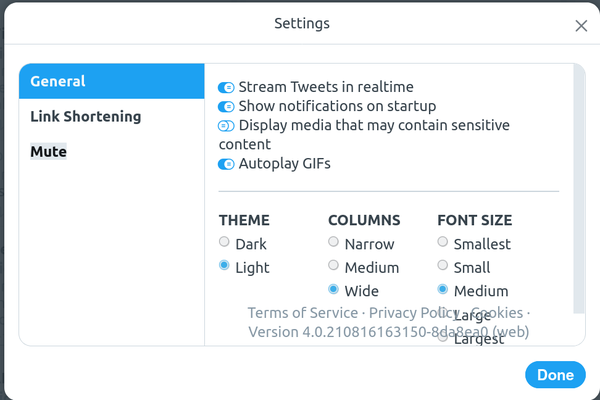
An alternative Twitter interface
Once a problem child on Linux, the Twitter client TweetDeck now installs easily, offering unrivaled features. However, potential changes in the updated beta version raise potential concerns for its future as an alternative Linux-based Twitter interface.
TweetDeck, the Twitter client, has a troubled history with Linux. When TweetDeck was a standalone interface, it was difficult to install because of its dependency on Adobe Air, which lacked a 64-bit Linux version. In addition, TweetDeck was Gnome-centric and did not always run well on other desktop environments. As a result, at least a dozen Linux alternatives for the command line and non-Gnome desktops have come and gone in the last decade or so, including Anatine, Choqok, Franz, Rainbow Stream, and Turpial -- all of which are adequate for basic tweeting but which lack TweetDeck’s array of advanced features.
By the time Twitter acquired TweetDeck a decade ago and released it as a freeware web application, Linux users had simply fallen out of the habit of trying to work with it. However, the installation problems no longer exist, and there is still no other Twitter client on any platform that rivals TweetDeck’s advanced features. A reconsideration of TweetDeck is long overdue.
-
Linux 5.14 SSD Benchmarks With Btrfs vs. EXT4 vs. F2FS vs. XFS
A number of Phoronix readers have been asking about some fresh file-system comparisons on recent kernels. With not having the time to conduct the usual kernel version vs. file-system comparison, here are some fresh benchmarks looking at the Btrfs, EXT4, F2FS, and XFS file-system benchmarks on a speedy WD_BLACK SN850 NVMe solid-state drive.
-
Exploring Void Linux - A Different Kind Of Distro - Invidious
Today, I'm taking a quick look at Void Linux. Void is an interesting Linux distribution in that it is an independent distro, and it is quite minimal (suckless) by design. It has its own package manager and its own init system (not systemd!).
-
I wasn't prepared for how much System76 has changed! - Invidious
-
Super 8 camera goes digital with Raspberry Pi
»
-

- Login or register to post comments
 Printer-friendly version
- 2176 reads
 PDF version
More in Tux Machines
- Highlights
- Front Page
- Latest Headlines
- Archive
- Recent comments
- All-Time Popular Stories
- Hot Topics
- New Members
digiKam 7.7.0 is released
After three months of active maintenance and another bug triage, the digiKam team is proud to present version 7.7.0 of its open source digital photo manager. See below the list of most important features coming with this release.
|
Dilution and Misuse of the "Linux" Brand
|
Samsung, Red Hat to Work on Linux Drivers for Future Tech
The metaverse is expected to uproot system design as we know it, and Samsung is one of many hardware vendors re-imagining data center infrastructure in preparation for a parallel 3D world.
Samsung is working on new memory technologies that provide faster bandwidth inside hardware for data to travel between CPUs, storage and other computing resources. The company also announced it was partnering with Red Hat to ensure these technologies have Linux compatibility.
|
today's howtos
|


 Content (where original) is available under CC-BY-SA, copyrighted by original author/s.



Recent comments
1 year 11 weeks ago
1 year 11 weeks ago
1 year 11 weeks ago
1 year 11 weeks ago
1 year 11 weeks ago
1 year 11 weeks ago
1 year 11 weeks ago
1 year 11 weeks ago
1 year 11 weeks ago
1 year 11 weeks ago