



today's leftovers
Submitted by Roy Schestowitz on Monday 10th of May 2021 05:11:35 AM
Filed under 
-
Grab a coffee for the Sunday Section and tell us what you've been playing
For today's Sunday Section we're going over a few missed bits and pieces for Linux, open source and gaming topics while also asking you that all important question.
Firstly, Steam has a fresh Steam Client Beta up! Well, there's actually been a few recently but one in particular released on April 26 caught my eye. Valve has upgraded the video decoder on all platforms, with Linux now using VA-API 0.2 for optional hardware decode functionality. So those of you with an AMD GPU should see a nicer experience for Remote Play.
-
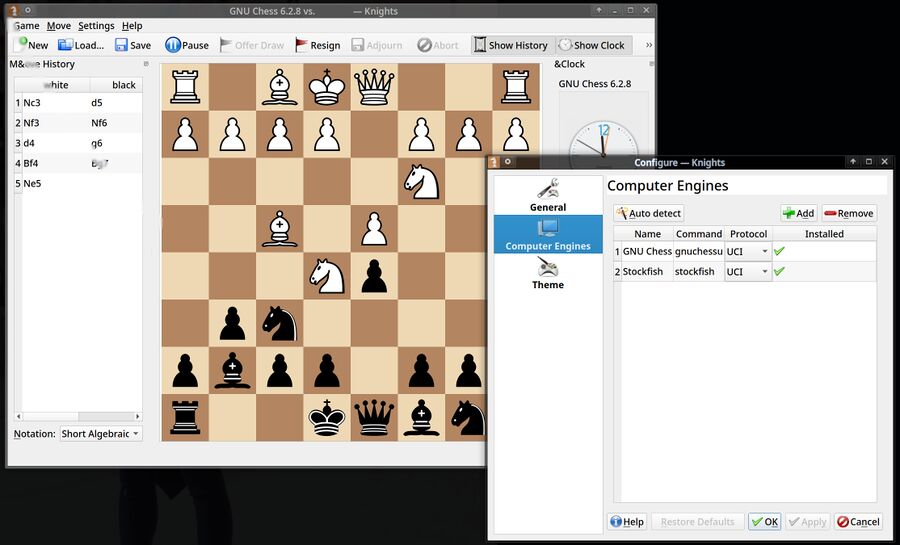
GNU Chess 6.2.8 Is Released - LinuxReviews
Antonio Ceballos from the GNU Chess engine team is "glad" to announce a new GNU Chess release with "Bug fixes mainly in the input processing". That's the entirety of the changelog since version 6.2.7 was released almost one year ago. The GNU Chess engine has been around since 1984. It has grown smart during it's years, and you may find that you will have a very hard time beating it.
[...]
There may not be much else to change to a chess engine that's been around for 37 years. GNU Chess was originally written by Stuart Cracraft in collaboration with Richard Stallman in 1984. Though.. the modern version isn't related to that version. GNU Chess was re-written by John Stanback before the 2.x series and it was again changed to use a completely new chess engine, based on the Cobalt chess engine written by Chua Kong-Sian, when GNU Chess 5 was released. And that wasn't the end of it, the current GNU Chess 6.x series using a completely different chess engine based on Fabien Letouzey's Fruit engine (Fruit 2.1 to be specific). The first version using the Fruit-based engine, GNU Chess 6.0, was released on April 26th, 2011. That's nearly a decade ago, so there may not be any need to do more with GNU Chess 6.x beyond "Bug fixes mainly in the input processing" at point.
-
Linux 5.13 Features From Apple M1 To New GPU Support, Security Additions
Following the two week merge window, feature development on the Linux 5.13 kernel is slated to end today with the release of Linux 5.13-rc1. Here is a look at some of the most interesting new features and improvements for this kernel that in turn should debut as stable around the end of June.
Arguably most notable with Linux 5.13 is the introduction of basic Apple M1 SoC/platform support. But there are also many other exciting updates coming with Linux 5.13 like preliminary Intel Alder Lake S graphics support, AMDGPU FreeSync/Adaptive-Sync HDMI support, AMD Aldebaran accelerator support, a generic USB display driver for interesting innovative use-cases, Amazon Luna Game Controller support, a new Intel cooling driver to help with overheating issues, the Landlock security module was finally mainlined, Clang CFI is now available, and other security improvements as well as plenty of other new hardware support.
-
Ben Hutchings: Debian LTS work, April 2021
In April I was assigned 16 hours of work by Freexian's Debian LTS initiative and carried over 2.5 hours from earlier months. I worked 14 hours and will carry over the remainder.
I spent a long time trying to verify that the futex issue in was now properly fixed in Linux 4.9, and reviewing the merge of these changes with the real-time (PREEMPT_RT) kernel patchset. Unfortunately this work is not complete and I did not make another upload this month.
-
EasyOS: Wallpaper corruption hopefully fixed in containers
The problem reported was for XenialPup. Also getting it with Racy. XenialPup is x86_64, Racy is i686, so that is not a cause. Not getting the corruption with the newer pups and EasyOS.
Note, the tray that you see on the desktop is created by JWM, the window manager. The desktop icons and wallpaper are created by ROX-Filer, what is called the "pinboard". So ROX-Filer is not just a file manager, it is also responsible for part of what you see on the desktop.When a pup or Easy desktop is launched in a container, JWM is started first, then ROX-Filer. Rox creates the desktop icons OK, but sometimes scrambles the wallpaper, even overwriting the desktop icons, with multiple reproductions of the icons.
There is a file, /root/Choices/ROX-Filer/PuppyPin, which may be located elsewhere in some pups, that defines the desktop icons and the wallpaper. It is an XML file, with tag for the wallpaper. If that tag is removed from PuppyPin, all is well, the desktop is fine in the container, desktop icons display, with a blank white background. -
postmarketOS v21.03 service pack 1 release
The first service pack for the current stable branch has been released, v21.03.1. Services packs bring improvements from the edge channel of postmarketOS to the stable release after they have been thoroughly tested.
-
Daniel Stenberg: curl up 2021
We had five presentations done, all prerecorded and made available before the event. At the Sunday afternoon we gathered to discuss the presentations and everything around those topics.
-
Blind people, advocates slam company claiming to make websites ADA compliant
In recent months, blind people and disability advocates have been speaking out on social media and suing companies that use AccessiBe. Blind people say AccessiBe, which is supposed to automatically make websites more compatible with the screen readers blind people rely on to access the internet, has prevented them from all sorts of normal activities online, like paying rent, teaching a class or buying Christmas gifts.
AccessiBe is the largest automated accessibility company on the market, according to Lucy Greco, who is blind and the head of web accessibility at the University of California, Berkeley.
The situation has gotten so bad that in the past two months more than 400 blind people, accessibility advocates and software developers signed an open letter calling on companies that use automated services, like AccessiBe and other companies with similar products, to stop.
»
-

- Login or register to post comments
 Printer-friendly version
- 2028 reads
 PDF version
More in Tux Machines
- Highlights
- Front Page
- Latest Headlines
- Archive
- Recent comments
- All-Time Popular Stories
- Hot Topics
- New Members
digiKam 7.7.0 is released
After three months of active maintenance and another bug triage, the digiKam team is proud to present version 7.7.0 of its open source digital photo manager. See below the list of most important features coming with this release.
|
Dilution and Misuse of the "Linux" Brand
|
Samsung, Red Hat to Work on Linux Drivers for Future Tech
The metaverse is expected to uproot system design as we know it, and Samsung is one of many hardware vendors re-imagining data center infrastructure in preparation for a parallel 3D world.
Samsung is working on new memory technologies that provide faster bandwidth inside hardware for data to travel between CPUs, storage and other computing resources. The company also announced it was partnering with Red Hat to ensure these technologies have Linux compatibility.
|
today's howtos
|


.svg_.png)

 Content (where original) is available under CC-BY-SA, copyrighted by original author/s.


Recent comments
1 year 11 weeks ago
1 year 11 weeks ago
1 year 11 weeks ago
1 year 11 weeks ago
1 year 11 weeks ago
1 year 11 weeks ago
1 year 11 weeks ago
1 year 11 weeks ago
1 year 11 weeks ago
1 year 11 weeks ago