



Debian: Ritesh Raj Sarraf on Retaining Data, ProtonMail Bridge on Sparky Linux, EasyOS Updates
Submitted by Roy Schestowitz on Tuesday 20th of April 2021 03:54:48 AM
-
Ritesh Raj Sarraf: Catching Up Your Sources
I’ve mostly had the preference of controlling my data rather than depend on someone else. That’s one reason why I still believe email to be my most reliable medium for data storage, one that is not plagued/locked by a single entity. If I had the resources, I’d prefer all digital data to be broken down to its simplest form for storage, like email format, and empower the user with it i.e. their data.
Yes, there are free services that are indirectly forced upon common users, and many of us get attracted to it. Many of us do not think that the information, which is shared for the free service in return, is of much importance. Which may be fair, depending on the individual, given that they get certain services without paying any direct dime.
[...]
So for my communication, I like to prefer emails over any other means. That doesn’t mean I don’t use the current trends. I do. But this blog is mostly about penning my desires. And desire be to have communication over email format.
Such is the case that for information useful over the internet, I crave to have it formatted in email for archival.
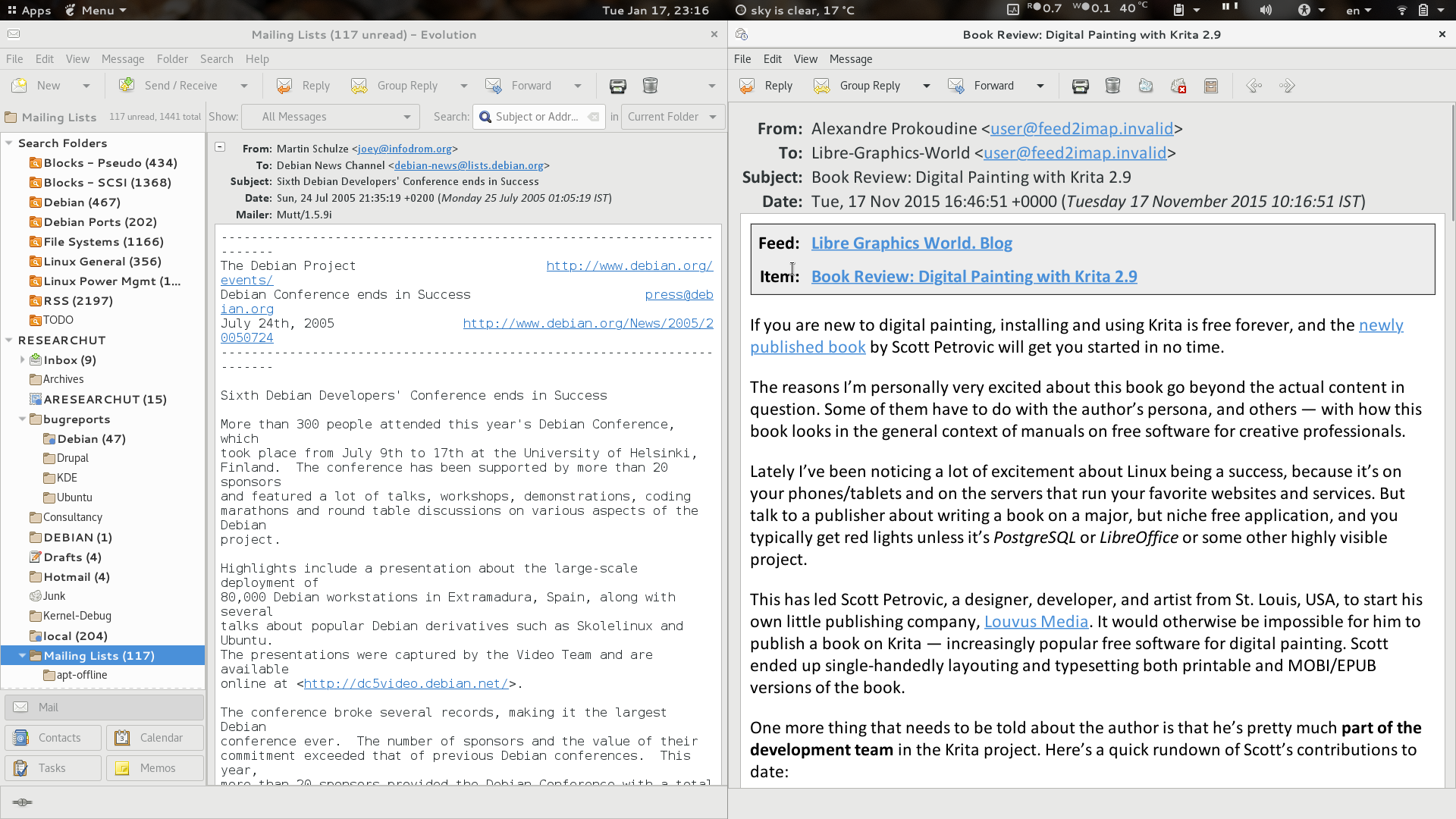
RSS feeds is my most common mode of keeping track of information I care about. Not all that I care for is available in RSS feeds but hey such is life. And adaptability is okay.
But my preference is still RSS.
So I use RSS feeds through a fine software called feed2imap. A software that fits my bill fairly well.
-
ProtonMail Bridge
There is a new tool available for Sparkers: ProtonMail Bridge
-
SeaMonkey bumped to 2.53.7.1
Just a short post. There has been a bugfix release of SeaMonkey. EasyOS has SM 2.53.7. I have compiled SM 2.53.7.1 and it will be in the next release of Easy, expected to be version 2.7.1.
-
Support for Samsung printers
OK, I got those two files 'rastertospl' and ' libscmssc.so' and created a PET, 'printer-driver-samsung-1.00.39-amd64.pet'. It is about 1Mb so will increase the size of 'easy.sfs' by that amount.
Have included it in the build, but there has to be a limit to this of course. There are so many other special files for various brands of printer and scanner. -
Brightness control in the tray
I have compiled 'setcolortemperature' package in OE. This has the 'sct' executable.
Added this to the package-list for Easy, as well as the 'brightness-control' PET that provides the tray operation (and uses sct).
»
-

- Login or register to post comments
 Printer-friendly version
- 1465 reads
 PDF version
More in Tux Machines
- Highlights
- Front Page
- Latest Headlines
- Archive
- Recent comments
- All-Time Popular Stories
- Hot Topics
- New Members
digiKam 7.7.0 is released
After three months of active maintenance and another bug triage, the digiKam team is proud to present version 7.7.0 of its open source digital photo manager. See below the list of most important features coming with this release.
|
Dilution and Misuse of the "Linux" Brand
|
Samsung, Red Hat to Work on Linux Drivers for Future Tech
The metaverse is expected to uproot system design as we know it, and Samsung is one of many hardware vendors re-imagining data center infrastructure in preparation for a parallel 3D world.
Samsung is working on new memory technologies that provide faster bandwidth inside hardware for data to travel between CPUs, storage and other computing resources. The company also announced it was partnering with Red Hat to ensure these technologies have Linux compatibility.
|
today's howtos
|


 Content (where original) is available under CC-BY-SA, copyrighted by original author/s.



Recent comments
1 year 11 weeks ago
1 year 11 weeks ago
1 year 11 weeks ago
1 year 11 weeks ago
1 year 11 weeks ago
1 year 11 weeks ago
1 year 11 weeks ago
1 year 11 weeks ago
1 year 11 weeks ago
1 year 11 weeks ago