



Christian Hergert: Sysprof and Podman
Submitted by Roy Schestowitz on Thursday 25th of February 2021 07:06:35 AM
Filed under 

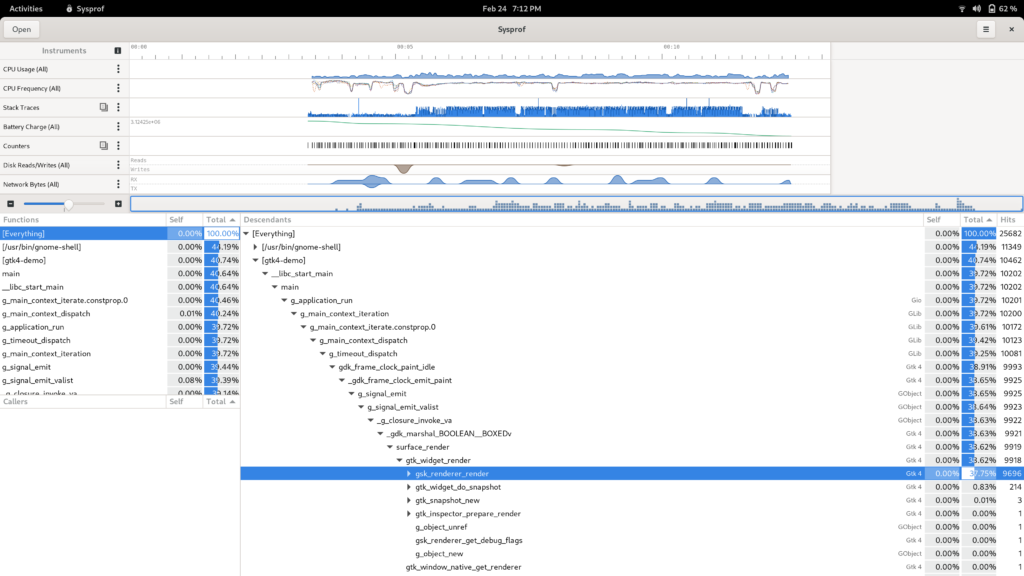
With the advent of immutable/re-provisional/read-only operating systems like Fedora’s Silverblue, people will be doing a lot more computing inside of containers on their desktops (as if they’re not already).
When you want to profile an entire system with tools like perf this can be problematic because the files that are mapped into memory could be coming from strange places like FUSE. In particular, fuse-overlayfs.
There doesn’t seem to be a good way to decode all this indirection which means in Sysprof, we’ve had broken ELF symbol decoding for your things running inside of podman containers (such as Fedora’s toolbox). For those of us who have to develop inside those containers, that can really be a drag.
The problem at the core is that Sysprof (and presumably other perf-based tooling) would think a file was mapped from somewhere like /usr/lib64/libglib-2.0.so according to the /proc/$pid/maps. Usually we translate that using /proc/$pid/mountinfo to the real mount or subvolume. But if fuse-overlayfs is in the picture, you don’t get any insight into that. When symbols are decoded, it looks at the host’s /usr/lib/libglib-2.0.so and finds an inode mismatch at which point it will stop trying to decode the instruction address.

»
-

- Login or register to post comments
 Printer-friendly version
- 2133 reads
 PDF version
More in Tux Machines
- Highlights
- Front Page
- Latest Headlines
- Archive
- Recent comments
- All-Time Popular Stories
- Hot Topics
- New Members
digiKam 7.7.0 is released
After three months of active maintenance and another bug triage, the digiKam team is proud to present version 7.7.0 of its open source digital photo manager. See below the list of most important features coming with this release.
|
Dilution and Misuse of the "Linux" Brand
|
Samsung, Red Hat to Work on Linux Drivers for Future Tech
The metaverse is expected to uproot system design as we know it, and Samsung is one of many hardware vendors re-imagining data center infrastructure in preparation for a parallel 3D world.
Samsung is working on new memory technologies that provide faster bandwidth inside hardware for data to travel between CPUs, storage and other computing resources. The company also announced it was partnering with Red Hat to ensure these technologies have Linux compatibility.
|
today's howtos
|


 Content (where original) is available under CC-BY-SA, copyrighted by original author/s.



Recent comments
1 year 11 weeks ago
1 year 11 weeks ago
1 year 11 weeks ago
1 year 11 weeks ago
1 year 11 weeks ago
1 year 11 weeks ago
1 year 11 weeks ago
1 year 11 weeks ago
1 year 11 weeks ago
1 year 11 weeks ago