



IBM/Red Hat/Fedora Leftovers
Submitted by Roy Schestowitz on Thursday 28th of January 2021 12:16:23 AM
Filed under 
-
CloudLinux expands its Extended Lifecycle Support services for Linux distributions
CloudLinux announces the expansion of its affordable Extended Lifecycle Support (ELS) services for Linux distributions, by providing its own updates and security patches for several years after expiration of the products’ end-of-life date. For example, support for CentOS 6 from Red Hat expired November 30 last year.
CloudLinux offers ELS for CentOS 6, available since November, 2020 and extends to June 2024. Oracle Linux 6 (ends March 2021) Extended Lifecycle Support service will be available starting in February 2021 and will extend to February 2025. Extended Lifecycle Support service for Ubuntu 16.04 (ends April 2021) and Debian 9 (ends June 2022) is under development.
-
Moving your applications to the cloud with Red Hat Enterprise Linux
Red Hat Enterprise Linux (RHEL) is widely deployed on-premise to run a variety of applications, but more conservative customers may need guidance in taking their first steps toward the cloud. One of the features in RHEL 8.3 is Image Builder’s Push to Cloud capability, which can help simplify and accelerate the transformation of workloads to the cloud. Building custom images is just one way to deploy RHEL for your enterprise.
[...]
RHEL provides a stable, manageable platform for applications for architects, operations, developers. Though some organizations may be hesitant to deploy an open source OS, RHEL is a supported solution, and there are ways to give it a try.
-
Red Hat OpenShift Container Storage 4.6 Offers New Data Resilience Capabilities
Red Hat OpenShift Container Storage 4.6 helps enterprises expand their existing data protection capabilities to include Kubernetes applications, without requiring additional technology or infrastructure upgrades.
Red Hat OpenShift Container Storage 4.6 delivers snapshot functionality orchestrated by the Container Storage Interface (CSI) for customizable, point-in-time snapshots and clones of persistent data volumes. This makes it easier for IT administrators and application developers to more quickly return to a prior state.
-
Elastic Deep Learning in high performance multitenant cluster
The Elastic Deep Learning capabilities of IBM Watson® Machine Learning Accelerator are designed for large-scale distributed deep learning workloads. It transforms static monolithic training into a dynamic process that is resilient to failures and automatically scales GPU allocation while training.
Data scientists, deep learning developers, and administrators can use Elastic Deep Learning capabilities to simplify production deployment, improve run time efficiency, and deliver on service level agreements (SLAs).
-
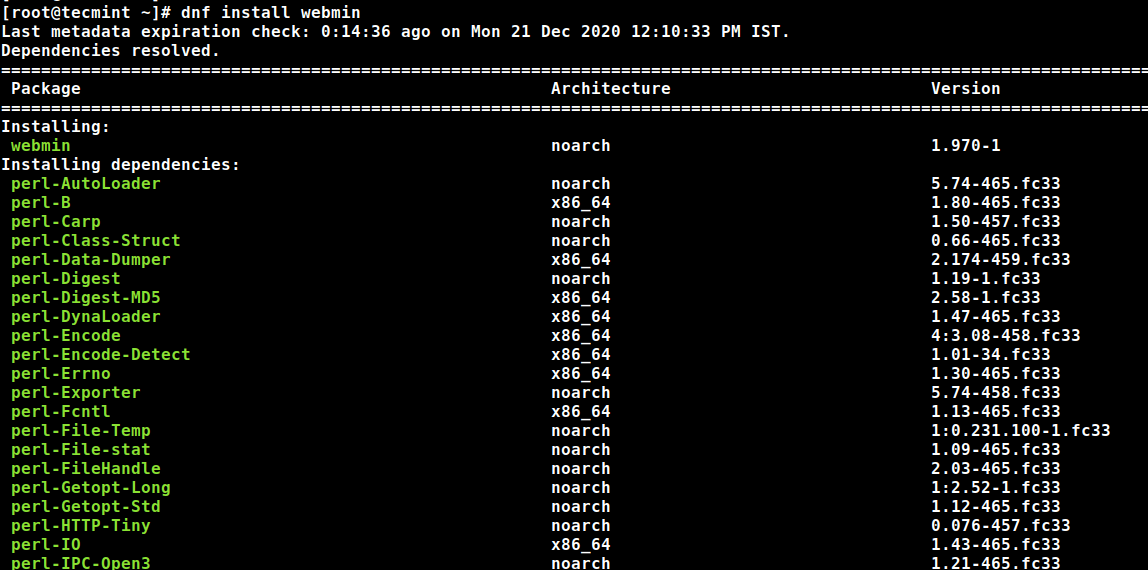
How to Install Webmin on Fedora Linux
Keeping an eye on your system’s performance is one of the essential tasks that any Linux user should undertake from time to time. This helps in diagnosing any bottlenecks that are likely to impact performance.
Webmin is a free and open-source front-end monitoring and administration tool that helps Linux users have a glance at various system metrics and perform administration tasks without the need of running commands on the terminal.
»
-

- Login or register to post comments
 Printer-friendly version
- 3863 reads
 PDF version
More in Tux Machines
- Highlights
- Front Page
- Latest Headlines
- Archive
- Recent comments
- All-Time Popular Stories
- Hot Topics
- New Members
digiKam 7.7.0 is released
After three months of active maintenance and another bug triage, the digiKam team is proud to present version 7.7.0 of its open source digital photo manager. See below the list of most important features coming with this release.
|
Dilution and Misuse of the "Linux" Brand
|
Samsung, Red Hat to Work on Linux Drivers for Future Tech
The metaverse is expected to uproot system design as we know it, and Samsung is one of many hardware vendors re-imagining data center infrastructure in preparation for a parallel 3D world.
Samsung is working on new memory technologies that provide faster bandwidth inside hardware for data to travel between CPUs, storage and other computing resources. The company also announced it was partnering with Red Hat to ensure these technologies have Linux compatibility.
|
today's howtos
|


 Content (where original) is available under CC-BY-SA, copyrighted by original author/s.



Recent comments
1 year 11 weeks ago
1 year 11 weeks ago
1 year 11 weeks ago
1 year 11 weeks ago
1 year 11 weeks ago
1 year 11 weeks ago
1 year 11 weeks ago
1 year 11 weeks ago
1 year 11 weeks ago
1 year 11 weeks ago