



Open Hardware: Raspberry Pi, Arduino, Thomas Petazzoni (Bootlin) on Training
Submitted by Roy Schestowitz on Tuesday 26th of January 2021 11:48:29 PM
Filed under 
-
Qsync fixed on the Pi4 and FF compiled
The Raspberry Pi4 does not have a hardware battery-backed clock, so relies on getting the date and time from an Internet time server. In EasyOS, Qsync is the utility that does that.
At first bootup, QuickSetup has a checkbox to enable getting time from the Internet, which will launch Qsync. At first bootup on the Pi4, if you are going to connect to Internet via wifi, not ethernet, then there won't be an immediate Internet access. No problem, Qsync will run once the Internet connection is established.
Qsync will run just once at bootup and after Internet connection. That's fine, but I couldn't understand why it would suddenly stop working. Then discovered that /etc/init.d/qsync was getting its executable-flag cleared.
-
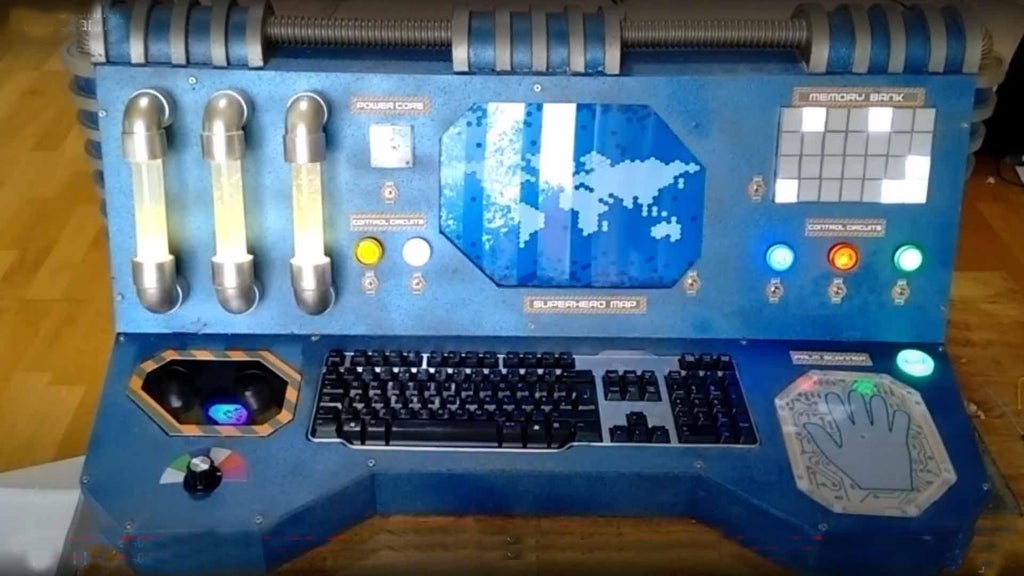
Arduino Blog » This children’s console looks like something straight out of a superhero’s lair
Kids have wonderful imaginations, and to help students at a primary school have a super time, creator “palladin” was asked to construct a console for them to use.
The device features a variety of lights and sci-fi additions, including glowing “reactor” tubes that diffuse light using hair gel and a “memory bank” that emits flashing patterns for a 1950s supercomputer look.
-
Arduino Blog » This pen plotter draws detailed maps the size of walls
Christopher Getschmann wanted a wall-sized map of the world. He soon realized, however, that it’s tough to actually buy such a map that’s both beautiful and detailed enough to satisfy his cartographic tastes. While many would simply move on to the next “thing,” Getschmann instead took things into his own hands, and built a pen plotter specifically to draw massive 2×3 meter map for his wall.
-
New training course: embedded Linux boot time optimization
For many embedded products, the issue of how much time it takes from power-on to the application being fully usable by the end-user is an important challenge. Bootlin has been providing its expertise and experience in this area to its customers for many years through numerous boot time optimization projects, and we have shared this knowledge through a number of talks at several conferences over the past years.
We are now happy to announce that we have a new training course Embedded Linux boot time optimization, open for public registration. This training course was already given to selected Bootlin customers and is now available for everyone.
»
-

- Login or register to post comments
 Printer-friendly version
- 2154 reads
 PDF version
More in Tux Machines
- Highlights
- Front Page
- Latest Headlines
- Archive
- Recent comments
- All-Time Popular Stories
- Hot Topics
- New Members
digiKam 7.7.0 is released
After three months of active maintenance and another bug triage, the digiKam team is proud to present version 7.7.0 of its open source digital photo manager. See below the list of most important features coming with this release.
|
Dilution and Misuse of the "Linux" Brand
|
Samsung, Red Hat to Work on Linux Drivers for Future Tech
The metaverse is expected to uproot system design as we know it, and Samsung is one of many hardware vendors re-imagining data center infrastructure in preparation for a parallel 3D world.
Samsung is working on new memory technologies that provide faster bandwidth inside hardware for data to travel between CPUs, storage and other computing resources. The company also announced it was partnering with Red Hat to ensure these technologies have Linux compatibility.
|
today's howtos
|


 Content (where original) is available under CC-BY-SA, copyrighted by original author/s.



Recent comments
1 year 11 weeks ago
1 year 11 weeks ago
1 year 11 weeks ago
1 year 11 weeks ago
1 year 11 weeks ago
1 year 11 weeks ago
1 year 11 weeks ago
1 year 11 weeks ago
1 year 11 weeks ago
1 year 11 weeks ago