



What is a System-on-Chip (SoC), and Why Do We Care if They are Open Source?
Submitted by Rianne Schestowitz on Monday 9th of November 2020 11:29:29 PM
Filed under 
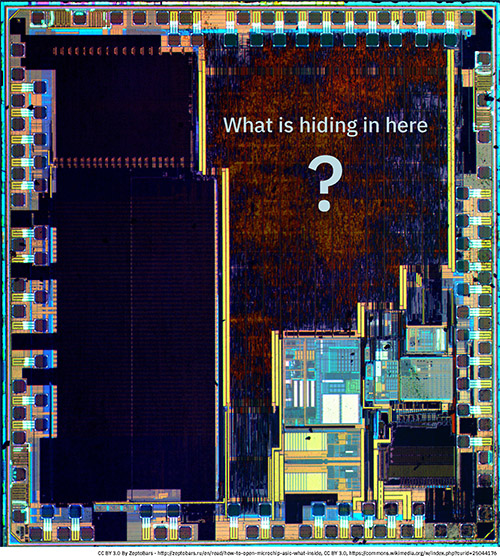
Modern gadgets are typically built around a single, highly integrated chip, known as a “System on Chip” (SoC). While the earliest home computer motherboards consisted of around a hundred chips, Moore’s Law pushed that down to just a handful of chips by the time 80286 PC/AT clones were mainstream, and the industry has never looked back. Now, a typical SoC integrates a CPU core complex, plus dozens of peripherals, including analog, RF, and power functions; there are even “System in Package” solutions available that package the SoC, RAM, and sometimes even the FLASH die into a single plastic package.
Modern SoCs are exceedingly complex. The “full user’s manual” for a modern SoC is thousands of pages long, and the errata (“bug list”) – if you’re allowed to see it – can be hundreds of pages alone. I put “full user’s manual” in quotations because even the most open, well-documented SoCs (such as the i.MX series from NXP) require a strict NDA to access thousands of pages of documentation on third party Intellectual Property (IP) blocks for functions such as video decoding, graphics acceleration, and security. Beyond the NDA blocks, there is typically a deeper layer of completely unpublished documentation for disused silicon, such as peripherals that were designed-in but did not make the final cut, internal debugging facilities, and pre-boot facilities. Many of these disused features aren’t even well-known within the team that designed the chip!
Disused silicon is a thing because building chips is less like snapping together Legos, and more like a sculptor chiseling away at a marble block: adding a circuit is much harder than deactivating a circuit. Adding a circuit might cost around $1 million in new masks, while delaying the project by about 70 days (at a cost of 100,000 man-hours worth of additional wages); with proper planning, deactivating a circuit may be as simple as a code change, or a small edit to a single mask layer, at a cost of perhaps $10,000 and a few days (assuming wafers were held at intermediate stages to facilitate this style of edit).

»
-

- Login or register to post comments
 Printer-friendly version
- 2084 reads
 PDF version
More in Tux Machines
- Highlights
- Front Page
- Latest Headlines
- Archive
- Recent comments
- All-Time Popular Stories
- Hot Topics
- New Members
digiKam 7.7.0 is released
After three months of active maintenance and another bug triage, the digiKam team is proud to present version 7.7.0 of its open source digital photo manager. See below the list of most important features coming with this release.
|
Dilution and Misuse of the "Linux" Brand
|
Samsung, Red Hat to Work on Linux Drivers for Future Tech
The metaverse is expected to uproot system design as we know it, and Samsung is one of many hardware vendors re-imagining data center infrastructure in preparation for a parallel 3D world.
Samsung is working on new memory technologies that provide faster bandwidth inside hardware for data to travel between CPUs, storage and other computing resources. The company also announced it was partnering with Red Hat to ensure these technologies have Linux compatibility.
|
today's howtos
|


 Content (where original) is available under CC-BY-SA, copyrighted by original author/s.



Recent comments
1 year 11 weeks ago
1 year 11 weeks ago
1 year 11 weeks ago
1 year 11 weeks ago
1 year 11 weeks ago
1 year 11 weeks ago
1 year 11 weeks ago
1 year 11 weeks ago
1 year 11 weeks ago
1 year 11 weeks ago